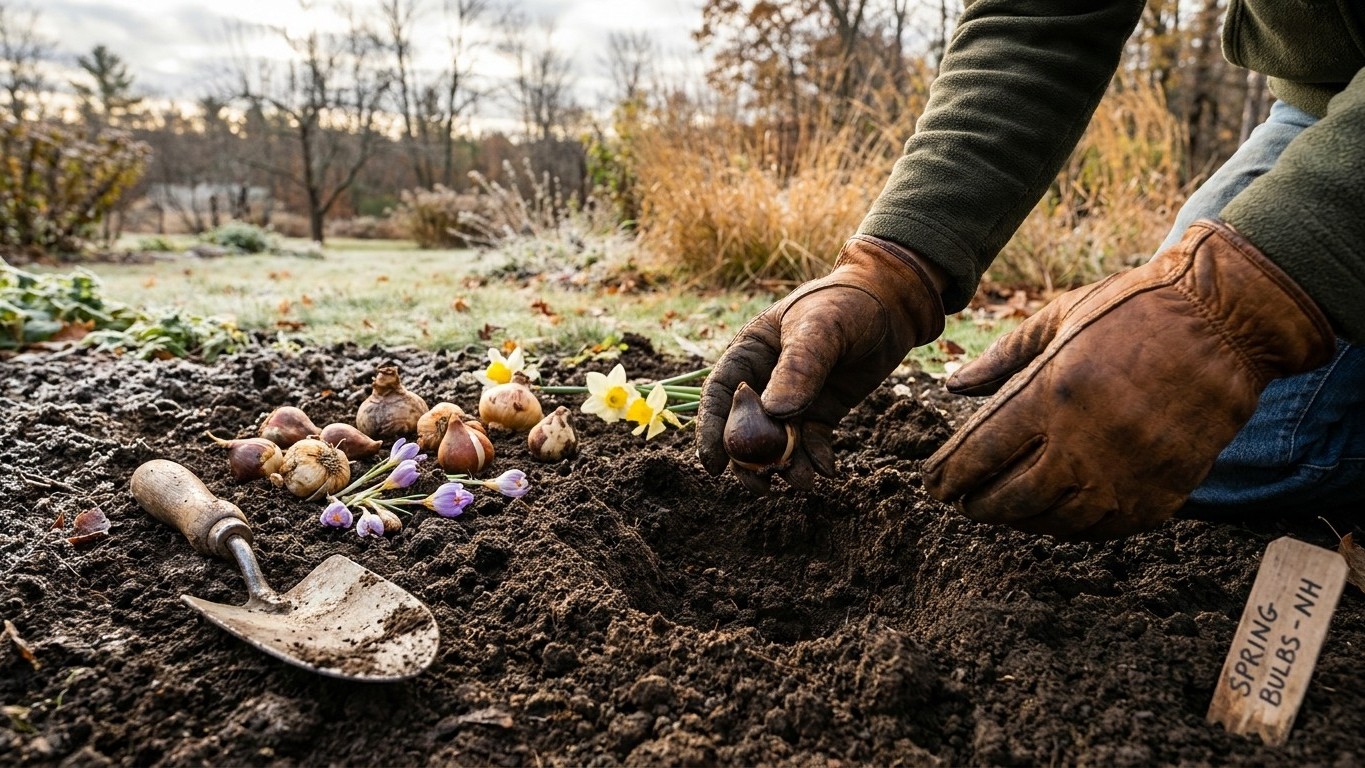

New Hampshire’s winters run cold enough for nearly every classic spring bulb sold in garden centers, and the state’s frost calendar gives most of the Granite State a clear six-week planting window between mid-September and late October. The question isn’t whether your winter is cold enough. It’s which bulbs are built for it, and which ones on the shelf next to them are not.
When to plant bulbs in New Hampshire

Spring bulbs want to go in the ground once the soil has cooled from summer but before it locks up hard for the winter. The rule of thumb nurseries use is six weeks before the ground freezes solid, and in New Hampshire that anchors on the average first fall frost, which falls between October 13 and October 26 depending on where you sit in the state (NOAA NCEI, 1991-2020 Climate Normals). Working backward from that, most of New Hampshire’s planting window sits somewhere between mid-September and the third week of October.
Too early or too late
Plant too early, while the soil is still warm from summer, and the bulb doesn’t just sit still. It pushes top growth, sometimes a few inches of green shoot, and that growth gets killed the first hard freeze. The bulb survives, but it’s spent energy it needed for spring, and the flower that season is often smaller or absent. Plant too late, after the ground has already gone rigid, and the bulb goes in without the chance to grow roots before winter locks everything down. A bulb with no root system heading into a New Hampshire winter comes up weak in spring, if it comes up at all, because it never anchored itself before the freeze.
The frost date itself deserves a caveat: it’s an average, which means roughly half of all years land on one side of it and half on the other. A garden in Manchester might see its first freeze on October 13 one year and November 2 the next. Treat the window as a target, not a deadline, and lean toward the earlier end if your soil is heavy clay, which cools more slowly than sandy loam. If the outdoor window closes before you get bulbs in the ground, Forcing Spring Bulbs Indoors in New Hampshire is a reliable way to still enjoy blooms without waiting on the soil.
Whether your winter is cold enough
Here’s the mechanism that decides whether a spring bulb blooms at all: it needs a long stretch of cold soil to trigger flowering. Most spring bulbs require twelve to fourteen weeks with soil temperatures below about 45°F. Skip that chilling period and the bulb doesn’t die, but it also doesn’t flower properly. It sends up leaves, sometimes a stunted bud on a stem too short to see above the mulch, and that’s it. This is the number to hold onto no matter what bulb you’re considering, because it’s the yardstick every catalog claim gets measured against.
New Hampshire’s coldest month averages a daily minimum of 17.1°F (NOAA NCEI Climate Normals, reference station Manchester). That’s not a record low, it’s the average low across the entire coldest month, and it sits more than 27 degrees below the 45°F threshold. Soil here stays under 45°F for a stretch that runs from mid-fall through the tail end of winter, well past the twelve to fourteen weeks any hardy spring bulb asks for. New Hampshire doesn’t just clear the bar. It clears it by months, not days.
What the margin buys you
That margin means no gardener in New Hampshire needs to pre-chill a bulb in the refrigerator before planting, a workaround gardeners in warmer states rely on. Pre-chilling means storing bulbs at refrigerator temperature for about twelve weeks, kept away from ripening fruit because the ethylene gas fruit gives off kills the flower bud forming inside the bulb. None of that applies here. Plant the bulb in the ground in fall, and the New Hampshire winter does the chilling on its own.
| Bulb | Weeks of cold required | What New Hampshire delivers | Verdict |
|---|---|---|---|
| Tulips | 12-16 weeks below 45°F | Well over 14 weeks, no pre-chill needed | Meets requirement with wide margin |
| Daffodils (Narcissus) | 12-15 weeks | Well over 14 weeks | Meets requirement with wide margin |
| Hyacinths | 12-14 weeks | Well over 14 weeks | Meets requirement with wide margin |
| Crocus | 8-15 weeks | Well over 15 weeks | Meets requirement easily |
| Alliums | 8-10 weeks | Well over 10 weeks | Meets requirement easily |
| Fritillaria | 12-14 weeks | Well over 14 weeks | Meets requirement with wide margin |
Which bulbs suit New Hampshire
New Hampshire spans USDA hardiness zones 3b to 6a (USDA Plant Hardiness Zone Map, 2023, based on 1991-2020 normals), which covers the survival range of essentially every bulb sold as “hardy spring bulb” in the country. Combined with the chill margin from the section above, that puts a long list of bulbs solidly in the yes column here.
- Daffodils / Narcissus — hardy zones 3-8
- Tulips (Darwin hybrid and species types) — hardy zones 3-7
- Crocus — hardy zones 3-8
- Grape hyacinth (Muscari) — hardy zones 4-8
- Siberian squill (Scilla siberica) — hardy zones 2-8
- Snowdrops (Galanthus) — hardy zones 3-7
- Allium — hardy zones 3-8, varies by species
- Hyacinth — hardy zones 4-8
A zone range is a guideline, not a fence. A bulb rated to zone 7 might survive a mild winter in a sheltered spot against a south-facing foundation in southern New Hampshire, and the same bulb planted in an open field in Coos County can fail even inside its supposed range if wind strips the snow cover that would have insulated it.
Bulbs that struggle here
Some bulbs marketed alongside hardy spring bulbs simply aren’t built for a New Hampshire winter. Ranunculus and Anemone coronaria, hardy only to zone 8, will rot in the ground over a New Hampshire winter unless dug up and stored indoors, which most gardeners never planned on doing when they bought them. Freesia, hardy to zone 9, behaves the same way. Dutch iris (Iris hollandica), hardy to zone 5, is a coin flip in the colder half of the state and generally fine in the southern tier. The failure with these isn’t a weak flower, it’s total loss: the bulb turns to mush by spring, and the gardener finds nothing where they planted it.
What digs them up here
Squirrels and voles are selective, and the selection comes down to chemistry rather than appetite. Daffodils contain lycorine, a compound toxic enough that rodents leave them alone. Alliums carry the same sulfur compounds that make onions sting your eyes, and fritillaria gives off a skunk-like smell that keeps most digging animals at a distance. Tulips and crocus have none of that natural defense, and both rank among the most raided bulbs in any New England garden.
- Squirrels and voles take: Tulips, Crocus
- Squirrels and voles leave alone: Daffodils, Alliums, Fritillaria, Snowdrops, Siberian squill, Hyacinths
The one method that works
Repellent sprays sold for this purpose wash off in the first hard rain, and reapplying every few weeks over an entire fall is more effort than most gardeners keep up with. The measure that actually holds is physical: lay a sheet of galvanized wire mesh over the planting bed right after you plant, stake it down at the corners, and leave it in place until the ground freezes hard. Squirrels dig by scent through loose soil in the weeks right after planting, before the ground locks up, so that’s the window the mesh needs to cover. Once the ground freezes, the mesh can come off, and the bulbs are through the worst of it until spring thaw.
Where to check for your own county
Every figure in this article, the frost date, the coldest-month minimum, comes from the Manchester weather station, and New Hampshire runs from the seacoast to the White Mountains across three USDA hardiness zones. A planting window built around the state’s biggest city can run two to three weeks off for a garden at elevation in Coos County or a coastal yard in Rockingham County that gets a later frost thanks to the ocean’s moderating effect.
The University of New Hampshire Cooperative Extension tracks local frost data and hardiness conditions county by county, and its county offices can tell you where your specific address falls relative to the state averages used here. For a bulb order going in the ground this fall, that county-level check is worth five minutes before you commit to a planting date.