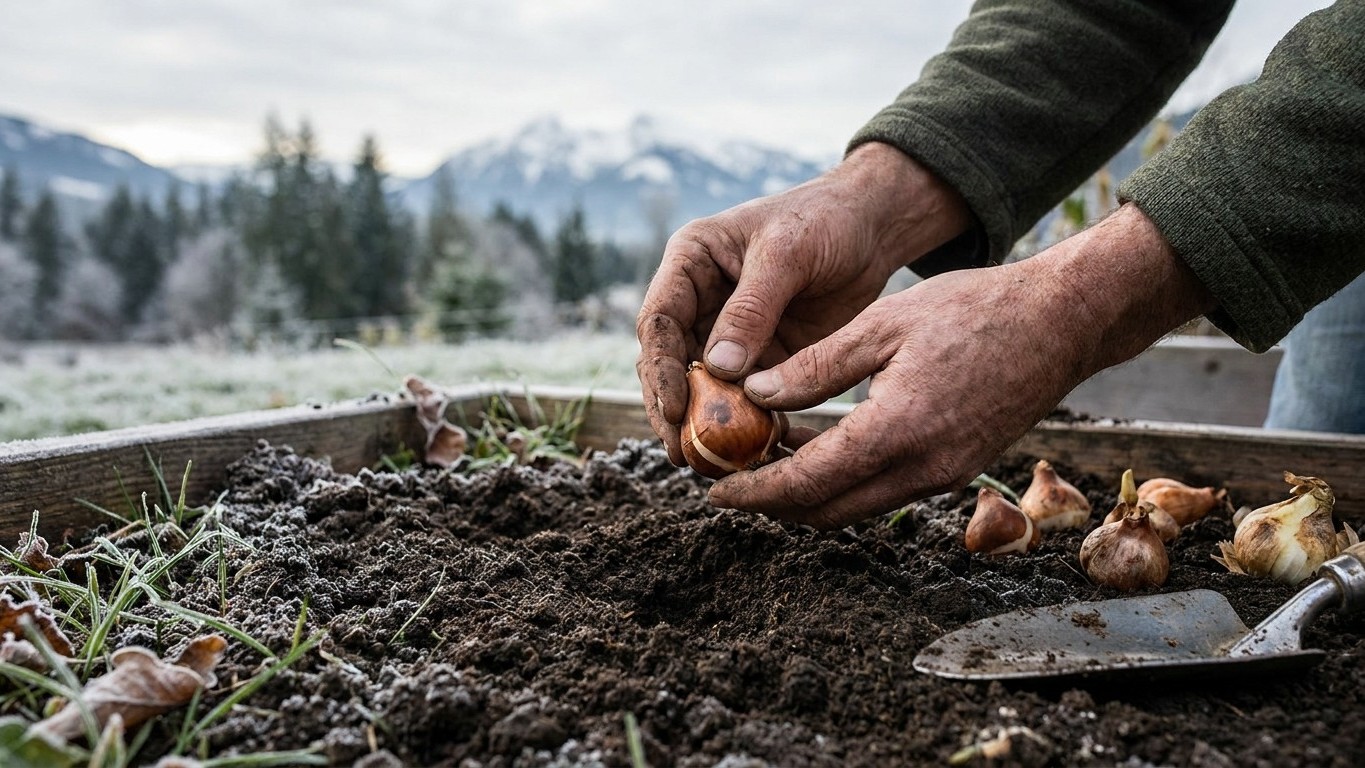

Alaska’s coldest winters check every box a tulip or daffodil bulb could ask for; the timing of your planting, not the temperature, is what trips people up. Get the bulb in the ground during the right six-week window before freeze-up, and the state’s long, cold winter does the rest of the work for free.
When to plant bulbs in Alaska

The planting window in Alaska runs about six weeks before the ground freezes solid, which means anchoring your calendar to the first fall frost rather than a fixed date. Around Anchorage, NOAA’s 1991-2020 climate normals put the first fall frost between September 22 and October 1. Working backward from that, most gardeners in south-central Alaska get bulbs into the ground from late August through mid-September, while soil is still workable but has cooled off enough to stop pushing new growth.
Plant too early, while soil is still warm from summer, and a bulb wakes up. It sends up a shoot before winter arrives, and that shoot gets killed by the first hard freeze, weakening or destroying the bulb’s one shot at flowering the following spring. Plant too late, once the ground has already started to lock up, and the bulb never develops the root system it needs before the soil freezes solid. Roots, not the bulb’s stored energy alone, are what carry a tulip or daffodil through an Alaska winter. A bulb dropped into half-frozen ground in October usually survives, but it often comes up short-stemmed and weak the first spring, if it comes up at all.
The frost date is an average, not a guarantee
That September 22 to October 1 window is an average drawn from thirty years of data, which means roughly half of all years fall on the early side of it and half on the late side. Some years bring a hard frost in the second week of September; others stretch mild weather into mid-October. Watching the soil and the extended forecast matters more than circling a date on the calendar. If a cold snap is forecast two weeks ahead of the usual date, get bulbs in the ground now rather than waiting for the average to arrive.
The safest approach treats the six-week rule as a moving target tied to actual weather rather than the calendar page. Soil thermometers are cheap, and a reading in the mid-40s Fahrenheit at planting depth is a better signal than any date on a seed packet.
Whether your winter is cold enough
Every spring bulb sold in garden centers needs a stretch of real cold before it will flower. Most varieties require twelve to fourteen weeks with soil temperatures below about 45°F. Skip that chilling period and the bulb still grows, but it puts its energy into leaves instead of a flower, or it produces a bloom on a stem too short to clear the foliage. This chilling requirement is also why Forcing Spring Bulbs Indoors in Alaska is possible using nothing more than a cold garage or refrigerator to mimic winter. This is also why gardeners without reliable in-ground chilling often turn to Growing Spring Bulbs in Containers in Alaska, since pots can be moved to control exposure more precisely. This single number, the weeks of cold and the 45°F threshold, is the yardstick every bulb catalog assumes you already know. Without it, there’s no way to judge whether a bulb variety offered at a nursery will actually bloom where you live.
Anchorage’s coldest month has a mean daily minimum of 11°F, according to NOAA’s 1991-2020 Climate Normals. That’s not a record low or a seasonal average; it’s the typical overnight low across the coldest weeks of winter, and it sits nowhere near the 45°F chilling ceiling. Soil in south-central Alaska stays well below that threshold from roughly November through March, which hands most bulbs four to five months of cold, more than double what even the most demanding varieties ask for. Interior Alaska runs colder still. Nobody gardening in this state needs to worry about insufficient chill.
That margin means pre-chilling, the practice of storing bulbs in a refrigerator for about twelve weeks before planting (kept away from ripening fruit, since the ethylene gas fruit gives off kills the flower bud inside the bulb), is simply unnecessary here. Gardeners in much milder parts of the country rely on that refrigerator trick to fake a winter their climate can’t provide. Alaska provides the real thing, at no cost and with room to spare.
| Bulb | Weeks of cold required | What Anchorage delivers | Verdict |
|---|---|---|---|
| Tulips | 12-16 weeks | ~20+ weeks below 45°F | Requirement cleared with margin |
| Daffodils | 12-14 weeks | ~20+ weeks below 45°F | Requirement cleared with margin |
| Hyacinths | 12-14 weeks | ~20+ weeks below 45°F | Requirement cleared with margin |
| Crocus | 8-15 weeks | ~20+ weeks below 45°F | Requirement cleared with margin |
| Alliums | 8-10 weeks | ~20+ weeks below 45°F | Requirement cleared with margin |
Which bulbs suit Alaska
Cold isn’t the limiting factor here, so the bulbs that thrive are the ones bred and selected for northern hardiness zones rather than the ones bred for long, mild springs. These do well across most of populated Alaska:
- Daffodils (Narcissus), hardiness zones 3-8
- Crocus, hardiness zones 3-8
- Siberian squill (Scilla siberica), hardiness zones 2-8
- Snowdrops (Galanthus), hardiness zones 3-8
- Grape hyacinth (Muscari), hardiness zones 3-8
- Allium, hardiness zones 3-8
- Checkered lily (Fritillaria meleagris), hardiness zones 3-8
Tulips deserve a caveat rather than an outright yes. Standard hybrid tulips fall in zones 3-8 and survive Alaska’s winters without trouble, but they’re prone to bulb rot in soil that stays waterlogged over winter, which makes drainage the deciding factor rather than cold. A tulip planted in a low, soggy corner of the yard often rots before spring even if the same bulb thrives twenty feet away in a raised bed.
Bulbs bred for warmer regions disappoint here in a predictable way rather than a vague one. Ranunculus (zones 8-10), Anemone coronaria (zones 7-10), and freesia (zones 9-10) either fail to survive the winter outright or come up as leaves with no flower the following year, because their internal chemistry expects a mild winter, not a real one. These aren’t marginal cases that might squeak by in a sheltered spot; they’re simply outside what Alaska’s climate can support outdoors, and no amount of mulch changes that math.
Zone ratings are not a hard line even among the bulbs that do belong here. A daffodil planted against a south-facing foundation wall, out of the wind, often outperforms the same variety planted in an exposed, open bed a few miles away, even though both sit in the same hardiness zone on paper.
What digs them up here
Squirrels and voles raid some bulb beds and leave others completely alone, and the pattern comes down to chemistry rather than chance. Daffodils and everything in the onion family contain compounds that are toxic or simply unpalatable to rodents, so they get planted and forgotten. Tulips and crocus have no such defense, and both rank among the most reliably dug-up bulbs in any yard where squirrels or voles are active.
The bulbs most likely to get eaten:
- Tulips
- Crocus
The bulbs rodents generally leave alone:
- Daffodils (Narcissus)
- Allium
- Snowdrops (Galanthus)
- Siberian squill (Scilla siberica)
- Checkered lily (Fritillaria meleagris)
For tulips and crocus, one measure actually works: lay a sheet of wire mesh flat over the planting bed, pinned at the edges, right after planting, and leave it there until the ground freezes hard. Squirrels dig by scent and feel; a physical barrier stops them cold. Repellent sprays and granules get marketed heavily every fall, but rain and irrigation wash them off within days, and by spring most gardeners who relied on them have a bed full of empty holes instead of tulips.
Where to check for your own county
Every figure in this article, the frost dates, the coldest-month minimum, the planting window, is anchored to Anchorage, the reference station for south-central Alaska’s climate data. Alaska spans a range of USDA hardiness zones from 1a to 8a, and a planting calendar built around Anchorage can be off by two or three weeks in either direction once you move to Fairbanks, the Kenai Peninsula, or Southeast Alaska. The Interior freezes earlier and harder than the coast; Southeast Alaska, moderated by the Pacific, often stays workable weeks longer than Anchorage does.
The University of Alaska Fairbanks Cooperative Extension Service tracks local frost data and planting recommendations by region and maintains county-level offices across the state. Their extension service directory is the fastest way to find a planting date calibrated to your actual location rather than a statewide average that may not describe your yard at all.