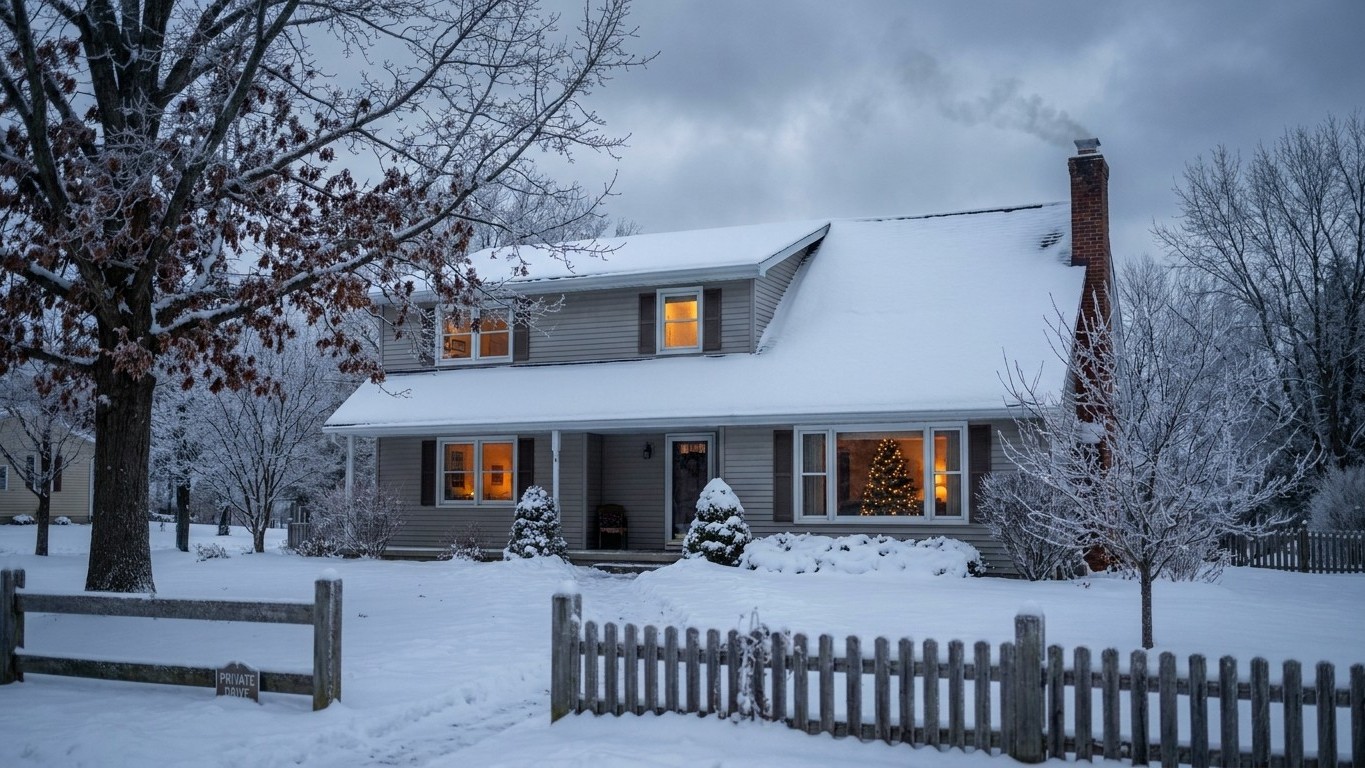

New York winters average a coldest-month low of 27.9°F, but the real cost of heating shows up in how long that cold sticks around and how much wood or fuel it takes to outlast it. Here’s what the numbers mean for a household planning ahead.
How cold it gets, and for how long

The mean daily minimum for New York’s coldest month sits at 27.9°F, based on NOAA’s 1991-2020 Climate Normals for the New York City reference station. That number alone doesn’t sound brutal. It’s a few degrees below freezing, not the kind of deep-freeze figure you’d see in the Adirondacks or across the border in Vermont. But a coastal reading like this one masks something homeowners inland or upstate need to account for: exposure and elevation shift the real number by several degrees, sometimes more.
What matters for a heating system isn’t the single coldest night. It’s the stretch of months when the furnace or woodstove runs nearly nonstop, and knowing when does the heating season start in New York helps set expectations for that stretch. A winter that hovers near freezing for four straight months puts a different kind of wear on equipment than one that dives far below zero for six weeks and then breaks. New York’s pattern, at least at the reference station, leans toward the former: a long, steady cold rather than short violent spikes.
That distinction changes what a house needs. A heating system sized for occasional deep cold might underperform during a long, grinding season where it never gets a break to reset. Chimneys see more creosote buildup because they’re in near-continuous use. Oil and propane tanks empty on a steadier schedule rather than in sudden gulps. And firewood, if that’s part of the mix, gets consumed at a slower burn but over more weeks, meaning the total volume needed for the season is the number to plan around, not the temperature on any single night.
Households used to short, sharp winters sometimes underestimate this. The four-month grind wears down a wood supply or a fuel budget in a way that catches people off guard by February, even when January felt manageable. Knowing When Can You Turn the Heat Off in New York? can help households pace that fuel budget through the tail end of the season instead of running short before spring truly arrives.
What a cord of wood is worth here
A cord of well-seasoned hardwood delivers about 20 million BTU, according to Michigan State University Extension. That figure is an average, species and moisture content move it up or down, but it’s the number to anchor expectations around. MSU also offers a comparison that makes the abstraction useful: one cord is roughly equivalent to the heat in 145 gallons of #2 fuel oil, or 215 gallons of LP gas.
Given New York’s steady, multi-month cold rather than short extreme spikes, a cord’s worth of heat gets stretched across a long burn season if wood is one part of a heating plan rather than the sole source. That’s the practical takeaway: the 20 million BTU isn’t a one-time jolt, it’s fuel for weeks of near-daily fires.
The word “cord” is also where most buyers get shorted. A cord is a volume, not a weight, and it has a fixed, legal definition: a stack measuring 4 feet by 4 feet by 8 feet, or 128 cubic feet total. Anything smaller, a “face cord” or a “rick” or a truckload eyeballed at the curb, isn’t a cord unless it adds up to that stack size.
| Measurement | Value |
|---|---|
| Dimensions | 4 ft x 4 ft x 8 ft |
| Total volume | 128 cubic feet |
| Heat energy (seasoned hardwood) | about 20 million BTU |
Density is the other half of the equation. Because a cord is a volume, a denser species packs more actual wood mass into that same 128 cubic feet, and more mass means more BTU per stack. That’s why two cords of different species can look identical in the yard and burn completely differently through January.
Moisture content matters just as much as species. MSU’s guidance is direct: wood should burn at 20 percent moisture or less, while green, freshly cut wood can run over 60 percent. Every bit of that water has to boil off before the wood gives up usable heat, which means wet wood spends a chunk of its potential energy on evaporation instead of warming the house.
How long wood takes to dry in New York
Seasoning time isn’t a fixed number that applies everywhere. It’s a function of local humidity and how hot and dry the summer runs, which is exactly why a figure that works in Arizona doesn’t transfer to the Northeast. In New York’s climate, split green wood typically needs one full summer stacked with airflow moving through it to reach that 20 percent moisture target, according to MSU Extension.
The emphasis on split and stacked isn’t a technicality. Wood left in rounds, uncut logs sitting in a pile, dries far slower because the bark and the tight grain structure trap moisture inside. Splitting exposes more surface area, and stacking off the ground with gaps for air movement is what actually pulls the water out over a summer’s worth of sun and wind.
Red oak is the named exception worth remembering. MSU points out that its cell structure makes it dry more slowly than other hardwoods, so a red oak stack cut this spring may not be ready by the time a faster-drying species would be. Burning it too soon shortchanges the household in two ways. First, less usable heat reaches the room, because energy that should be warming the house is instead boiling off trapped water. Second, unseasoned wood burns cooler and dirtier, which means more creosote builds up in the flue. That’s not a dramatic hazard on any single night, but it does mean the chimney needs sweeping sooner and more often than it would with dry wood.
None of this is a fixed calendar. It’s a function of how the wood was cut, split, and stacked, which is why a stack from last spring isn’t automatically ready just because a year has passed.
Where to check before you buy
New York covers a wide range of elevation, coastal exposure, and inland cold pockets, and the figures above describe the NOAA reference station in New York City specifically. A property in the Southern Tier or the Catskills will run colder and season wood on a different timeline than the coast does.
For guidance tailored to a specific county, including which species are locally available and any seasonal restrictions on outdoor burning, Cornell Cooperative Extension is the resource to check. Burn rules, including open burning restrictions and any air-quality advisories tied to wood smoke, are set at the local level and can change from one year to the next. What was allowed last winter isn’t a guarantee for this one, and checking ahead avoids finding out the hard way, mid-season, that a fire pit or outdoor boiler needs a permit it doesn’t have.
What each heat source costs to run in New York
At New York’s average residential prices, this is what one million Btu of heat delivered into the house costs with each system. It compares fuels on the same unit: it is not a yearly bill, and it leaves out the price of the equipment.
| System | Cost per million Btu delivered |
|---|---|
| Electric resistance (baseboard, 100% efficient) | $86.11 |
| Heat pump at 8.1 HSPF2 (seasonal COP about 2.4) | $36.27 |
| Natural gas furnace at 97% AFUE | $17.48 |
Cheapest to run in New York: natural gas furnace, $18.79 less per million Btu than the heat pump.
Prices: U.S. Energy Information Administration (EIA), average residential prices. Efficiencies: ENERGY STAR criteria. A heat pump’s figure is a seasonal average; in the coldest weather its efficiency drops.