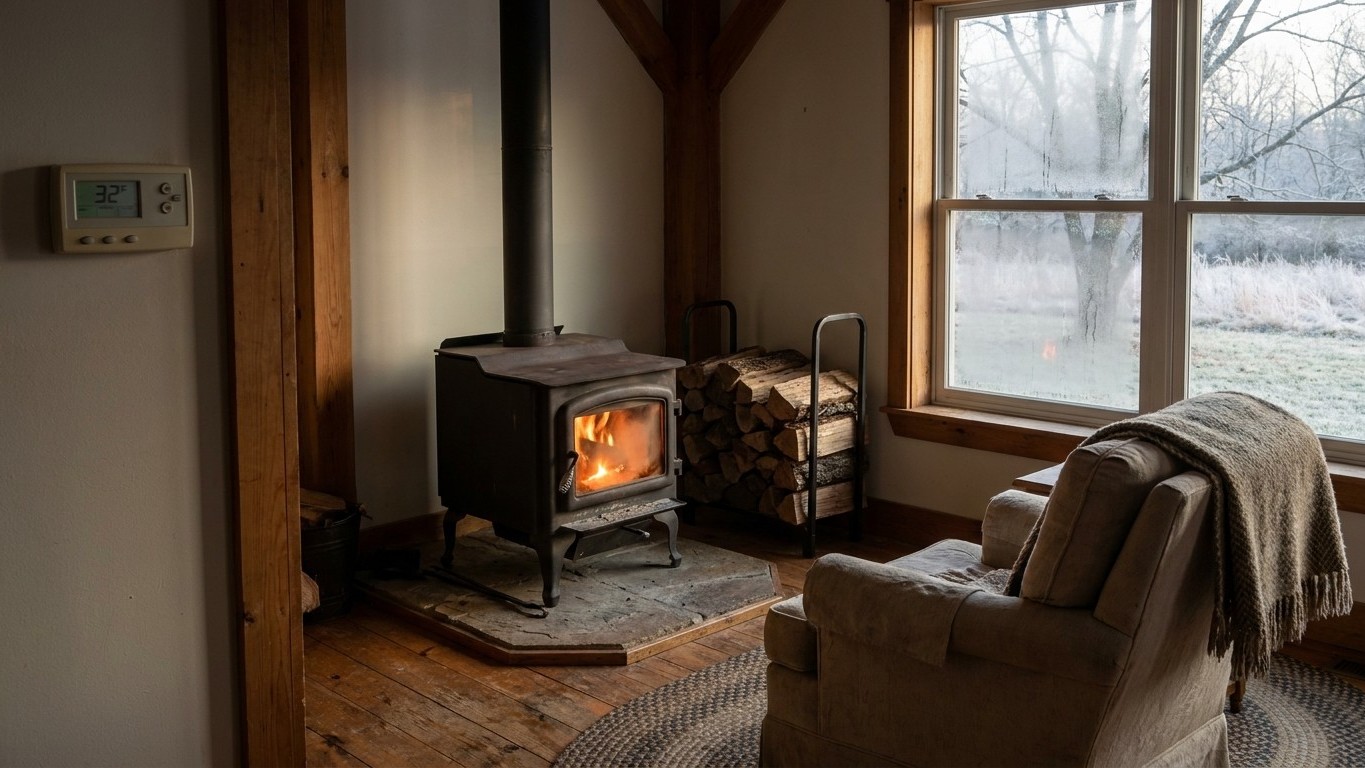

Little Rock’s coldest month bottoms out at a mean daily minimum of 30.9°F, a number that lands right at the edge of freezing rather than deep into it. That single figure shapes almost everything about heating costs and firewood strategy in Arkansas, from how long the furnace runs to how a cord of oak actually performs once winter sets in.
How cold it gets, and for how long

A mean daily minimum of 30.9°F in the coldest month doesn’t sound dramatic next to states where January lows sit in the teens or single digits. But that number tells you something specific: Arkansas winters hover right around the freeze line rather than plunging far below it. The practical result is a heating season defined more by duration than by intensity, which raises the question of When Does the Heating Season Start in Arkansas?
A house here isn’t fighting off subzero air for weeks at a stretch. It’s dealing with months of chilly, damp mornings where the thermostat clicks on before dawn and off again by midmorning, only to repeat the cycle that evening. That’s a different load profile than a Minnesota or Montana winter, where the equipment has to produce a lot of heat fast and hold it. In Arkansas, the equipment runs more often but at a gentler intensity, and a wood stove or insert sized for moderate output tends to match the climate better than one built for extreme cold snaps.
This also matters for anyone burning wood as a primary or supplemental heat source. A stove doesn’t need to blast out maximum BTUs around the clock. It needs to hold a steady, moderate burn for a long stretch, which changes how much wood a household actually goes through and how it should be seasoned and stacked going into fall.
What this means for equipment sizing
Oversizing a stove or furnace for Arkansas’s climate wastes fuel and forces short, hot burns that don’t use wood efficiently. A furnace or stove matched to a 30.9°F coldest-month minimum should be built for sustained, moderate heat output over a long season rather than short bursts of extreme output, which is also why knowing When Can You Turn the Heat Off in Arkansas? matters just as much as sizing the equipment correctly.
What a cord of wood is worth here
A cord isn’t a weight. It’s a volume: a stack measuring 4 feet by 4 feet by 8 feet, which works out to 128 cubic feet. That distinction is where a lot of firewood buyers get shorted, because a loosely stacked or oddly cut “cord” can look full while containing a fraction of that volume. Dense hardwoods pack more mass into the same 128 cubic feet than softer species, which is why oak and hickory outperform pine and poplar for sustained heat.
| Measurement | Value |
|---|---|
| Cord dimensions | 4 ft x 4 ft x 8 ft |
| Total volume | 128 cubic feet |
| Heat energy (well-seasoned hardwood) | about 20 million BTU per cord |
According to Michigan State University Extension, a cord of well-seasoned hardwood delivers roughly 20 million BTU, which the extension service equates to the heat output of about 145 gallons of #2 fuel oil or 215 gallons of LP gas. That comparison is useful because it turns an abstract stack of logs into something a household can weigh against a utility bill or a propane tank fill.
Given Arkansas’s coldest-month minimum sitting near 30.9°F, a well-seasoned cord goes further into the season than it would in a climate with deeper, longer cold snaps, since the stove or furnace isn’t running flat-out around the clock. But the heat value on paper only holds if the wood is actually dry. Green wood, still carrying a lot of internal moisture, gives up a large share of its potential heat just boiling off that water before it ever warms a room. That’s the seasoning question, and it’s the one most likely to separate a warm January from a smoky, underheated one.
How long wood takes to dry in Arkansas
Seasoning isn’t a fixed calendar date. It’s a function of humidity, airflow, and heat, and Michigan State University Extension puts the target at 20 percent moisture or less before burning, compared to green wood that can carry over 60 percent moisture straight off the tree. Split and stacked correctly, most wood reaches that 20 percent threshold after one full summer of drying, provided air can move freely through the stack. Left in rounds, or piled tight with no airflow, the same wood can sit far wetter going into winter.
Arkansas’s humid summers work against fast drying compared to a drier climate, which is part of why cutting wood a full season ahead matters more here than it might in an arid region. Red oak is the one species MSU flags by name as slow to dry, thanks to a cell structure that resists moisture loss even after splitting. A red oak round that looks seasoned after a single summer may still be well above the 20 percent mark.
Burning wood before it’s actually dry doesn’t just mean a weaker fire. Wet wood spends a large share of its combustion energy boiling off internal moisture instead of heating the room, so the stove works harder for less output. That incomplete combustion also produces more creosote, the tar-like residue that builds up inside a flue and raises the risk of a chimney fire. The practical fallout is a chimney that needs sweeping more often and a heating season that costs more in labor and fuel than it should.
None of this calls for guesswork. A cheap moisture meter, split-tested on a fresh face of a log, tells a household exactly where their wood stands relative to that 20 percent target, rather than relying on how long a pile has been sitting in the yard.
Where to check before you buy
Arkansas spans real differences in elevation, humidity, and tree cover, from the Ozark highlands to the Delta lowlands, and the figures above describe conditions at the reference station in Little Rock. A homeowner in the northwest corner of the state or down in the southeast bottomlands may see somewhat different seasoning times and species availability.
The University of Arkansas Cooperative Extension Service is the right resource for local specifics: which hardwood species are actually common and affordable in a given county, and whether any seasonal burn restrictions apply. Burn rules, including outdoor burning bans tied to drought conditions or air quality, are set at the local and county level and can change from one year to the next, so checking current guidance before stocking up or lighting a fire is worth the five minutes it takes.
What each heat source costs to run in Arkansas
At Arkansas’s average residential prices, this is what one million Btu of heat delivered into the house costs with each system. It compares fuels on the same unit: it is not a yearly bill, and it leaves out the price of the equipment.
| System | Cost per million Btu delivered |
|---|---|
| Electric resistance (baseboard, 100% efficient) | $39.89 |
| Heat pump at 8.1 HSPF2 (seasonal COP about 2.4) | $16.80 |
| Natural gas furnace at 95% AFUE | $19.54 |
Cheapest to run in Arkansas: heat pump, $2.74 less per million Btu than the natural gas furnace.
Prices: U.S. Energy Information Administration (EIA), average residential prices. Efficiencies: ENERGY STAR criteria. A heat pump’s figure is a seasonal average; in the coldest weather its efficiency drops.