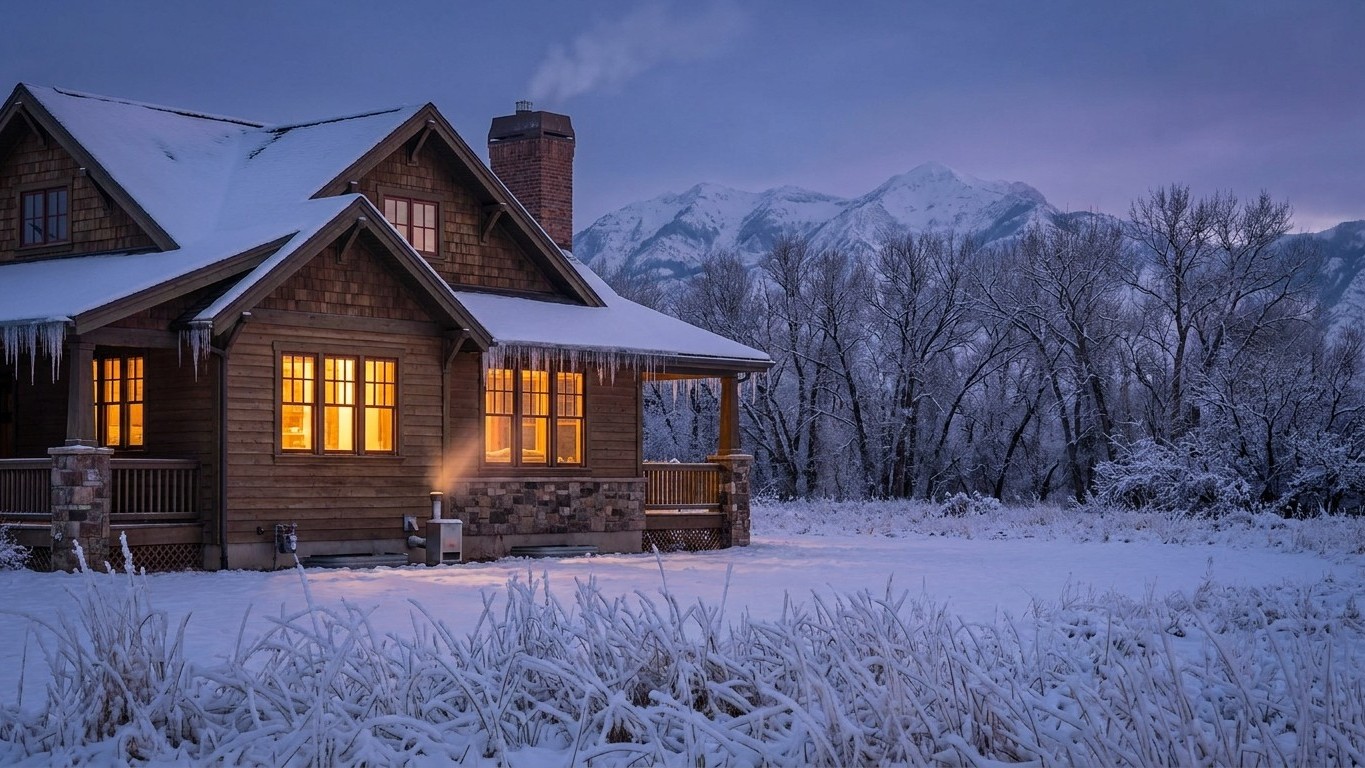

Salt Lake City’s coldest month bottoms out at a mean daily minimum of 24.2°F, and that single number shapes everything from furnace runtime to firewood budgets. Here’s what actually goes into keeping a Utah home warm from November through March.
How cold it gets, and for how long

That 24.2°F figure isn’t the record low, it’s the average minimum temperature during the coldest month, which for Salt Lake City is typically January. Translate that into daily life and it means overnight lows regularly dip into the low-to-mid 20s, with daytime highs often struggling to clear freezing. This is what NOAA calls a Normal, built from three decades of data, so it smooths out the occasional deep-freeze week and the occasional mild one.
What matters more than the number itself is duration. A winter that hovers just below freezing for four straight months puts different demands on a heating system than one that plunges hard for six weeks and then breaks. Utah’s Wasatch Front sits in the first category: a long, moderately cold season rather than a short, brutal one. Furnaces here run often but rarely at their absolute limit, and that steady demand is exactly why insulation quality and heating fuel choice matter as much as the equipment’s rated output.
Elevation complicates the picture. Salt Lake City sits around 4,200 feet, but plenty of Utah communities sit thousands of feet higher, in mountain valleys and canyon towns where cold air pools overnight. A homeowner in Park City or Heber Valley is dealing with a meaningfully colder microclimate than the reference station this 24.2°F comes from, even though both count as “Utah winter.” The state’s north-south length adds another wrinkle: St. George’s winters look nothing like Logan’s. The Salt Lake figure is a useful benchmark, not a statewide promise.
For anyone supplementing a furnace with wood heat, or relying on wood as a backup during outages, that four-month stretch of near-freezing temperatures is the real planning window. Knowing When Does the Heating Season Start in Utah? is long enough that fuel quantity and quality decisions made in September show up directly in February heating bills.
What a cord of wood is worth here
A cord is a volume, not a weight, and that distinction is where most firewood buyers get shortchanged. The standard measure is a stack 4 feet high, 4 feet wide, and 8 feet long, totaling 128 cubic feet. Nothing about that definition specifies species or density, which is exactly why two cords can heat very differently.
| Measurement | Value |
|---|---|
| Standard dimensions | 4 ft x 4 ft x 8 ft |
| Total volume | 128 cubic feet |
| Heat content (well-seasoned hardwood) | about 20 million BTU |
According to Michigan State University Extension, a cord of well-seasoned hardwood delivers roughly 20 million BTU, which the university compares to about 145 gallons of #2 fuel oil or 215 gallons of LP gas. That’s a useful mental yardstick for a Utah household stacking wood against a four-month heating season: one cord of dense, properly dried hardwood represents a meaningful chunk of a winter’s heat, though nobody should treat 20 million BTU as a fixed number for every load. Species and moisture content swing that figure substantially in either direction.
Density is the variable that does the real work. A cord of a dense hardwood packs more actual wood mass into that same 128 cubic feet than a cord of a lighter, softer species, and more mass means more fuel to burn. This is also why seasoning matters as much as species: wet wood spends a portion of its heat outboiling off the water trapped in its cells before any of that energy reaches the room. Buy by species and by dryness, not just by the word “cord” on an invoice.
How long wood takes to dry in Utah
Firewood needs to reach roughly 20 percent moisture or less before it burns efficiently, and green wood fresh off the tree can sit above 60 percent, according to Michigan State University Extension. That gap between 60 percent and 20 percent isn’t cosmetic. It’s the difference between wood that lights easily and throws real heat, and wood that hisses, smokes, and underperforms.
Seasoning time isn’t a universal number stamped on every log. It depends on climate, and Utah’s dry summer air is actually an advantage here compared to more humid parts of the country. Wood that’s split and stacked, not left in rounds, with air able to move through the pile, typically reaches that 20 percent threshold after one full summer of seasoning. The key words are split and stacked. A round log with bark intact traps moisture and dries far slower than the same wood split into pieces and exposed to airflow on all sides.
Red oak is the named exception worth remembering: MSU notes it dries more slowly than most species because of its cell structure, so it needs extra time beyond a single summer to reach burnable dryness. Anyone buying or cutting red oak in Utah should plan for a longer seasoning window, not the standard one.
Burning wood before it’s properly seasoned carries consequences beyond a weaker fire. Unseasoned wood produces more creosote buildup in the chimney flue, since incomplete combustion leaves more residue behind as smoke condenses on cooler flue surfaces. That means more frequent chimney sweeping, and a higher fire risk if that maintenance gets skipped. It’s not an emergency-level hazard for a single damp log, but it’s a real cost that adds up over a season of burning wood that hasn’t had enough time to dry out.
Where to check before you buy
Everything above describes Salt Lake City, the reference station behind the 24.2°F figure. Utah’s range of elevation, from the Dixie lowlands to mountain valleys above 6,000 feet, means actual conditions in any given community can differ meaningfully from that benchmark. The same goes for firewood: species availability shifts by region, and a species common in northern Utah forests may be scarce or absent farther south.
Local burn restrictions add another layer that no statewide figure can capture. Many Utah counties impose seasonal wood-burning restrictions tied to air quality, particularly along the Wasatch Front during winter inversions, and these rules are set locally and change from year to year. What was allowed last winter isn’t a guarantee for this one.
For guidance specific to a given county, elevation, and species mix, Utah State University Extension is the resource built for exactly this. It’s the place to check current burn-restriction status, ask about locally available firewood species, and get advice tailored to a specific part of the state rather than a single reference city’s climate normals.
What each heat source costs to run in Utah
At Utah’s average residential prices, this is what one million Btu of heat delivered into the house costs with each system. It compares fuels on the same unit: it is not a yearly bill, and it leaves out the price of the equipment.
| System | Cost per million Btu delivered |
|---|---|
| Electric resistance (baseboard, 100% efficient) | $38.57 |
| Heat pump at 8.1 HSPF2 (seasonal COP about 2.4) | $16.25 |
| Natural gas furnace at 97% AFUE | $10.13 |
Cheapest to run in Utah: natural gas furnace, $6.12 less per million Btu than the heat pump.
Prices: U.S. Energy Information Administration (EIA), average residential prices. Efficiencies: ENERGY STAR criteria. A heat pump’s figure is a seasonal average; in the coldest weather its efficiency drops.