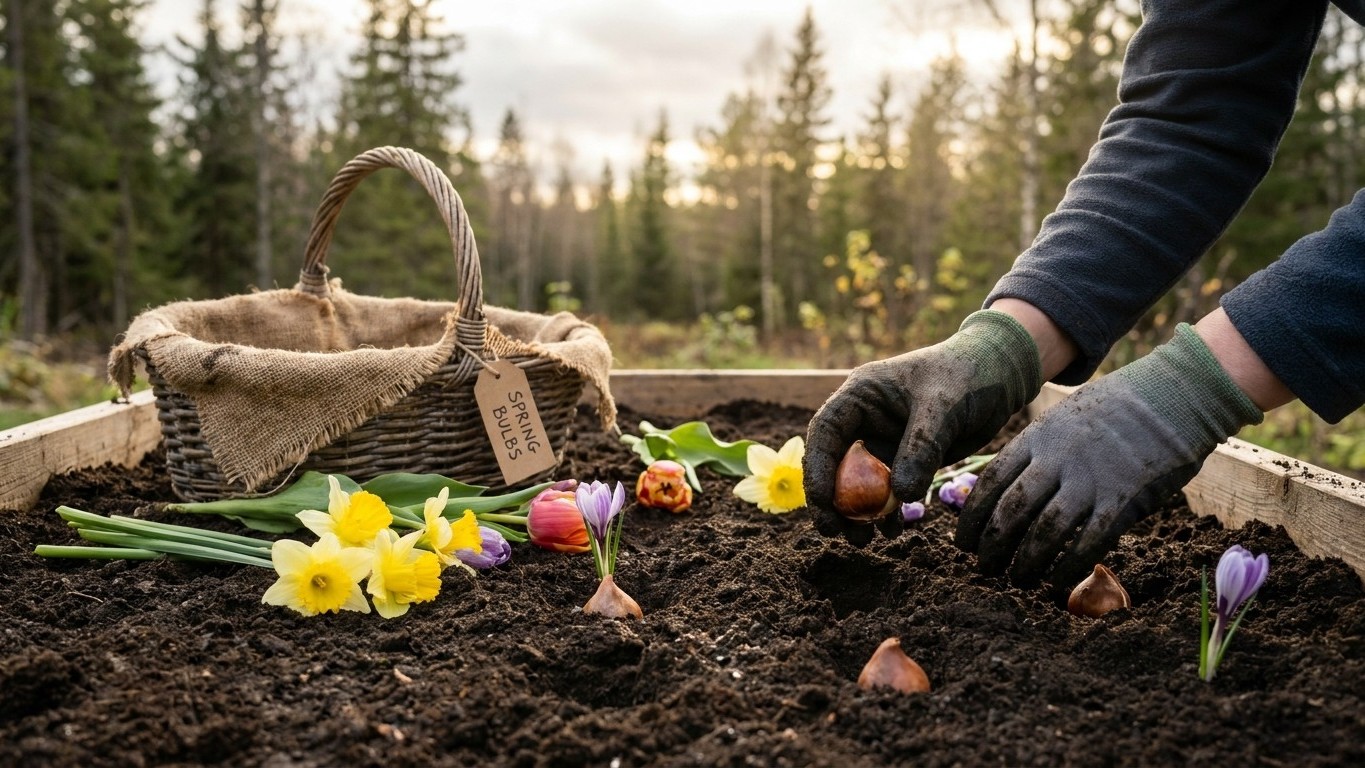

Spring bulbs can absolutely go in the ground in the Northwest Territories, but the calendar window is short and the cold is more than enough for chilling. The real question isn’t whether it gets cold here. It’s which bulbs can survive that cold once they’re planted, and which ones just can’t take it.
When to plant bulbs in Northwest Territories

The average first fall frost at Yellowknife A, the reference station for the territory, lands on September 18. That date is the anchor for everything that follows, because bulbs need to go into soil that has cooled down but hasn’t locked solid yet, and that window sits roughly six weeks ahead of the point when the ground freezes hard for the winter.
In practical terms, that means the last days of August through the middle of September is the working window for most of the territory near Yellowknife’s latitude. Plant earlier than that, while the soil is still warm from summer, and bulbs often push up top growth before winter arrives. That growth gets killed back by the first hard freeze, and a bulb that spends its stored energy on leaves it didn’t need going into winter is a weaker bulb come spring. Plant too late, after the ground has already started to stiffen, and the bulb doesn’t have time to grow the roots it needs before everything freezes. A bulb with no root system sitting in cold ground either comes up stunted the following spring or doesn’t come up at all. For gardeners who want more control over timing and soil conditions, Growing Spring Bulbs in Containers in Northwest Territories is a reliable way to sidestep the narrow outdoor planting window entirely, and Forcing Spring Bulbs Indoors in Northwest Territories offers another option for gardeners who’d rather skip outdoor timing constraints altogether.
Treat the frost date as a midpoint, not a deadline
September 18 is a mean date pulled from thirty years of climate records, not a guarantee. In roughly half of all years, the first frost arrives later than that, sometimes by a week or two. In the other half, it arrives earlier. A gardener who waits until September 18 to start planting, assuming there’s still time, is gambling on the wrong half of that split. The safer approach is to treat late August as the start of the window and aim to have bulbs in the ground before the middle of September, rather than using the average date itself as a cutoff.
Northern and upland areas of the territory run behind Yellowknife’s climate by a matter of weeks, not days, which pushes the safe window even earlier for anyone gardening outside the immediate area. That’s worth keeping in mind before locking in a date based on figures tied to one station.
Whether your winter is cold enough
Every spring bulb needs a period of sustained cold before it will flower. For most of the familiar bulbs sold in catalogs, that means twelve to fourteen weeks with the soil temperature below about 45°F. Skip that requirement and the bulb doesn’t just flower late or small, it often skips flowering entirely, putting up leaves on a bare stem with nothing at the top. That number matters no matter where a gardener lives, because it’s the yardstick for judging any bulb offered for sale, in any catalog, in any climate.
The Northwest Territories clears that bar by a wide margin. The coldest month at Yellowknife averages a daily minimum of -21.1°F, and soil in a climate that cold stays below 45°F for something closer to five or six months than the twelve to fourteen weeks a tulip or daffodil actually needs. There’s no scenario here where a standard spring bulb comes up flowerless for lack of cold. Pre-chilling in a refrigerator, the trick gardeners in warm climates use to fake a winter their soil never delivers, is a non-issue in this territory. Nobody here needs to fake anything.
The chill requirement, bulb by bulb
| Bulb | Weeks of cold needed (below 45°F) | Weeks the NWT typically provides | Verdict |
|---|---|---|---|
| Tulip | 12-14 | 20+ | Chill requirement met with room to spare |
| Daffodil | 12-14 | 20+ | Met easily |
| Crocus | 8-15 | 20+ | Met easily |
| Hyacinth | 12-14 | 20+ | Chill met; survival is the actual concern here |
| Allium | 8-10 | 20+ | Met easily |
| Snowdrop | 6-8 | 20+ | Met easily |
So the chill box gets checked for nearly everything. What separates a bulb that thrives here from one that rots or dies back isn’t a shortage of cold, it’s an excess of it, past what the bulb’s own tissue can tolerate. That’s a different failure than the one gardeners face further south, and it’s the subject of the next section. Note that the territory’s plant hardiness zone, rated 1b under Natural Resources Canada’s system, uses seven climate variables and doesn’t translate to a USDA zone number. The two scales aren’t interchangeable, so hardiness ratings printed on US bulb packaging need to be read against the actual winter minimum, not against a zone label borrowed from a different system.
Which bulbs suit Northwest Territories
The bulbs that hold up in this climate share two traits: a hardiness rating that covers extreme cold, and a growth habit suited to a short, intense growing season. The following do well:
- Snowdrops (Galanthus nivalis), commonly rated hardy in USDA zones 3-8
- Siberian squill (Scilla siberica), rated hardy in zones 2-8
- Species crocus (Crocus chrysanthus), rated hardy in zones 3-8
- Grape hyacinth (Muscari armeniacum), rated hardy in zones 3-8
- Species tulips (Tulipa tarda, Tulipa turkestanica), rated hardy in zones 3-8, and far more likely to return year after year here than hybrid bedding tulips
- Daffodils, particularly smaller and species types, rated hardy in zones 3-8
The bulbs that disappoint are the ones bred for garden display rather than survival. Large hybrid tulips (Darwin, Triumph, and similar bedding varieties) often behave here the way they do in much milder climates when treated as long-term perennials: a strong first-year show, then a decline, then nothing. In a climate this severe, that decline happens faster, sometimes in a single winter. Hyacinths, rated hardy only to about zone 4, sit right at the edge of what this cold will allow, and a wet spring on top of that cold often means bulb rot before the plant even gets a chance to fail from cold alone. Large-flowered ornamental alliums, rated to zone 4 as well, fall into the same marginal category.
None of these ratings are a hard line. A hybrid tulip tucked against a south-facing foundation wall, with reflected heat and extra snow cover, sometimes limps through a winter that would kill the same bulb in an open, wind-scoured bed. But that’s a bet on microclimate, not a plan a gardener should count on.
What digs them up here
Squirrels and voles are selective, and the pattern comes down to chemistry rather than chance. Daffodils and other bulbs in that toxic family taste bitter and mildly poisonous to rodents, so they get left alone almost every time. Tulips and crocus contain none of that defense and rank among the most raided bulbs in any garden, whether in the Northwest Territories or anywhere else they’re planted.
Of the bulbs recommended above, that split matters directly:
- Usually taken: tulips (including species tulips), crocus
- Usually left alone: daffodils, snowdrops, grape hyacinth, Siberian squill, alliums
For the bulbs worth protecting, one method actually holds up: laying wire mesh flat over the planting bed and pinning it down until the ground freezes solid, which is usually enough to make it not worth a squirrel’s effort. Repellent sprays are a waste of money in this climate specifically, since they wash off in rain or melting snow and need constant reapplication that most gardeners give up on by the second week.
Where to check for your own county
Every figure in this article, the frost date, the hardiness zone, the coldest-month minimum, is tied to one weather station near Yellowknife. The Northwest Territories spans a huge stretch of latitude, and conditions in the Deh Cho region or along the Arctic coast can run weeks behind what the numbers here describe. A planting window built around the territorial capital can be off by three weeks or more at either edge of the territory.
The Government of the Northwest Territories agriculture services is the right place to check local growing conditions and get guidance specific to a given community rather than to the reference station used across this guide. Local knowledge fills in the gap that any territory-wide figure leaves open, and for a place this size, that gap is real.