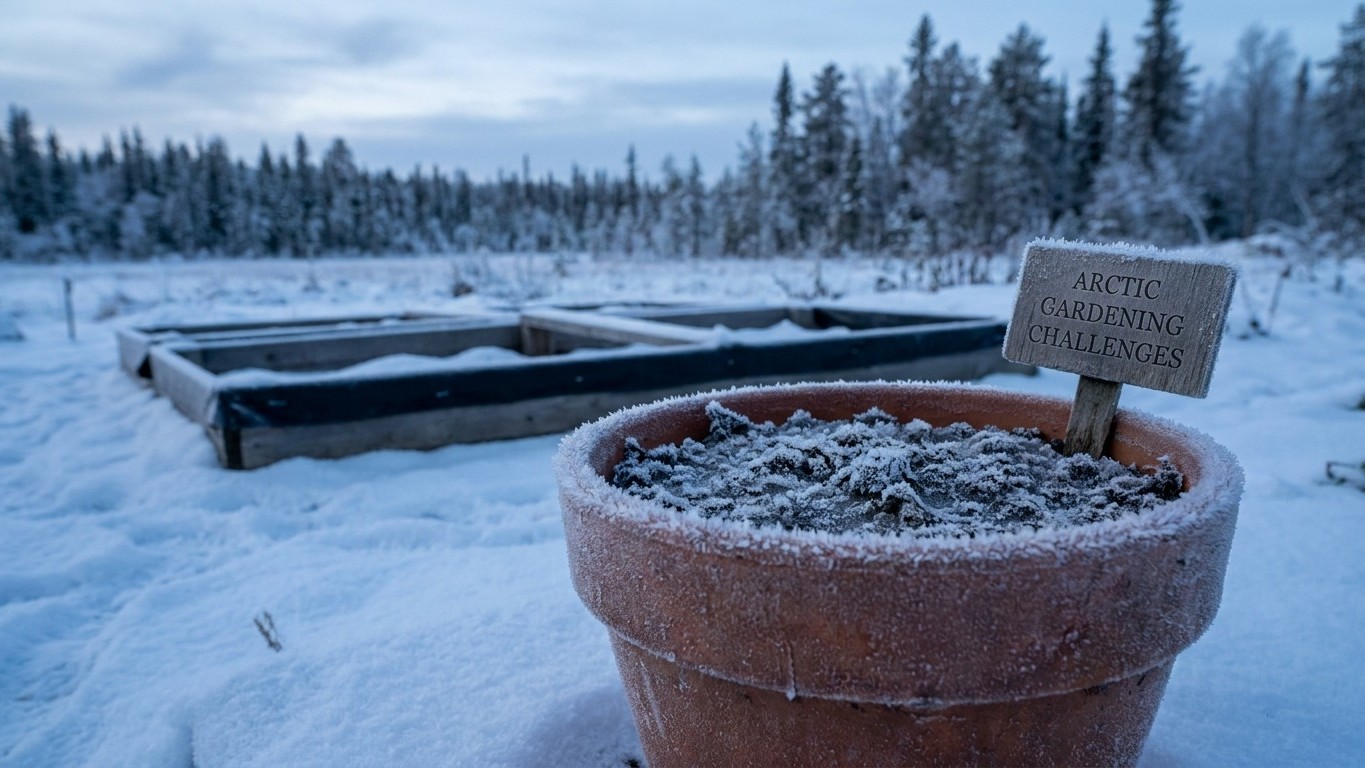

Spring bulbs need a stretch of cold before they’ll bloom, and the ground in most of the country supplies that automatically. In Northwest Territories, the cold is never in short supply. The problem gardeners run into here is different: a container freezes solid, bulb and roots together, in conditions where an in-ground planting would only freeze at the surface.
Why this matters in Northwest Territories

Yellowknife’s coldest month averages a daily minimum of -21.1 F, and the reference city sits in Canadian hardiness zone 1b, using the Canadian system built on seven climate variables rather than the single-variable USDA scale used elsewhere on this site. Those two numbers settle a question before it’s even asked: does this territory need artificial forcing because winter is too mild? No. A place that averages -21.1 F on its coldest nights delivers far more than the twelve to fourteen weeks below 45 F that a tulip or daffodil bulb needs to break dormancy. Forcing for lack of cold, the technique gardeners in warm-winter states rely on, simply isn’t the issue here.
The cold is not the problem
An in-ground bulb bed in this territory gets exactly what it needs and then some. The soil below the frost line stays cold but insulated, buffered by the earth mass around it, and the bulb rides out winter the way it would anywhere cold enough to trigger spring bloom.
The pot is
A container doesn’t have that buffer. Soil in a pot is exposed on every side, and at -21.1 F ambient, that soil mass freezes through in days rather than gradually over weeks. A bulb tag rated for a garden bed two or three zones warmer than 1b will die in a pot left outside here, even though the same bulb might survive planted directly in the ground with a foot of native soil around it. Containers need roughly two zones of hardiness above what the label calls for, or they need to come indoors. In zone 1b, that math rarely works out in the pot’s favor.
How to do it here
Because the ground supplies plenty of natural cold, the useful skill in this territory isn’t chilling bulbs artificially, it’s protecting the ones planted in containers, and forcing a batch indoors for an early bloom before the outdoor season even starts if that’s the goal.
Chilling bulbs for an indoor bloom
- Pick bulbs sold for forcing, such as paperwhites or amaryllis, which need no chilling at all, or standard hardy bulbs like tulips and hyacinths, which need the standard twelve to fourteen weeks below 45 F to complete dormancy.
- Store bulbs that need chilling in an unheated garage that stays consistently above freezing but below 45 F, or in a refrigerator drawer set aside for the purpose.
- Keep chilling bulbs away from apples, pears, or any ripening fruit in that fridge or garage. Fruit gives off ethylene gas as it ripens, and ethylene kills the flower bud inside a dormant bulb before it ever gets the chance to open.
- After the chilling period is complete, move the bulbs into a bright, cool room to bloom, checked by hand for a firm, unshriveled bulb and root growth at the base before assuming the chill worked.
Protecting bulbs left in containers
- Check the hardiness rating on the bulb package or supplier tag and compare it to Canadian zone 1b. If the rating is warmer than roughly zone -1, the pot cannot survive an NWT winter outdoors unprotected.
- Move the pot into an unheated but enclosed space, an attached garage or a cold porch that never drops much below the low 30s, for the coldest stretch of winter.
- If moving the pot indoors isn’t possible, sink the entire container into the ground up to its rim and mound mulch over the top, so the pot borrows the insulating mass of the surrounding soil instead of freezing on its own.
- Accept that bulbs left in an exposed, unprotected pot through a Northwest Territories winter are a one-season planting, and budget for replacing them rather than expecting a repeat bloom.
Which bulbs are worth it
Not every bulb rewards the extra handling a container demands in this climate. A short chilling requirement means faster, more reliable results indoors, and a short, sturdy stem means a pot that doesn’t topple over on a windowsill or a porch table. A tall bulb with a long chill requirement asks for more from the gardener and gives less certainty in return. Where a bulb was already destined to be a single-season purchase because the container can’t protect it through winter anyway, forcing it for an early indoor bloom costs nothing extra since it was never coming back regardless.
Bulbs that force reliably here
- Paperwhite narcissus — no chilling needed, blooms in three to four weeks from planting
- Amaryllis — no chilling needed, large single stem, easy to manage in a pot
- Hyacinth — short chill requirement, sturdy stem, well suited to a small container
- Crocus — short chill requirement, low stature, rarely topples
- Dwarf iris (Iris reticulata) — short chill requirement, compact form
Bulbs that sulk
- Standard tall daffodils — long chill requirement, top-heavy stems that lean or fall in a pot
- Tulips — long chill requirement, tall stems, and container roots can’t reach the depth they’d get in a bed
- Fritillaria — finicky about chilling length and drainage, unforgiving of small pot volume
What goes wrong, and when you can still fix it
Leaves but no flower
This means the chilling period ran short. The bulb produced enough energy for foliage but never fully differentiated a flower bud before it was warmed. There’s no rescue for that bulb this season. The leaves should be left to grow and photosynthesize normally, and the bulb can be chilled properly the following year, but this year’s bloom isn’t coming.
Short stem, flower buried in the leaves
This happens when the bulb was warmed too early, before the stem had a chance to elongate normally. The flower forms but stays low and hidden. Nothing brings the stem back up once this happens. It’s a timing error to correct on the next planting, not something to fix on this one.
Rot in the pot
Soft, mushy bulb tissue with a sour smell means the container never drained. Standing water around a dormant bulb suffocates it and invites rot organisms that spread fast in the small soil volume of a pot. A rotted bulb doesn’t recover this season or any other. The bulb should be discarded, and the next attempt needs drainage holes and a pot that never sits in a saucer of standing water.