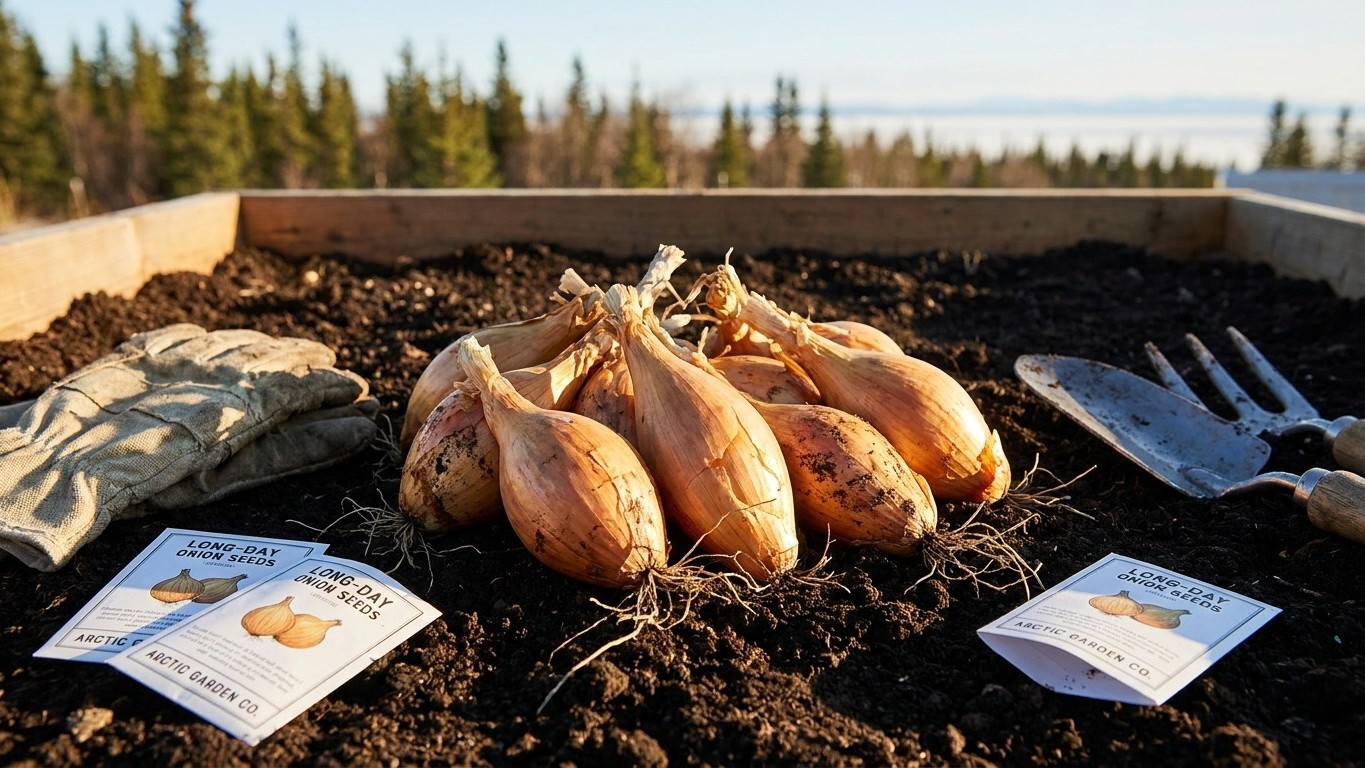

Northwest Territories sits at a latitude few gardening guides ever address, and that changes everything about which onion seeds are worth planting. At Yellowknife’s 62.46 degrees north, the growing season delivers close to 19 hours and 30 minutes of daylight at the summer solstice, which rules out almost every onion variety sold in mainstream catalogs. Only one type on the market is actually bred to bulb this far north.
How long your longest day is

Yellowknife sits at 62.46 degrees north latitude, and on the longest day of the year the sun keeps the sky lit for roughly 19 hours and 30 minutes. That single number does more to decide which onions will work in your garden than soil, fertilizer, or watering schedule combined. Onions don’t bulb because of heat. They bulb because of day length, and each variety carries a genetic trigger tuned to a specific number of daylight hours.
Short-day onions trigger at around 12 hours of daylight, a threshold documented by Clemson Cooperative Extension’s Home & Garden Information Center. That means a short-day bulb starts forming almost as soon as the plant has a few leaves, no matter where it’s growing. Long-day varieties wait much longer, needing 14 to 16 hours before bulbing kicks in. At Yellowknife’s nearly 19-and-a-half-hour summer day, that threshold arrives with room to spare. This is the day-length group Northwest Territories falls into: long-day, and only long-day.
What this rules out is almost everything else on the shelf. Intermediate-day onions, bred for the middle latitudes of the continental United States, need roughly 13 to 14 hours and are built for a climate that never sees a Northwest Territories summer night. Short-day onions are worse than useless here, planted this far north, they bulb prematurely, before the plant has grown enough foliage to feed a decent-sized onion. The result is a small, weak bulb from a plant that should have had months more to grow. To get the timing right for your own garden, see When to Plant Onions in Northwest Territories.
One more thing worth flagging before moving to specific varieties: Yellowknife is one station, not the whole territory. Northwest Territories spans a wide range of latitude, and a garden well north of Yellowknife will see even longer summer days, while one further south will see somewhat shorter ones. If you’re gardening near Fort Smith or Fort Liard, closer to the southern edge of the territory, it’s worth checking your own latitude rather than assuming Yellowknife’s numbers apply exactly. The daylight math shifts by minutes per degree of latitude, and at this scale, those minutes matter.
Which varieties bulb in Northwest Territories
Of the 28 onion varieties tracked on this site, exactly one has a published latitude range that covers 62.46 degrees north. To see the full breakdown, check out The Best Onion Varieties for Northwest Territories. That variety is:
- Redwing — long-day, rated for 43 to 65 degrees north
Redwing’s range was built for exactly this kind of far-north growing season, which is why it’s the sole entry on the list. Everything else sold as a garden onion falls short of the latitude this territory demands, and that’s not a small gap. It’s the difference between a variety that was never meant to grow here and one that was.
Varieties that will not bulb here
This is the list that matters most if you’ve already tried growing onions from a supermarket set or a seed packet picked up without checking its range. Twenty-seven varieties documented on this site have published latitude ranges that fall below 62.46 degrees north, meaning none of them are rated to reach this far into long-day territory:
- Ailsa Craig, Barolo, Blush, Bridger, Frontier, New York Early, Patterson, Powell, Red Carpet, Rossa di Milano, Safrane, Talon, Walla Walla Sweet (long-day varieties, all with northern limits below 62.46N)
- Cabernet, Calibra, Candy, Elsye, Expression, Monastrell, Red Long of Florence, Red Long of Tropea, Scout, Sierra Blanca (intermediate-day varieties)
- Gabriella, Madalyn, Red Rock, White Castle (short-day varieties, no page of their own on this site)
Plant any of these in Northwest Territories and the pattern is predictable. The onion grows leaves, sometimes vigorously, because the plant is healthy and the soil is fine. But the daylight trigger it’s genetically waiting for either never arrives (long-day and intermediate varieties bred for latitudes below 62.46N may not fully synchronize with this far-north light cycle) or arrives too early (short-day types bulb almost immediately, before the plant has built enough leaf mass to support a real onion). Either way, the gardener ends up with a plant that looks fine through midsummer, then produces a small, soft, or rotting bulb by fall. It’s not a watering mistake or a fertilizer mistake. It’s a variety mismatch, decided the day the seed packet was chosen.
If you’ve had that exact experience, decent green tops, disappointing or rotten bulbs at harvest, this is very likely why. The seed rack at a general store rarely sorts by latitude, and a bag labeled simply “onion sets” gives no clue whether it’s short, intermediate, or long-day stock.
When to plant onions in Northwest Territories
Because Northwest Territories falls firmly into the long-day group, its planting calendar looks nothing like the fall-planting schedule used in mild-winter southern states. There, gardeners tuck onion sets into the ground in autumn and let them overwinter. Here, the frost-free window is short and arrives late, so planting waits until late winter or early spring, timed to give the onion as many long-day months as possible before the daylight trigger fires.
The frame for that timing comes from two average dates recorded at Yellowknife: the last spring frost falls on average around May 25, and the first fall frost arrives on average around September 18, according to Environment and Climate Change Canada’s climate normals for the 1981-2010 period. That gives a frost-free season of roughly four months, which sounds tight for an onion crop, but the extended daylight hours partly compensate by accelerating growth once the plant is established.
Two things to keep in mind about those dates. First, they’re averages, not guarantees. A mean date means frost arrives later than May 25 in roughly half of all years, so treating it as a firm safe-to-plant marker is a mistake gardeners make every spring. Build in a buffer, start onion sets or transplants indoors ahead of that date, and watch local conditions rather than the calendar alone. Second, Yellowknife is a single weather station in a territory that stretches across a wide range of terrain and latitude. Northern communities and upland or more continental districts routinely run weeks behind Yellowknife’s numbers, so a gardener elsewhere in the territory should treat these dates as a starting reference, not a fixed rule.
Given the short window, most Northwest Territories gardeners get better results starting onions indoors from seed in late winter, then transplanting hardened-off seedlings outside once the soil has warmed and the frost risk has genuinely passed, rather than relying on direct seeding outdoors. That approach gives the plant a head start on leaf growth before the long summer days trigger bulbing, which matters because a long-day onion still needs solid foliage built up before it switches into bulb production. Skip that head start, and even a correctly chosen long-day variety like Redwing may bulb before it’s had the chance to grow to size.