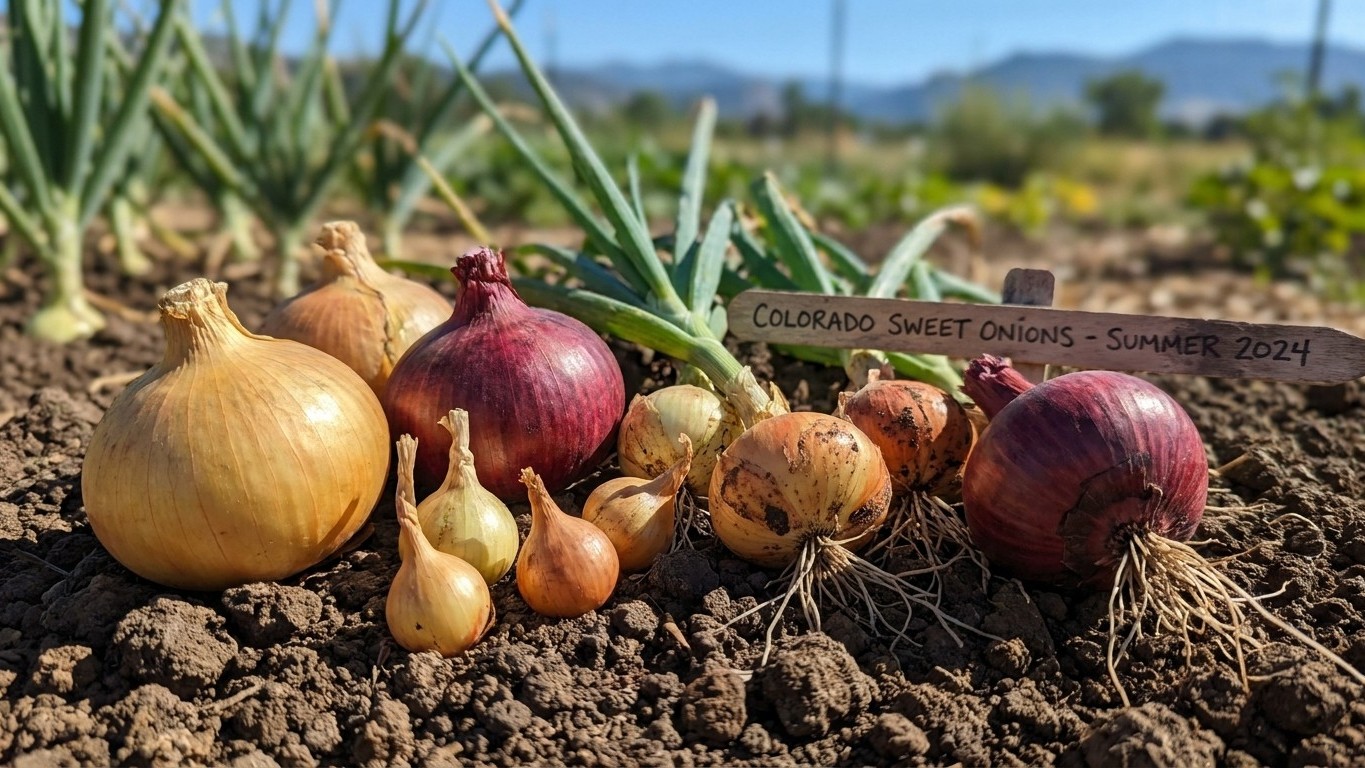

Denver sits at 39.83 degrees north, and on the longest day of the year the sun gives that spot 14 hours and 50 minutes of daylight. That single fact decides which onions will bulb in a Colorado garden and which ones will sit there making leaves until they rot. Short-day onions need almost none of it, long-day onions need every minute, and a lot of seed racks don’t tell you the difference.
How long your longest day is

An onion doesn’t bulb because the weather warms up. It bulbs because the days get long enough, and each variety has a published threshold for exactly how long “long enough” needs to be. That’s why the 14 hours and 50 minutes at Denver’s latitude matters more than any date on a seed packet. Clemson Cooperative Extension puts the trigger point for short-day types at roughly 12 hours of daylight, a threshold this state blows past by close to three hours at midsummer.
Three hours sounds small until you realize it’s the whole ballgame. A short-day onion planted here will start forming a bulb the moment the days reach that 12-hour mark, usually in late spring, while the plant is still a handful of thin leaves. The bulb it produces is tiny, because the plant never got the chance to build up enough leaf mass first. Meanwhile a variety built for 14 to 16 hours of daylight waits patiently through spring, keeps piling on leaves as the days lengthen, and only starts bulbing once Denver’s summer daylight actually reaches the range it’s waiting for. At 14 hours 50 minutes, that range is covered for long-day types and comfortably covered for the intermediate group in between.
Why the edge of the state is different
39.83 degrees is Denver’s number, not Colorado’s. The state runs from roughly 37 to 41 degrees north, and daylight length shifts with every degree of latitude. A garden near the Wyoming border gets a few extra minutes of summer sun compared to one near New Mexico, and a few minutes is exactly the margin that separates “bulbed fine” from “bulbed small” for a variety sitting near the edge of its published range. If your place isn’t near Denver, it’s worth checking your own latitude before betting a whole row on a borderline variety, consulting a planting calendar onions Colorado resource can help you time things right, the general rule holds statewide, but the fine print doesn’t.
Which varieties bulb in Colorado
Eighteen of the varieties documented on this site have a published latitude range that fully covers 39.83 degrees north. These are the best varieties onions Colorado gardeners can rely on, spanning both the long-day and intermediate-day groups:
- Ailsa Craig (long-day, 38-60N)
- Barolo (long-day, 38-55N)
- Blush (long-day, 38-55N)
- Bridger (long-day, 35-50N)
- Cabernet (intermediate-day, 35-45N)
- Calibra (intermediate-day, 35-45N)
- Candy (intermediate-day, 33-40N)
- Elsye (intermediate-day, 32-45N)
- Expression (intermediate-day, 32-45N)
- Monastrell (intermediate-day, 35-46N)
- New York Early (long-day, 38-50N)
- Patterson (long-day, 38-55N)
- Red Long of Florence (intermediate-day, 38-50N)
- Red Long of Tropea (intermediate-day, 35-48N)
- Rossa di Milano (long-day, 38-50N)
- Scout (intermediate-day, 32-46N)
- Sierra Blanca (intermediate-day, 32-45N)
- Walla Walla Sweet (long-day, 35-55N)
Two more sit within a degree and a half of a published bound: Frontier (long-day, 40-50N) and Red Carpet (long-day, 40-45N). Those ranges are a continuum, not a cutoff, so treat both as a maybe rather than a guaranteed yes, a Denver garden is right at the southern edge of what each was bred for.
Now the part that actually saves a gardener’s season. Eight documented varieties will not bulb at this latitude, for two opposite reasons.
- Gabriella (short-day, 20-35N), triggers bulbing far too early here, staying small
- Madalyn (short-day, 20-35N), same problem, small bulbs before the plant is ready
- Red Rock (short-day, 30-36N), bulbs prematurely at this latitude
- White Castle (short-day, 30-38N), bulbs prematurely at this latitude
- Powell (long-day, 43-47N), the day never gets long enough here to trigger bulbing at all
- Redwing (long-day, 43-65N), same issue, no bulb ever forms
- Safrane (long-day, 42-50N), leaves only, then rot
- Talon (long-day, 42-50N), leaves only, then rot
The short-day group gives you a small, disappointing onion. The long-day group above 42 degrees gives you nothing at all, just a plant that keeps making leaves through summer and collapses into mush once the top dies back. If you’ve ever bought a generic grocery-store onion set, planted it in a Colorado garden, and watched it do exactly that, this is why. It wasn’t the soil. It was the variety’s latitude requirement, mismatched to the length of a Denver summer day.
When to plant onions in Colorado
Planting timing follows straight from that day-length math, which is why the advice for a southern state and the advice for Colorado look nothing alike. In mild-winter climates farther south, growers plant onions in autumn and let them overwinter as small plants. That approach doesn’t work at 39.83 degrees north, where winter actually freezes the ground. Colorado gardeners plant in late winter to early spring instead, giving the young onion plants time to build leaf mass before the long June days arrive and flip the switch to bulbing.
The frame for that spring planting is the last spring frost window at the reference station: May 1 to May 11. Onion sets and transplants tolerate a light frost better than most vegetable starts, so many Colorado growers get plants or sets into the ground several weeks ahead of that date, sometimes as early as March if the soil can be worked. The point isn’t to dodge every frost, it’s to get enough leaf growth in before the solstice that the bulb has something to draw on once daylight triggers it.
On the back end, the first fall frost window runs September 30 to October 12. That’s the marker for harvest, since bulbs need their tops to fall over and dry down before a hard freeze hits the exposed bulb. Both windows are averages built from 30 to 70 percent freeze probability, not a guarantee, treat May 1 and September 30 as the early edge of the risk, not a safe date circled on the calendar. And remember the caution that applies to the whole state: Denver’s numbers describe the plains at 5,280 feet. A mountain town can see frost in July, and the western slope runs on its own schedule entirely. A gardener there should pull local frost data rather than borrow Denver’s.
Sweet onions or onions that keep
What ends up in a Colorado pantry depends on which day-length group filled the garden, and that split maps onto a real chemical trade-off, not marketing language. University of Missouri Extension notes that sweet onion varieties do not store as well as the more pungent types, because the same volatile sulfur compounds that give an onion its bite are also what protect the bulb through months in storage. Fewer of those compounds means a milder onion on the cutting board and a shorter shelf life in the pantry.
Short-day and some intermediate-day varieties tend to run sweeter and lighter on those sulfur compounds, which is part of why they’re prized for eating fresh, in salads or raw on a sandwich, within weeks of harvest. Long-day varieties, the ones bred for this latitude’s long summer days, tend to carry more of those compounds by nature of a longer growing season and more time to build them up. That’s not a guarantee every long-day onion in this list is a great keeper, but the general lean holds: a Colorado garden built mostly around long-day and intermediate-day varieties skews toward onions with more bite and more staying power than a garden farther south growing short-day types.
Practically, that means a Colorado grower shouldn’t expect the same eat-it-fresh sweetness that a Gulf Coast garden gets from its short-day crop, those varieties won’t even bulb here, as the list above shows. What a Colorado pantry can realistically expect instead is a harvest of firmer, sharper onions that cure down well and hold through winter storage, with a few of the milder long-day varieties like Walla Walla Sweet mixed in for near-term eating. The trade-off runs one direction only: nothing on this list promises both the sweetness of a short-day onion and the storage life of a true long-day keeper. Pick the row for one purpose, not both.