
Ontario’s climate rarely pushes gardens into true heat stress, so the real skill is matching water to soil type and to what’s actually dry at root depth, not to a fixed schedule. Restrictions vary by municipality and change season to season, so the rules below point you toward your local water authority rather than guessing.
How much, how often

The biggest mistake gardeners make is watering a little bit every day. Shallow, frequent sips train roots to stay near the surface, where they’re the first to fry when a dry stretch hits. Deep, infrequent watering does the opposite: it pushes roots downward, chasing moisture that lingers longer below the surface. That’s the goal in almost any Ontario yard, whether it’s a vegetable bed in Windsor or a perennial border in Ottawa.
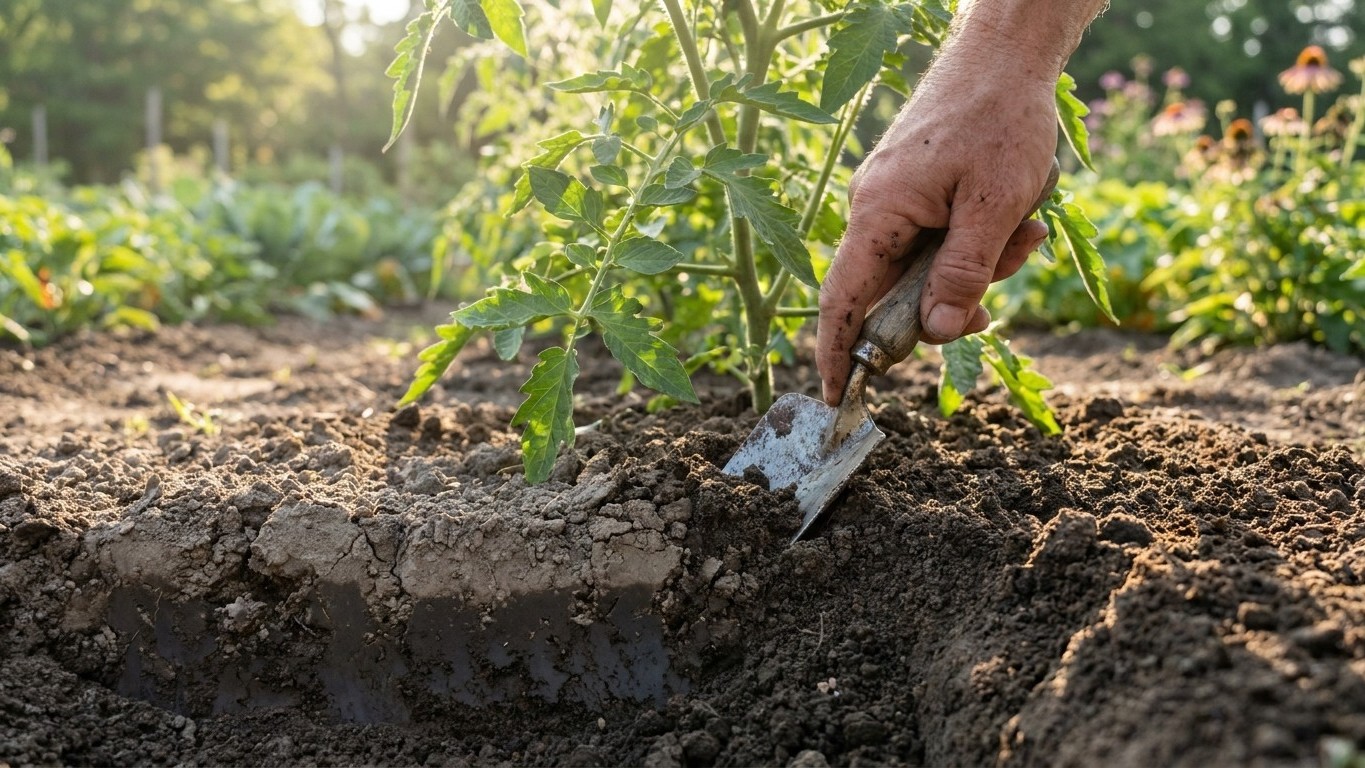
The way to know when to water isn’t the calendar, it’s the soil. Push a finger, or better, a garden trowel, about two inches into the ground near the plant’s base. If it’s dry at that depth, water. If it’s still cool and damp, wait. This single habit replaces guesswork with something you can actually verify, and it adjusts automatically for whatever the sky is doing that week.
Soil texture changes the math. Sandy soil, common in parts of Norfolk County and along the Lake Huron shoreline, drains fast and holds little reserve, so it needs shorter, more frequent soakings rather than one big drenching. Heavy clay, which shows up across much of the Golden Horseshoe and southwestern Ontario, can hold a week’s worth of water in reserve, but it punishes overwatering. Clay that’s already wet and gets watered again, or worked with a shovel while damp, compacts into something roots can’t push through. The rule with clay is patience: wait until it’s genuinely dry before adding more.
Ontario’s climate normals show essentially zero days a year reaching 90°F at the Toronto reference station, so gardens here aren’t fighting the kind of relentless heat that drives daily watering in the desert Southwest. That’s a real advantage, but it doesn’t mean the hose stays coiled all summer. Watering Through a Dry Spell in Ontario still requires attention, since container plants, new transplants, and anything under an eave or a wide roof overhang miss out on rain that never reaches them. Watering Pots and Containers in Ontario is worth reading closely, since pots dry out far faster than garden beds and often need daily checks even when the rest of the yard is fine.
A simple watering sequence
- Check the soil first. Two inches down, dry means water; damp means wait another day or two.
- Water at the base, not the leaves. Wet foliage overnight invites fungal disease; aim the hose or drip line at the soil line.
- Water in the morning. Early watering gives moisture time to soak in before the afternoon sun evaporates it, and dries any leaf splash before nightfall.
- Sandy soil: shorter, more frequent soakings, roughly every 2 to 3 days in a dry stretch, since it holds little reserve.
- Clay soil: longer intervals, deeper soak, often once a week is enough once the topsoil layer has genuinely dried out.
- Let containers guide the schedule. Pots dry out faster than garden beds and may need water daily during a hot, dry week even when the ground beds don’t.
Restrictions and rules
Watering restrictions are common across Ontario municipalities during dry summers, and the details, which days are allowed, what hours, whether hand-watering is exempt, are set locally and revised from year to year. There’s no single provincial watering schedule that applies everywhere, so anything printed here as a fixed rule would likely be wrong somewhere or outdated by next season.
The reliable move is to check with your municipal water utility or regional conservation authority before setting a sprinkler timer, especially in June through August when demand peaks. Many municipalities post current watering schedules directly on their websites, and some tie restrictions to reservoir levels or drought conditions rather than a fixed calendar.
Given that Ontario’s summer climate rarely brings the extreme heat load of days above 90°F, mandatory restrictions here tend to be less severe and less frequent than in hotter, drier provinces or U.S. states. That said, “less likely” isn’t “never,” and a dry June or July can still trigger stage-one restrictions in a given town even in an otherwise mild year. For provincial resources on agriculture and water use more broadly, Ontario’s agriculture and food page is a starting point, though local bylaw pages will have the specific watering-day rules that actually apply to your address.
Renters and new homeowners should ask specifically: does the property use municipal water, a well, or a shared irrigation system? Rules and even legal responsibility for compliance can differ across those three situations, and a landlord or property manager may already have a watering plan in place that residents are expected to follow.
Using less
Cutting water use in an Ontario garden usually comes down to a handful of techniques that each solve a different part of the problem, from evaporation to runoff to plants that simply don’t need as much in the first place. Layering two or three of these together does more than any single fix on its own.
- Mulch, 2 to 3 inches deep. A layer of shredded bark or straw over garden beds slows evaporation from the soil surface, which means longer stretches between waterings and fewer weeds competing for the moisture that’s there.
- Drip irrigation or soaker hoses. Delivering water directly to the root zone instead of spraying it overhead cuts losses to wind drift and evaporation, and it keeps foliage dry, which also reduces disease pressure in Ontario’s humid summers.
- Group plants by water need. Putting drought-tolerant natives and thirstier annuals in separate zones means you’re not overwatering the tough plants just to keep the thirsty ones alive, or underwatering everything to compromise.
- Work organic matter into the soil. Compost added to sandy soil improves its ability to hold water between waterings; added to clay, it improves drainage so the soil dries out enough between soakings to avoid root rot.
- Rain barrels, where local bylaws allow them. As a rule of thumb, an inch of rain falling on a 1,000-square-foot roof produces roughly 600 gallons of runoff, water that a barrel and downspout diverter can capture instead of sending straight to the storm drain.
That rain barrel math is useful, but how much it actually helps depends on how often rain shows up to refill the barrel. Ontario’s climate doesn’t have the kind of essentially rainless summer month you’d see in parts of the arid West, where a barrel fills once and then sits empty for weeks. Exact monthly rainfall totals vary by region and by year, so the practical move is to check your local conservation authority’s rainfall data or simply track it yourself with a basic rain gauge, that tells you far more about how long a full barrel will actually last than any regional average can.
Common questions
How do I know if my Ontario soil is sandy or clay without a lab test?
Roll a handful of moist soil between your palms. If it falls apart and won’t hold a shape, it’s sandy. If it forms a ribbon or stays molded like modeling clay, it’s clay-heavy. Most Ontario gardens fall somewhere in between, which is often called loam.
Is it ever okay to water in the evening instead of the morning?
It works in a pinch, but leaves that stay wet overnight are more prone to fungal disease in Ontario’s humid summers. Morning watering is the more reliable habit if the schedule allows for it.
Do watering restrictions apply to vegetable gardens the same way they apply to lawns?
Many municipal bylaws treat hand-watering of food gardens differently than automatic lawn sprinklers, sometimes exempting it entirely. That distinction isn’t universal, so check your specific municipality’s bylaw wording rather than assuming.
Why does the frost date matter for a watering schedule?
The average last spring frost around Toronto falls near April 30 and the average first fall frost near October 16, based on Environment and Climate Change Canada’s 1981-2010 normals. Those are mean dates, not guarantees, frost arrives later than average in half of all years. They mark the rough window when tender plants are actively growing and drawing water, which is also the window when a consistent watering routine matters most.