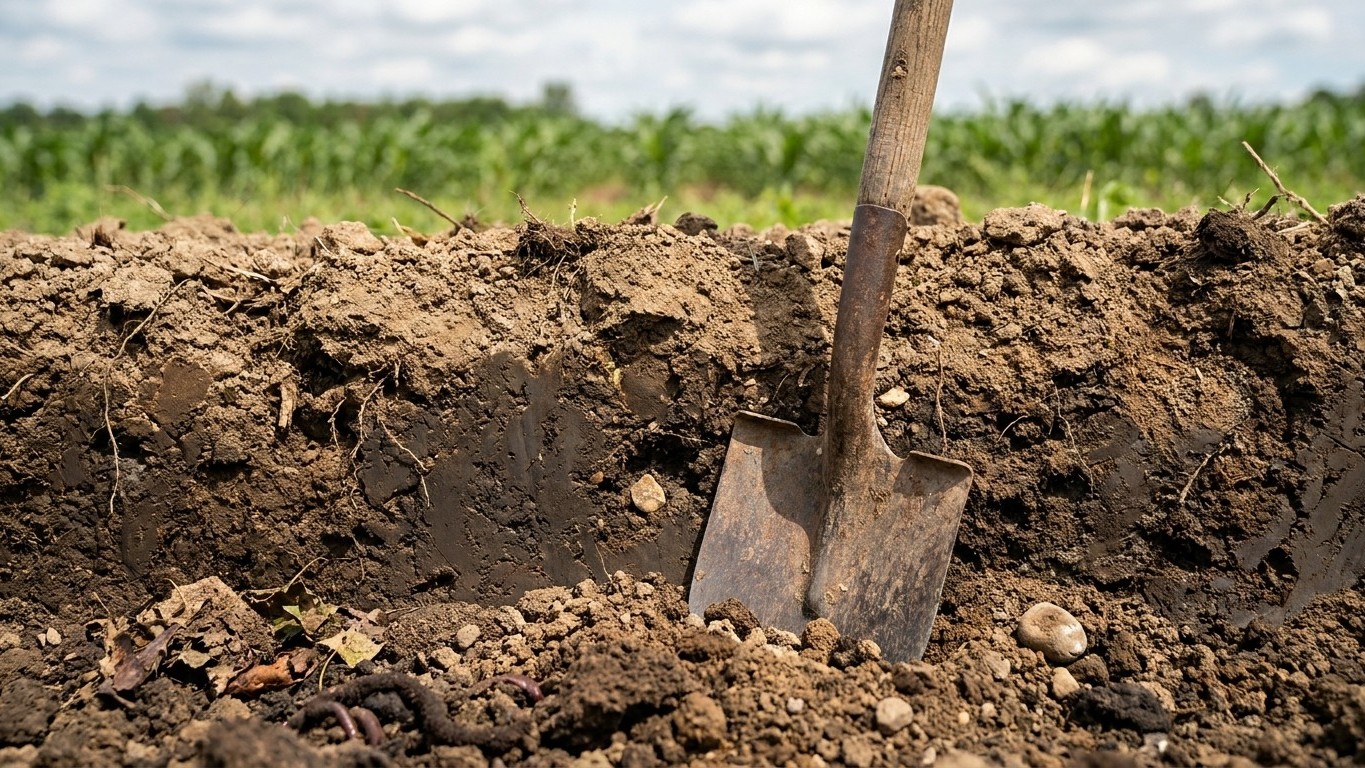

Most agricultural ground in Ontario sits on a Luvisol, a forest-formed soil where clay has washed downward out of the topsoil, leaving a paler, lighter surface layer sitting over denser subsoil. That’s the dominant profile across the province’s mapped farmland, with a median surface pH near 6.5, a loam-to-silt texture, and organic matter around 4.3 percent. None of that tells you what’s under your own beds, but it tells you what the region tends toward, and it gives you a baseline to test your own dirt against.
What is under your garden

According to the Canadian Soil Information Service, the most common soil order across Ontario’s mapped agricultural surface horizons is Luvisol, covering 39 percent of that mapped ground, with Gleysolic soils as the next most common order. A Luvisol forms under forest cover as clay particles migrate downward through the profile over centuries, thinning out the topsoil while building a heavier, denser layer below it. That’s why a shovel often goes in easily for the first several inches and then meets real resistance.
The measured figures for these surface horizons are specific. Median surface pH sits at about 6.5, which counts as slightly acid. Texture runs 43 percent sand, 17 percent clay, and 41 percent silt, a loam-to-silt mix rather than anything heavy or sandy. Organic matter comes in around 4.3 percent, and drainage across the profile is classed as well drained. Those numbers aren’t estimates rounded for convenience; they’re the median readings from 846 mapped soil components across the province’s farmed regions.
Why this isn’t your soil
This median describes agricultural Ontario, not every backyard in it, and it doesn’t reach into the far north of the province, where mapping for this dataset thins out. A garden near a river will run heavier and wetter than the median. Muskeg is its own world entirely. And if a builder scraped topsoil off your lot before pouring a foundation, or trucked in fill to level a yard, what you’re digging into has nothing to do with any provincial average, it’s whatever ended up dumped there.
Reading your own dirt in five minutes
Two quick checks tell you more than a paragraph of description ever could:
- The ribbon test: wet a small handful of soil and squeeze it between thumb and forefinger, pushing it up into a ribbon. Sandy soil won’t hold together at all. A loam forms a short ribbon of an inch or two before breaking. Clay stretches into a long, smooth ribbon that resists breaking.
- The jar test: fill a clear jar about a third with soil, top it with water, shake hard, then let it sit overnight. Sand settles first and forms the bottom layer, silt settles next, and clay stays suspended longest, forming the top layer once things finally clear. The proportions you see roughly match what’s in the ground.
Do both, and you’ll know out loud what you’re standing on before you plant a single thing.
Testing before you amend
Guessing at soil chemistry usually means buying the wrong bag. Lime dumped onto ground that’s already near neutral does nothing useful and can push pH too high for years. Sulfur applied to soil that’s already acidic makes a real problem worse. A lab test costs less than a flat of perennials and tells you the two things your eyes genuinely can’t: the actual pH number and the nutrient levels sitting in the root zone.
A representative sample matters more than most people think. Pull soil from six to eight spots across the bed or lawn area, each core going down about six inches, since that’s roughly where vegetable and lawn roots do most of their feeding. Mix those cores together in a clean bucket, remove any rocks or roots, and send in about two cups of the blended sample rather than one spot’s worth of dirt. A single sample from next to the porch doesn’t speak for the whole yard.
The result will list pH along with phosphorus, potassium, and often organic matter percentage. Given that Ontario’s regional median runs about 6.5, a homeowner can reasonably expect a result somewhere in the slightly acid to near-neutral range, especially on ground that hasn’t been disturbed much. But expecting isn’t knowing. Fill and disturbed lots, heavy compost use, or years of lawn fertilizer can shift a yard’s number well off that baseline in either direction, and the only way to find out is to send in the sample.
Amending it
Ontario’s median pH of about 6.5 sits close enough to neutral that most vegetables, lawns, and ornamentals need no correction at all. That’s the useful part of the regional number: it tells you not to assume a problem exists before your own test says so. But a median is not a guarantee, and plenty of individual yards land well outside it once tested.
If your test comes back low
Should your number come back below about 5.5, lime is the tool, not sulfur. Acid ground that low locks up phosphorus so plants can’t use it even when it’s present in the soil, and it punishes brassicas specifically, showing up as stunted, purplish cabbage and broccoli. Lime works slowly, moving through the root zone over a season or two as it reacts with soil moisture, not something that shows results in a week. Applying it in fall ahead of spring planting gives it time to work before roots need it.
If your test comes back high
If the number comes back above about 7.3, lime must never go anywhere near that ground, full stop. The honest fix is elemental sulfur worked in gradually, paired with steady additions of organic matter, both of which nudge pH down over multiple seasons rather than one application. High pH locks iron out of reach of plant roots, and that’s exactly what yellow leaves with dark green veins on something like a hydrangea or blueberry are reporting back to you.
Texture: what the sand and clay numbers mean here
At 43 percent sand and 17 percent clay, Ontario’s median texture is a workable loam-to-silt blend, not the heavy clay or fast-draining sand that demands aggressive correction. If your own soil test or jar test shows something closer to heavy clay, organic matter is the fix, worked in over multiple seasons, never sand dumped into clay, which tends to set up like concrete. Never work clay soil while it’s wet; compress it in that state and you’ll be fighting compaction for years. If your soil leans sandy instead, organic matter still helps, alongside shorter, more frequent watering, since sandy ground won’t hold moisture or nutrients in place no matter what you add. Texture fixes are the slow ones, three seasons is a realistic timeline. pH correction on the acid side can show measurable movement within a single season if lime is applied generously and worked in.
Drainage and compaction
The Luvisol profile common across Ontario’s farmed ground is classed as well drained, which in practice means water moves through it at a reasonable rate rather than pooling for days or vanishing in hours. But “well drained” describes the median mapped profile, not your particular backyard, especially if that yard sits in a low spot or has been compacted by years of foot traffic or construction equipment.
Running your own percolation test
Dig a hole about a foot deep and roughly the same across, fill it with water, and let it drain completely once to saturate the surrounding soil. Fill it a second time and time how fast the water level drops. A drop of one to three inches per hour is the workable range for most garden plants. Faster than that and water is running through too quickly to be useful, slower and roots risk sitting wet, which suffocates them just as surely as drought stresses them.
Compaction and when to stop fighting it
Foot traffic, parked equipment, and even repeated foot traffic pushing a wheelbarrow along the same path compress soil structure and squeeze out the pore space roots and water both need. Double digging, once the standard fix, has largely fallen out of favor because it disturbs soil biology and structure that took years to build, often making compaction worse in the following season rather than better. A better approach on compacted ground is surface application of compost combined with reduced foot traffic and, where the site allows it, permanent pathways that keep the same spots absorbing the pressure every time.
On a lot with heavy compaction, poor drainage results, or soil that’s clearly construction fill rather than native ground, a raised bed is the more honest answer than three years of amendment. Building up six to twelve inches of good soil mix over compacted or contaminated ground sidesteps the problem entirely rather than trying to slowly rehabilitate soil that may never fully recover under a home landscape’s constraints.
Local help
Soil testing and agricultural guidance for Ontario run through the province’s Ontario Ministry of Agriculture, Food and Rural Affairs. County and regional offices can point homeowners toward accredited testing labs and help interpret a result once it comes back, matching the numbers on the report to what’s actually happening in a specific garden.
Common questions
Is Ontario soil good for gardening?
Much of the province’s agricultural ground is a workable loam-to-silt texture with median pH near neutral, which suits a wide range of vegetables and ornamentals without heavy correction. Individual yards vary, especially disturbed or fill-based lots.
Why is Ontario topsoil so thin in places?
Luvisols form as clay migrates downward out of the surface layer over long periods, leaving topsoil lighter and thinner while the subsoil below becomes denser and more clay-rich.
Do I need to lime my soil in Ontario?
Only if a soil test shows pH below about 5.5. The regional median sits near 6.5, close to neutral, so many yards need no lime at all, and applying it without a test risks pushing pH too high.
How much does a soil test cost in Ontario?
Costs vary by lab and package, but a basic pH and nutrient test typically runs less than the price of a flat of plants. Local extension offices can point homeowners to accredited testing labs and current pricing.
Related guides
- Manitoba Soil: What You Are Digging Into, and How to Improve It
- Quebec Soil: What You Are Digging Into, and How to Improve It
- Prince Edward Island Soil: What You Are Digging Into, and How to Improve It
- Beet Soil in Ontario
- Will Carrots Fork in Ontario Soil
- What to Plant in Ontario in February
- Nova Scotia Soil: What You Are Digging Into, and How to Improve It
- British Columbia Soil: What You Are Digging Into, and How to Improve It