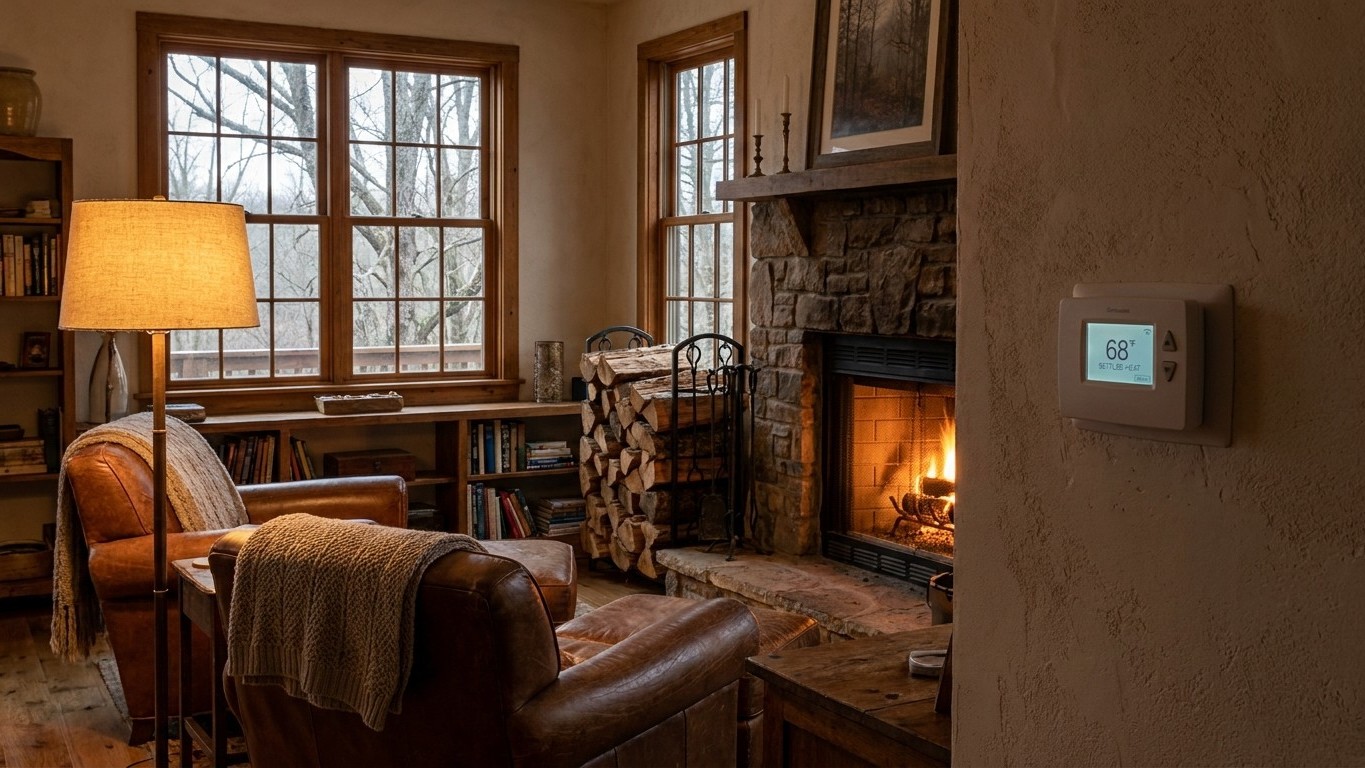

Nashville’s coldest month averages a 30.1°F low, a number that sounds mild until you multiply it by weeks on the calendar. Tennessee winters aren’t brutal, but they’re long enough and damp enough that heating costs add up quietly, and firewood buyers get shortchanged more often than they realize.
How cold it gets, and for how long

That 30.1°F figure is the average daily minimum for the coldest month, not a record low and not some abstract yearly average. It’s the number that tells you what a house has to survive on an ordinary night, night after night, for the length of a Tennessee winter. Hovering just below freezing means pipes need protection but not the kind of bunker-grade insulation you’d find built into homes in International Falls or Fargo.
What this means in practice: Tennessee winters run long rather than savage. Furnaces and heat pumps cycle for months, not weeks, and that steady, moderate demand is a different animal than the short, punishing cold snaps you’d design around in the northern Plains. A heat pump sized for this climate can carry most of the load efficiently, because it rarely has to fight temperatures far below freezing. Where things get expensive is duration, not intensity: a system that runs from November through March, depending on when the heating season starts in Tennessee, is burning fuel or electricity for a lot longer than a system in a place with a shorter, colder season, and knowing When Can You Turn the Heat Off in Tennessee? can help trim those extra weeks of runtime.
For wood burners, that 30.1°F average also sets the rhythm of the season. Fires get lit in the shoulder months, stay lit through a long stretch of chilly-not-frigid weather, and taper off by early spring. It’s a season that rewards a well-stocked woodshed more than a heavy-duty stove rated for sub-zero performance.
What a cord of wood is worth here
A cord is a volume, not a weight, and that distinction is where most firewood buyers get taken advantage of. The standard cord measures 4 feet by 4 feet by 8 feet, which works out to 128 cubic feet of stacked wood, air gaps included. Two stacks of the same size can hold very different amounts of usable heat depending on the species, because dense hardwoods like oak and hickory pack more mass into that same volume than a softer wood ever will.
According to Michigan State University Extension, a cord of well-seasoned hardwood delivers about 20 million BTU. That’s an average across species and moisture levels, not a guarantee for any particular load, but it’s a useful yardstick. MSU frames it in terms a homeowner can actually picture: one cord is roughly equivalent to the heat in 145 gallons of #2 fuel oil, or 215 gallons of LP gas. In a Tennessee winter built around months of moderate, steady cold rather than deep freezes, that kind of heat output from a single cord can stretch a long way if the wood is dense and properly dried.
The cord, measured out
| Dimension | Value |
|---|---|
| Length | 8 ft |
| Height | 4 ft |
| Depth | 4 ft |
| Total volume | 128 cubic feet |
| Heat output (seasoned hardwood, average) | about 20 million BTU |
Anyone buying wood by the truckload rather than the measured cord is buying a guess. It’s worth doing the math on the pile before it’s stacked, not after the cash has changed hands.
How long wood takes to dry in Tennessee
Wood needs to burn at 20 percent moisture or less to give up its heat efficiently. Green wood, fresh off the tree, can carry more than 60 percent moisture, and every bit of that water has to boil off before the fire produces usable heat. That’s not a minor inefficiency; it’s energy diverted straight into steam instead of warmth.
Split and stacked so air can move through the pile, most green hardwood reaches that 20 percent threshold after one full summer of drying. Tennessee’s humid, hot summers do the job, but only if the wood is split first and stacked with airflow in mind, not left sitting in rounds where the bark seals in moisture. Red oak is the notable exception here: MSU points out that its cell structure makes it dry more slowly than other hardwoods, so it needs more time on the rack before it’s ready to burn.
Burn wood too soon and the penalties show up fast. Less heat reaches the room because so much energy is spent boiling off water. The fire smolders instead of burning clean, and that incomplete combustion sends more creosote up the flue, which means a chimney that needs sweeping sooner than it should. None of this is dangerous if it’s caught early, but it’s the kind of maintenance cost that a properly seasoned woodpile avoids entirely.
Where to check before you buy
Tennessee stretches from Mississippi River bottomland to Appalachian ridgelines, and elevation and exposure shift both firewood availability and burn conditions across that range. The figures above describe Nashville as a reference point, not the whole state. A cabin in the higher elevations of the Cherokee National Forest, for one example, deals with different humidity and a different growing season for the trees supplying local firewood than a property in the western lowlands does.
The University of Tennessee Institute of Agriculture Extension is the resource worth checking before buying wood or planning a heating season around it. Local extension offices can speak to which species are actually available near a given property, how local drying times compare to the statewide average, and whether any seasonal burn restrictions are in effect. Those restrictions are set at the local level and revised year to year, often in response to drought conditions or air quality concerns, so a rule that applied last winter isn’t guaranteed to hold this one.
What each heat source costs to run in Tennessee
At Tennessee’s average residential prices, this is what one million Btu of heat delivered into the house costs with each system. It compares fuels on the same unit: it is not a yearly bill, and it leaves out the price of the equipment.
| System | Cost per million Btu delivered |
|---|---|
| Electric resistance (baseboard, 100% efficient) | $40.65 |
| Heat pump at 8.1 HSPF2 (seasonal COP about 2.4) | $17.12 |
| Natural gas furnace at 95% AFUE | $12.02 |
Cheapest to run in Tennessee: natural gas furnace, $5.10 less per million Btu than the heat pump.
Prices: U.S. Energy Information Administration (EIA), average residential prices. Efficiencies: ENERGY STAR criteria. A heat pump’s figure is a seasonal average; in the coldest weather its efficiency drops.