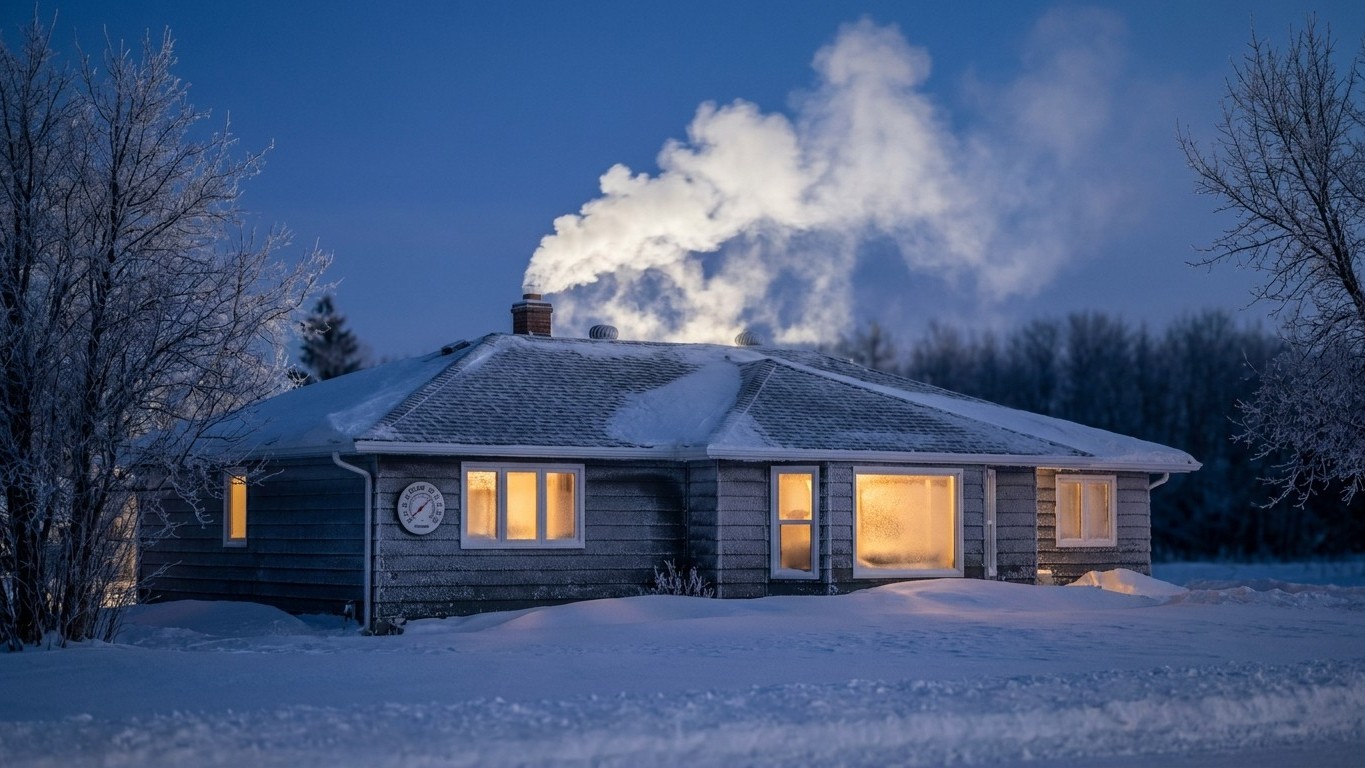

Winnipeg’s coldest month averages a daily low of -6.6°F, and that single number reshapes everything about how a Manitoba home stays warm: furnace sizing, fuel budgets, backup heat, even how a woodpile gets stacked. Here’s what that cold actually demands from a house.
How cold it gets, and for how long

Start with the number: -6.6°F is the mean daily minimum for the coldest month at the Winnipeg reference station, not the record low and not some cherry-picked cold snap. It’s the average low a household in this part of the province wakes up to, night after night, for the worst stretch of the year. That distinction matters because a house doesn’t just need to survive one brutal night. It needs equipment that can hold that kind of output for weeks without strain.
A winter that dips below zero regularly is a different animal from one that hovers just under freezing. In places where the coldest month averages a low near 28°F, a furnace cycles on and off, doing moderate work. In Manitoba, the furnace is often running close to continuously through January and into February, and it’s pulling against a Temperature swing of 60 degrees or more between the indoor thermostat setting and the outdoor air. That’s the kind of load that exposes an undersized furnace, a leaky attic hatch, or a water line that wasn’t buried deep enough.
What this means for heating season length
The practical result is a When Does the Heating Season Start in Manitoba? question with a clear answer: it stretches from October through April in a typical year, with the core demand concentrated in December, January, and February. Homes here aren’t just fighting cold snaps, they’re fighting sustained cold, which is why backup heat sources (a wood stove, a space heater for a single room, a generator for the furnace blower) get more attention in Manitoba than in milder territories. A furnace that’s merely adequate in a mild winter gets tested hard here, and it’s tested for months, not days.
That sustained demand also changes how homeowners think about supplemental wood heat. A stove that only needs to carry a house through occasional cold nights is a very different purchase than one expected to run daily from November to March. The cold isn’t the only variable. Duration is the one that actually drives the fuel bill and the firewood pile.
What a cord of wood is worth here
A cord of well-seasoned hardwood delivers about 20 million BTU, according to Michigan State University Extension. That figure is an average, not a guarantee: species and moisture content move it substantially, so no two cords are identical. But it’s a useful benchmark for anyone trying to size a woodpile against a Manitoba winter that runs five or six months long.
The word “cord” is where most firewood buyers get shorted. A cord is a volume, not a weight or a vague pile estimate: it’s a stack measuring 4 feet by 4 feet by 8 feet, which works out to 128 cubic feet. Anything smaller, a “face cord” or a truck-bed load sold as a “cord,” isn’t the real thing. If a seller can’t tell you the stack dimensions, assume it’s short.
| Measurement | Value |
|---|---|
| Stack dimensions | 4 ft x 4 ft x 8 ft |
| Total volume | 128 cubic feet |
| Heat output (seasoned hardwood) | about 20 million BTU |
MSU puts that in terms a homeowner can actually use: one cord of seasoned hardwood is roughly equivalent to 145 gallons of #2 fuel oil, or 215 gallons of LP gas. That’s a meaningful chunk of a Manitoba heating season, especially for a household using wood as the primary source in one room while the furnace handles the rest of the house.
None of that holds if the wood is green. Wood that hasn’t dried spends a large share of its potential heat boiling off water instead of warming the house, which is why density alone doesn’t tell the whole story. Dense species pack more mass into that same 128 cubic feet, but only seasoned wood actually delivers the BTU figure above.
How long wood takes to dry in Manitoba
Firewood needs to reach roughly 20 percent moisture or less before it burns efficiently, and green wood coming straight off the tree can sit well above 60 percent, according to Michigan State University Extension. That gap between green and seasoned is the difference between a stove that throws real heat and one that hisses, smokes, and struggles to stay lit.
Split green wood usually reaches that 20 percent mark after one full summer, provided it’s split and stacked so air can move through the pile. Rounds left whole, or wood piled tight against a wall with no airflow, dry far slower. Manitoba’s summer heat and relatively low humidity help the process along compared to more humid climates, but the wood still has to be prepped correctly to take advantage of it. There’s one named exception worth knowing: red oak dries slowly because of its cell structure, so it needs more time than most species even under good stacking conditions.
Burning too soon has real consequences beyond a weaker fire. Wet wood produces less usable heat because so much energy goes into evaporating trapped water, and that incomplete combustion leaves more creosote built up inside the flue. Over a Manitoba winter, with the stove running for months rather than weeks, that buildup accumulates faster than it would in a shorter, milder season, which means a chimney sweep sooner than the homeowner might expect. Splitting in spring for the following winter, not the one about to start, is the simple fix.
Where to check before you buy
The numbers above describe the Winnipeg reference station, and Manitoba stretches well beyond it, north into colder, harsher terrain and across varied exposure and elevation. A household outside the Winnipeg area should treat -6.6°F and the wood-drying timeline as a starting point, not a guarantee for their specific location.
For local guidance on species availability, wood suppliers, and any seasonal restrictions on outdoor burning, Manitoba Agriculture is the right first stop. Burn rules aren’t set at the provincial level once and forgotten. They’re managed locally and revised year to year depending on drought conditions, wildfire risk, and air quality concerns, so what was allowed last winter isn’t automatically allowed this one.
Checking before wood gets delivered, or before a stove gets lit for the season, costs nothing and avoids a fine or a wasted purchase. It also means finding out which species are actually sold locally, since availability varies more across Manitoba than the province-wide averages suggest.
What each heat source costs to run in Manitoba
At Manitoba’s average residential prices, this is what one million Btu of heat delivered into the house costs with each system (Canadian dollars). It compares fuels on the same unit: it is not a yearly bill, and it leaves out the price of the equipment.
| System | Cost per million Btu delivered |
|---|---|
| Electric resistance (baseboard, 100% efficient) | C$30.86 |
| Heat pump at 8.1 HSPF2 (seasonal COP about 2.4) | C$13.00 |
Cheapest to run in Manitoba: heat pump, C$17.86 less per million Btu than the electric resistance.
Prices: Hydro-Québec, 2025 Comparison of Electricity Prices in Major North American Cities. Efficiencies: ENERGY STAR criteria. A heat pump’s figure is a seasonal average; in the coldest weather its efficiency drops.