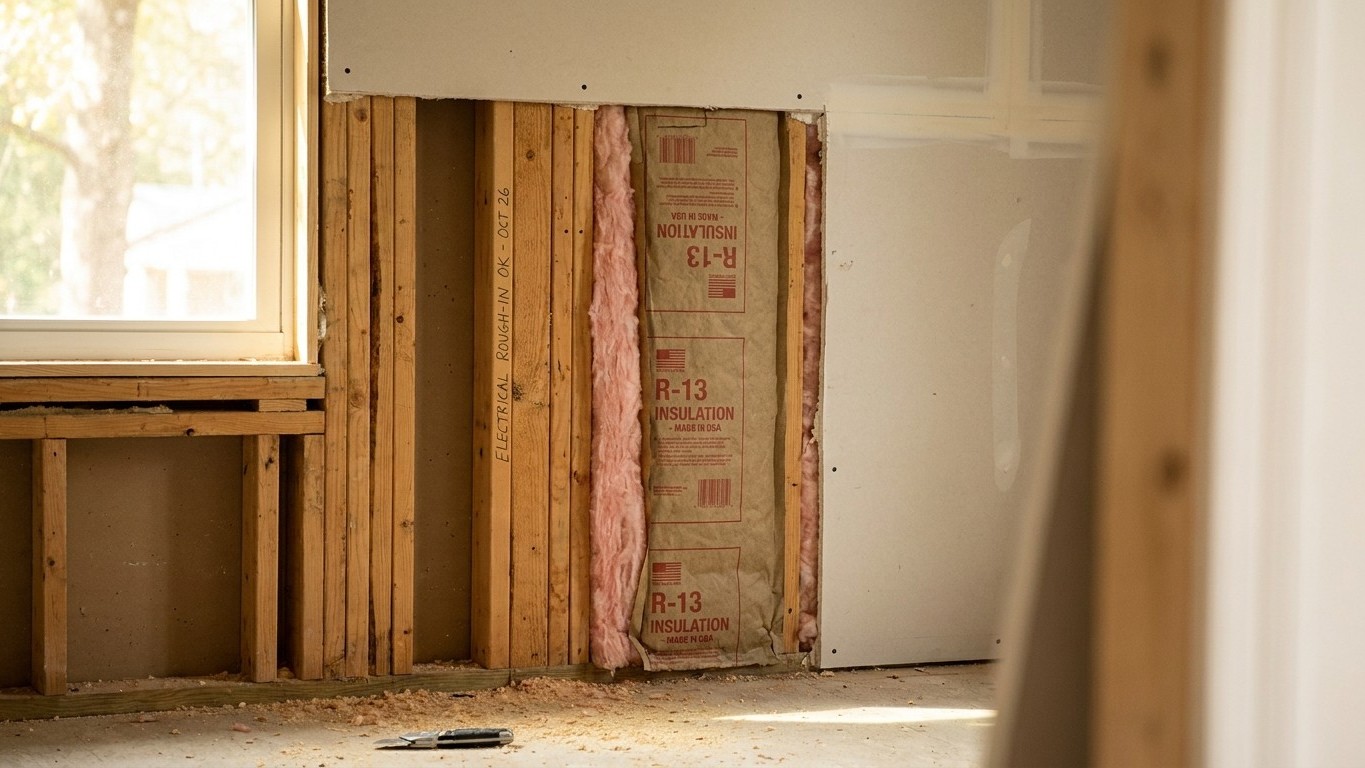

Tennessee doesn’t give one answer. In the state’s 61 counties that sit in IECC Climate Zone 4A, the 2021 International Residential Code calls for an interior vapor retarder on frame walls. In the 34 counties that fall in Zone 3A, that same code drops the requirement entirely. Same state, same code book, two different walls.
What the code asks for in Tennessee

Section R702.7 of the 2021 International Residential Code states that a vapor retarder of the class listed in Table R702.7(2) “shall be provided on the interior side of frame walls.” That’s the baseline rule, and it applies everywhere the code has been adopted, with a short list of exceptions. One of those exceptions matters more in Tennessee than almost anywhere else: “A vapor retarder shall not be required in Climate Zones 1, 2 and 3.”
That single sentence is why Tennessee doesn’t have a uniform answer. The state’s 95 counties split across two IECC zones: 61 counties in Zone 4A, and 34 counties in Zone 3A, according to the climate zone tables in the 2021 IECC. A homeowner in one of the 34 Zone 3A counties is building under the exception, meaning the code does not obligate an interior vapor retarder on their above-grade frame walls. A homeowner two counties over in a Zone 4A county is building under the base rule, and their wall does need one, in the class the table specifies.
Notice the wording. “Not required” is not “forbidden.” The Zone 3A exception removes an obligation, it doesn’t ban a vapor retarder outright. A builder in a 3A county isn’t breaking any rule by adding one, though as the next section explains, adding the wrong class in a warm climate can cause the exact damage the code is trying to prevent elsewhere.
This is also why the page can’t tell you what your own wall needs. The IRC is a model code. States and counties adopt it, sometimes with local amendments, sometimes on a delayed schedule, and the version enforced in your jurisdiction is the one that governs your permit, not whatever edition happens to be cited online. A wall with the wrong vapor control doesn’t announce the mistake with a crack in the drywall. It sits quietly for years while moisture cycles through the cavity, and the rot only shows up once the damage is already structural. That’s the reason this question is worth asking your local building department directly, before framing goes up, not after.
Why the answer is the opposite in a warm climate
The logic behind Section R702.7 isn’t arbitrary. It follows the direction water vapor actually travels, and that direction flips depending on climate.
In a cold climate, the warm, moisture-laden air lives inside the house. In winter, that indoor air pushes outward through the wall assembly toward the cold sheathing. A vapor retarder placed on the interior side intercepts that moisture before it reaches the cold surface where it would condense. That’s the assembly the base rule in R702.7 is built for, and it’s why Zone 4A counties in Tennessee, along with every colder zone further north, keep the requirement.
In a warm, humid climate, the physics run the other way. The moisture-loaded air is outside, driven inward by heat and humidity, especially where air conditioning keeps interior surfaces cool. If a wall in that climate has an impermeable vapor retarder on the interior side, that layer becomes the cold surface the incoming vapor hits. The U.S. Department of Energy’s Building America program describes exactly what happens next: “If the wall contains a vapor retarder on the interior side of the Insulation, the water vapor will condense on this cool, impermeable surface,” a process that leads to “ruined Insulation, mold, and structural rot of framing members.”
That’s not a minor caveat. It’s the reason Zones 1, 2 and 3, which cover the Gulf Coast, Florida, and Tennessee’s 34 Zone 3A counties, are exempted from the base rule rather than just given a lighter version of it. The code isn’t easing up out of convenience. It’s tracking the direction the water is moving, and in those zones, the same material that protects a wall in Minnesota can rot one in Memphis. Different rules for different zones aren’t bureaucratic inconsistency. They’re the same physical principle applied twice, in opposite directions.
The three classes, and why the word matters
Every conversation about vapor barriers gets muddled by loose language. The code doesn’t recognize a generic “vapor barrier.” It defines three classes of vapor retarder, each named by how much moisture passes through it, measured in perms.
| Class | Example materials | Permeance |
|---|---|---|
| Class I | Sheet polyethylene, nonperforated aluminum foil | 0.1 perm or less |
| Class II | Kraft-faced fiberglass batts, vapor retarder paint | Above 0.1 up to 1.0 perm |
| Class III | Latex or enamel paint | Above 1.0 up to 10.0 perm |
Sheet polyethylene is Class I, not “a vapor barrier” in some general sense. That distinction is the whole disagreement between a builder framing a wall in Zone 4A and one framing a wall in Zone 3A. Neither is arguing about whether a vapor retarder should exist. The argument, if there is one, is about which class belongs on which wall, because a Class I sheet in the wrong climate is the assembly the DOE warned about above.
Here’s the part most homeowners miss entirely: ordinary latex paint qualifies as a Class III vapor retarder. If your interior walls are painted with standard latex, you already have a vapor retarder in place, whether you planned for one or not. That’s often enough to satisfy the intent of the code in milder assemblies, without adding a separate sheet product at all.
One more distinction worth keeping straight: a vapor retarder is not an air barrier. Controlling water vapor diffusion and stopping bulk air leakage are two separate jobs. Some products do both at once, but the code treats them as different requirements, and meeting one doesn’t automatically satisfy the other.
Where the rule stops
Section R702.7 lists exceptions beyond the climate-zone carve-out already covered above. The base rule, requiring an interior vapor retarder on frame walls, does not apply in these situations:
- Basement walls
- The below-grade portion of any wall
- Construction where accumulation, condensation, or freezing of moisture will not damage the materials
The basement exception is the one most homeowners actually run into, usually while finishing a basement for extra living space. A poured concrete foundation wall holds groundwater moisture for years after it’s cured, and it continues absorbing and releasing moisture through its life. That assembly needs to be able to dry toward the interior. Sealing the inside face with an impermeable sheet traps that moisture against the concrete and the framing built against it, which is the reverse of what a vapor retarder is supposed to do. That’s a large enough topic on its own, and this site covers it in more detail in the guide to vapor barrier rules for basement walls.
The third exception, construction where moisture won’t damage the materials, covers assemblies without vapor-sensitive components, such as certain masonry or engineered systems designed to tolerate moisture cycling without degrading. It’s a narrower case than the basement exception and rarely comes up in typical residential framing.
Who actually decides, in Tennessee
None of this replaces a conversation with the building department that has jurisdiction over your address. The IRC is the model code, but Tennessee counties and municipalities adopt their own edition, sometimes with amendments, and that adopted version, not the national model, is what your inspector will check against. The office that issues your permit can tell you which edition is in force and how it treats your specific zone.
That local check matters more here than in a state that sits cleanly in one climate zone. Tennessee’s split, 61 counties in 4A and 34 in 3A, means the answer genuinely changes depending on which side of the county line you’re on. There’s no shortcut around checking the zone assigned to your specific county before you decide what the wall assembly needs.
The stakes behind that check aren’t abstract. Nashville International Airport, used as the NOAA reference station for the region, logs roughly 3,364 heating degree days a year, alongside about 1,873 cooling degree days. Those figures measure heating and cooling demand, not raw temperature, and they tell you Tennessee carries a real winter load, not the token cold snap of a Gulf Coast winter, while also carrying enough summer humidity to make the warm-climate mechanism relevant too. That’s precisely why this state can’t be summarized with a single rule. A wall built with the wrong vapor control here won’t fail the day it’s finished. It fails slowly, from the inside, and by the time anyone notices, the fix is a demolition job rather than a paint job.