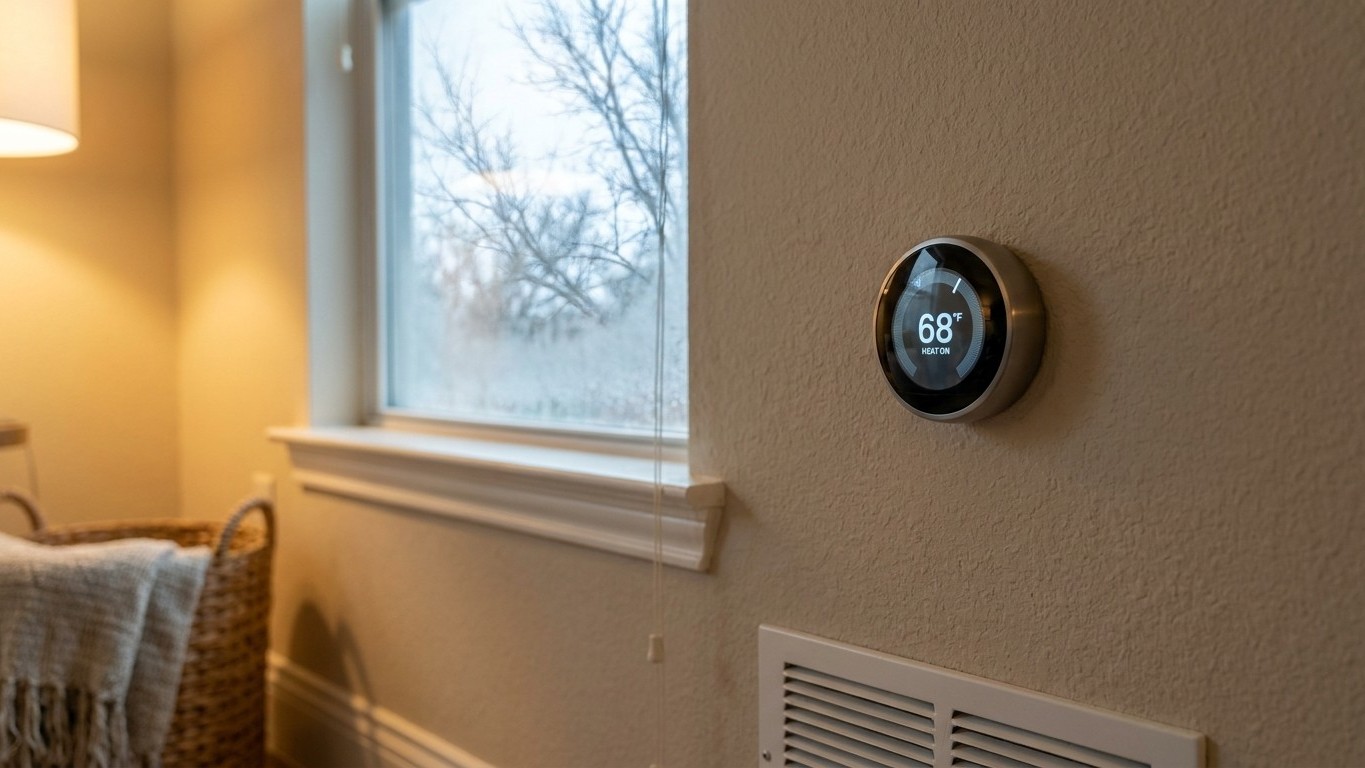

Winter in Texas rarely announces itself the way it does farther north. The coldest month still averages a nighttime low of 43.7°F, which sounds mild until you factor in humidity, older housing stock, and heating systems sized for occasional use rather than sustained cold. Here’s what that actually means for your energy bill and your woodpile.
How cold it gets, and for how long

The mean daily minimum for the coldest month in Houston sits at 43.7°F, according to NOAA’s 1991-2020 Climate Normals. That’s not a record low, and it’s not a random cold snap. It’s the average low you can expect on a typical night during the coldest stretch of the year, which raises the question of When Does the Heating Season Start in Texas? For comparison, that’s roughly the temperature inside a home refrigerator, not exactly brutal, but cold enough that a house needs real heat for a real chunk of the year.
The number matters less on its own than what it tells you about the shape of the season. A place that hovers near freezing for four straight months puts a different kind of load on a heating system than a place that drops far below zero for six weeks. Texas falls into the first category. The cold isn’t severe by national standards, but it’s persistent enough that a furnace or heat pump runs on and off for a long stretch, rather than working hard for a short, intense burst.
What this means for equipment choices
Heat pumps, which struggle in deep cold, actually do well in a climate like this one. They don’t need to fight single-digit temperatures often, so their efficiency advantage over gas furnaces holds up for most of the season. Wood-burning supplemental heat, by contrast, tends to get used more as a comfort feature or backup than as a primary system, since the mild average low doesn’t demand it the way a harsher climate would. Homeowners who do rely on a wood stove or fireplace insert are usually burning it on the coldest nights of an otherwise mild winter, not running it around the clock for months, which is also why so many end up asking When Can You Turn the Heat Off in Texas?
What a cord of wood is worth here
A cord isn’t a weight. It’s a volume, and that distinction is exactly where firewood buyers get shortchanged. A full cord measures 4 feet by 4 feet by 8 feet, which works out to 128 cubic feet of stacked wood, air gaps included. Two loads that look similar in a truck bed can differ by 20 or 30 percent depending on how tightly the wood is stacked and how large the pieces are.
According to Michigan State University Extension, a cord of well-seasoned hardwood delivers about 20 million BTU of heat energy. MSU frames that in terms most homeowners can picture: one cord is roughly equivalent to the heat you’d get from 145 gallons of #2 fuel oil, or 215 gallons of LP gas. That’s a useful yardstick when you’re deciding whether wood heat makes sense as a supplement to your existing system.
| Measurement | Value |
|---|---|
| Cord dimensions | 4 ft x 4 ft x 8 ft |
| Total volume | 128 cubic feet |
| Heat energy (seasoned hardwood) | about 20 million BTU |
| Fuel oil equivalent | about 145 gallons |
| LP gas equivalent | about 215 gallons |
Given the mild, four-month heating season typical here, a single cord can often stretch further into the season than it would in a colder climate, provided the wood is properly seasoned. That last part carries a lot of weight. Wood that hasn’t dried out loses much of that 20 million BTU potential to something other than heating your living room, which brings up the next problem.
How long wood takes to dry in Texas
Seasoning firewood is a climate-dependent process, not a fixed calendar date you can circle in advance. MSU Extension sets the target at 20 percent moisture or less for good burning, while green, freshly cut wood can hold more than 60 percent moisture. Every bit of that water has to boil off before the wood releases usable heat, and boiling water takes energy, specifically the energy you were counting on to warm your house.
Split and stacked properly, so air can move through the pile, wood typically reaches that 20 percent threshold after one full summer of drying. Texas summers, long, hot, and often dry inland, tend to work in a buyer’s favor here compared to cooler, damper climates where seasoning drags on. Coastal humidity around Houston can slow things down somewhat, so wood stored in a humid spot without good airflow may need extra time even under a hot sun.
Red oak is the one species MSU specifically flags as slow to dry, thanks to its cell structure, so if you’re burning red oak, don’t assume it’s ready on the same timeline as ash or maple cut the same week. Splitting into smaller pieces, stacking off the ground, and covering just the top (not the sides) all speed the process along.
Burning before the wood is ready costs you twice. First, you get less heat per log, since energy goes into evaporating water instead of warming the room. Second, unburned moisture and incomplete combustion send more creosote up the flue, which builds up faster on the chimney walls and means more frequent sweeping to avoid a chimney fire. Neither problem is dramatic in the moment, but both show up as a smokier fire, a duller flame, and a chimney sweep bill that arrives sooner than it should.
Where to check before you buy
Every figure above describes Houston, the NOAA reference station for this territory, and Texas is too large a state for one city’s numbers to apply everywhere. Elevation, distance from the Gulf, and local tree cover all shift both the cold and the humidity that governs seasoning time. A property in the Panhandle sees a meaningfully colder winter than one along the coast, and wood that dries in one summer near Houston might need longer in a shadier, damper spot elsewhere in the state.
For species availability and guidance suited to your specific county, Texas A&M AgriLife Extension is the resource to check. Extension offices also track local air-quality burn restrictions, which some Texas counties and municipalities impose during high-pollution days or drought conditions. These rules are set at the local level and can change from one year to the next, so it’s worth a quick call or website check before you plan on a wood stove as your go-to backup heat source this winter.