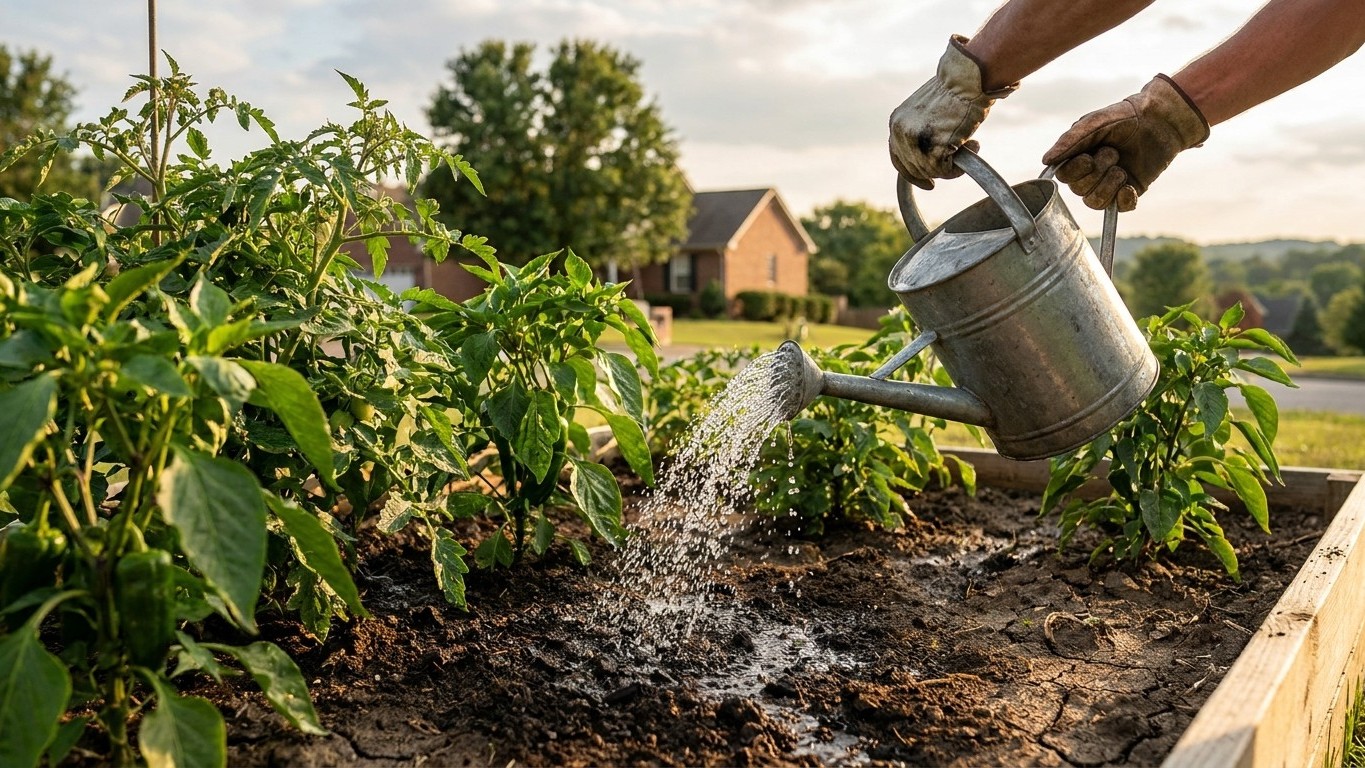

Virginia gardens don’t follow a single script. A patch of ground in Virginia Beach behaves nothing like one in the Blue Ridge foothills, but the baseline rule holds statewide: aim for about an inch of water a week at root depth, watch for the stretch of days above 90F that pulls moisture out of the soil fast, and check with your local water authority before you assume irrigation is unrestricted.
What the climate asks of you

The number that changes everything for a Virginia garden is 26.0 days a year at 90F or hotter, based on the NOAA climate normal reference station in Virginia Beach. That’s not a summer average, it’s the count of days when soil dries out fast enough that a garden bed can go from moist to cracked in an afternoon. It’s also the number that rules out cool-season lawns and thin-leaved plants that wilt the moment the mercury climbs.
Here’s the arithmetic every Virginia gardener eventually does in their head: a vegetable bed or a young shrub wants roughly an inch of water a week. Virginia doesn’t have a true dry season the way the Desert Southwest does, rain shows up through summer as scattered thunderstorms rather than a steady drip. That’s actually the trap. A storm can dump an inch in twenty minutes over one yard and miss the yard three streets over entirely. You can’t count on the sky to deliver that inch on schedule, so the safe assumption is that you’re supplying most or all of it yourself during any run of hot, dry days, topping up the gaps the rest of the time, and knowing how to approach Watering Through a Dry Spell in Virginia before one settles in.
Soil changes the math
Where you garden in the state matters almost as much as when. The Coastal Plain, including the Tidewater and Hampton Roads area, runs sandy and drains fast, so the same inch of rain that would sit for a week in heavier ground disappears in two or three days. Move west into the Piedmont and the soil turns to clay loam that holds water far longer, sometimes long enough to drown roots if you water on top of a soaking rain. In the Blue Ridge and southwest Virginia, thinner mountain soils and cooler nights change the equation again, water less often but check more carefully, since a shallow layer over rock can look moist on the surface and be bone dry three inches down.
How much, how often
Deep and infrequent beats shallow and daily, every time. A quick daily sprinkle wets only the top inch of soil, which trains roots to stay near the surface where they bake the moment a hot spell hits. A deep soak every few days pushes water down six to eight inches, which is where you actually want the root system living when a stretch of 90-degree days shows up. The same deep-and-infrequent logic applies to potted plants, though containers dry out faster than garden beds, so it’s worth reviewing the specifics of Watering Pots and Containers in Virginia before assuming the same schedule works for both.
The simplest gut check costs nothing: push a finger two inches into the soil near the base of the plant, or dig a small hole with a trowel. If it’s dry at that depth, water. If it’s still damp, wait. This beats any fixed schedule, because a week of thunderstorms and a week of clear skies call for completely different amounts, and no calendar can tell you which week you’re in.
Sandy Coastal Plain soil holds so little water that it usually needs shorter, more frequent soakings, maybe every two to three days in the middle of summer, rather than one big weekly dose that just runs straight through. Heavy Piedmont clay is the opposite problem: it holds a week’s worth of water easily, but working it or watering it while it’s already wet compacts it and suffocates roots. Let clay dry until it crumbles rather than sticks to a shovel before you touch it again.
Here’s a watering sequence that works across most of the state, adjusted for your own soil texture:
- Check soil moisture two inches down with a finger or trowel before turning on any hose or sprinkler.
- Water early in the morning, ideally before 10 a.m., so moisture soaks in before the heat of the day pulls it back out through evaporation.
- Apply water at the base of the plant, not overhead, keeping leaves dry to cut down on fungal disease in Virginia’s humid summers.
- Deliver roughly an inch of water per session on sandy soil every two to three days during hot stretches, or a slower, deeper soak once a week on clay soil.
- Skip the next scheduled watering entirely after any storm that clearly soaked the bed, and recheck with the finger test in two days rather than watering on autopilot.
Restrictions and rules
Watering restrictions aren’t rare in Virginia, and they don’t look the same from one county to the next. Some water utilities set voluntary conservation requests during dry stretches, others move to mandatory odd-even day schedules or outright bans on daytime sprinkler use once reservoir levels drop. None of that is fixed or statewide, and rules can change within a single season depending on rainfall and reservoir conditions.
The only way to know what applies to your address is to check directly with your local water utility or municipal water authority before you set a sprinkler timer for the summer. Don’t assume last year’s rules still apply, and don’t assume a neighboring town’s rules match yours, since Virginia water systems are managed locally rather than through one statewide watering code.
Given how much of Virginia’s summer rain arrives as isolated thunderstorms rather than steady, even rainfall, and given the 26 days a year that push past 90F, dry stretches serious enough to trigger restrictions aren’t unusual. That makes it worth a five-minute call or website check at the start of the season rather than a scramble once a ban is already posted. The Virginia Cooperative Extension network, run through ext.vt.edu, can point you toward your local office and any current guidance for your county.
Using less
Cutting water use in a Virginia garden doesn’t mean watching plants suffer, it means putting the water you do use where it actually helps. A few methods carry most of the weight.
- Mulch, two to three inches deep: slows evaporation from the soil surface and keeps sandy Coastal Plain beds from drying out between soakings.
- Drip irrigation or soaker hoses: delivers water straight to the root zone instead of into the air or onto pathways, cutting the waste that overhead sprinklers lose to evaporation on 90-degree afternoons.
- Grouping plants by water need: keeps thirsty vegetables and new transplants on their own zone, separate from established shrubs and drought-tolerant natives that can go longer between waterings.
- Organic matter worked into the soil: compost improves both problems at once, it helps sandy soil hold water longer and helps clay soil drain better instead of staying waterlogged.
- Rain barrels, where local rules allow them: capture roof runoff for later use instead of letting it run into the storm drain.
On the rain barrel math: an inch of rain falling on a thousand square feet of roof adds up to roughly 600 gallons of runoff. In a Virginia summer that means a barrel can fill fast during a good thunderstorm, but with rainfall arriving unevenly and 26 days a year pushing past 90F, that same barrel can also sit empty for a stretch right when the garden needs it most. Treat a rain barrel as a supplement for containers and small beds, not as your only water source during a dry, hot week.
Common questions
What USDA hardiness zone is Virginia in?
Virginia spans USDA zones 5a to 8b, a wide range that runs from the cooler mountains of southwest Virginia to the milder Coastal Plain and Hampton Roads area. That range is too broad for a single planting date, so check the specific zone for your county rather than assuming a statewide answer.
When is the frost-free growing season in Virginia?
At the Oceana reference station near Virginia Beach, the last spring frost typically falls between March 20 and April 3, and the first fall frost arrives between November 10 and November 24. That’s the mild end of the state. The Blue Ridge and southwest Virginia see frost weeks later in spring and weeks earlier in fall, so adjust accordingly if you’re gardening inland or at higher elevation.
Is it better to water in the morning or evening in Virginia?
Morning wins. Watering before 10 a.m. gives moisture time to soak into the root zone before the day’s heat pulls it back out, and it lets any water on the leaves dry before evening, which cuts down on the fungal disease that thrives in Virginia’s humid nights.
How do I know if my area has watering restrictions right now?
Contact your local water utility or municipal water authority directly, since rules vary by county and change with drought conditions. The Virginia Cooperative Extension directory at ext.vt.edu can also connect you to your local office for current guidance.