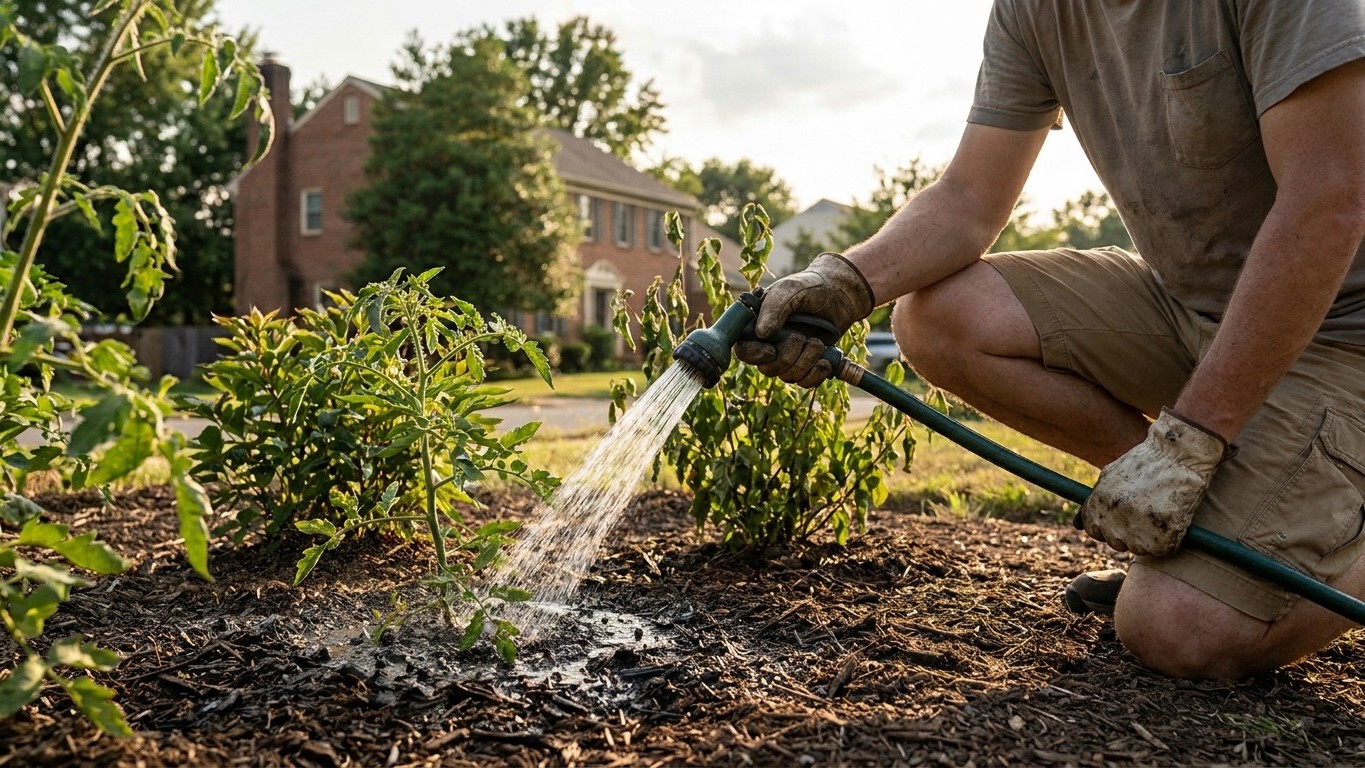

During a Virginia dry spell, the safest habit is deep watering once or twice a week, not a daily sprinkle. Aim for about an inch of water per session, delivered slowly at the base of the plant, and let the gap between rainfall and the hose set the schedule. June is the driest summer month here, and the state also logs 26 days a year at or above 90F, a combination that pushes most gardens past what rain alone can cover.
What changes here

Two numbers set the terms for a Virginia summer garden: 4.15 inches of rain in June, the driest month of the growing season, and 26.0 days a year that reach 90F or higher. Together they say the sky delivers less water exactly when the heat is asking plants to use more of it, a mismatch that widens every week a dry spell continues.
Run the arithmetic and the gap gets concrete. A vegetable bed or a young shrub wants roughly an inch of water a week to keep growing without stress. June holds 30 days, a little over four weeks, so that 4.15 inches works out to about 0.97 inches a week if it fell evenly across the month. On paper that’s nearly the full inch a garden needs. In practice it rarely lands that evenly: Virginia’s summer rain tends to arrive as thunderstorms, dumping half an inch in twenty minutes and running off a compacted bed rather than soaking down to root depth. The gardener ends up carrying more of that weekly inch than the monthly average suggests, especially in a June when the rain bunches into two or three storms instead of spreading out.
July and August don’t make the case easier. NOAA’s normals put July at 5.76 inches and August at 5.09, both higher than June, but by then the 90F days are stacking up too, and a hot afternoon can pull moisture out of the top few inches of soil almost as fast as a storm puts it back. Soil texture decides how far that inch actually reaches. On sandy ground, water drains through the root zone within a day, so beds need shorter, more frequent watering to keep up. On heavy clay, the same inch can sit in the top foot of soil for a week, which sounds like an advantage until it drowns roots that never had the chance to dry out. Since statewide rainfall normals don’t describe any single yard’s soil, the dig-test described below tells a gardener more than the monthly figures ever will.
How to water when it matters
The method that works through Virginia’s summer heat is deep, infrequent watering at the base of the plant, done in the morning. Deep watering pushes moisture down to where roots actually grow, six to ten inches for most vegetables and perennials, training the root system to follow water downward instead of staying shallow. Morning watering matters because it gives leaves and the soil surface several hours to dry before evening; foliage that stays wet overnight, especially in Virginia’s summer humidity, is an open invitation to fungal disease. Watering at the base rather than overhead also means less of that weekly inch is lost to evaporation before it ever reaches a root.
Checking whether the soil actually needs water beats watering on a fixed calendar. Push a finger two inches into the soil near the root zone, or use a trowel for a quick core sample: dry at that depth means water now, still damp means wait. This matters more on Virginia’s clay-heavy ground, common across the Piedmont, where the surface can look bone-dry while the layer below still holds last week’s rain. On sandier coastal soils the opposite risk shows up: the surface looks fine while the root zone below has already dried out, because sand drains fast and holds little.
A starting point, to check against your own soil: during June’s driest stretch, aim for about an inch of water split across two sessions a week rather than one large soak or seven small ones. Adjust from there once the finger test tells you how your particular bed behaves.
- Check soil moisture two inches down before watering, not by looking at the surface.
- Water early in the morning, ideally before 9 a.m., so leaves dry before the day’s heat sets in.
- Apply water at the base of the plant with a soaker hose or drip line, not overhead.
- On sandy soil, water more often with smaller amounts; on clay, water less often but let it soak in slowly to avoid runoff.
- Add two to three inches of mulch around the base to slow evaporation between sessions.
- Re-check with the finger test every few days during a dry spell instead of watering on a fixed schedule.
What goes wrong
A little water every day
A daily five-minute sprinkle feels responsible, but it keeps roots near the surface where the first hot afternoon bakes them dry. Roots grow toward water, and if that water only ever sits in the top inch of soil, that’s where the roots stay, right in the layer that heats up fastest and dries out first once a 90F day arrives. Deep, infrequent watering trains roots to reach down where soil temperature swings less and moisture lasts longer.
Watering the leaves in the evening
Evening watering seems convenient after a long summer day, but foliage that stays damp overnight in Virginia’s humid air is exactly the setup fungal diseases need. Powdery mildew and various leaf spots spread fastest on leaves that stay wet for eight or more hours in the dark. Morning watering gives the sun and a few hours of airflow to dry everything off before nightfall.
Trusting a rain shower that never soaked in
This is probably the costliest habit in a Virginia summer, because the region’s rain often arrives as short, heavy thunderstorms rather than the slow, soaking kind. A storm can drop half an inch in twenty minutes, look like it solved the problem, and still leave the top two inches of soil dry by the next afternoon because most of it ran off a dry, compacted surface instead of soaking in. The finger test settles it: dry two inches down means the shower didn’t count.
Skipping the mulch
Bare soil under a summer sun loses water to evaporation almost as fast as it’s applied, particularly on the days that hit 90F or above, of which Virginia averages 26 a year. A two- to three-inch layer of mulch, straw, shredded bark, even grass clippings, cuts that evaporation noticeably and keeps the soil several degrees cooler at root depth, stretching the interval between waterings.
Local help
For guidance tailored to Virginia soils and crops, Virginia Cooperative Extension, run jointly by Virginia Tech and Virginia State University, publishes region-specific advice at ext.vt.edu. Watering restrictions during a dry spell are set locally and change with reservoir levels, so check with your own water utility or county before setting an irrigation schedule, rather than assuming a statewide rule applies.
Common questions
How much should I water my garden during a Virginia dry spell?
Start with about an inch of water a week, split into two deep sessions rather than daily light watering, then adjust based on how your soil feels two inches down.
What’s the driest month in Virginia, and does that change how I water?
June averages 4.15 inches of rain, the lowest of the summer months, so it’s the point in the season when a garden is most likely to need supplemental watering even before the hottest days of July and August arrive.
Does sandy or clay soil change my watering schedule in Virginia?
Yes. Sandy soil drains fast and needs shorter, more frequent watering, while clay-heavy soil, common across much of the Piedmont, holds water longer but can drown roots if watered again before it’s had time to dry.
Are there watering restrictions during a dry spell in Virginia?
There can be, depending on the county or utility, especially during drought advisories. Rules vary by district and change with reservoir and groundwater levels, so check with your local water provider for current restrictions rather than assuming a statewide standard.