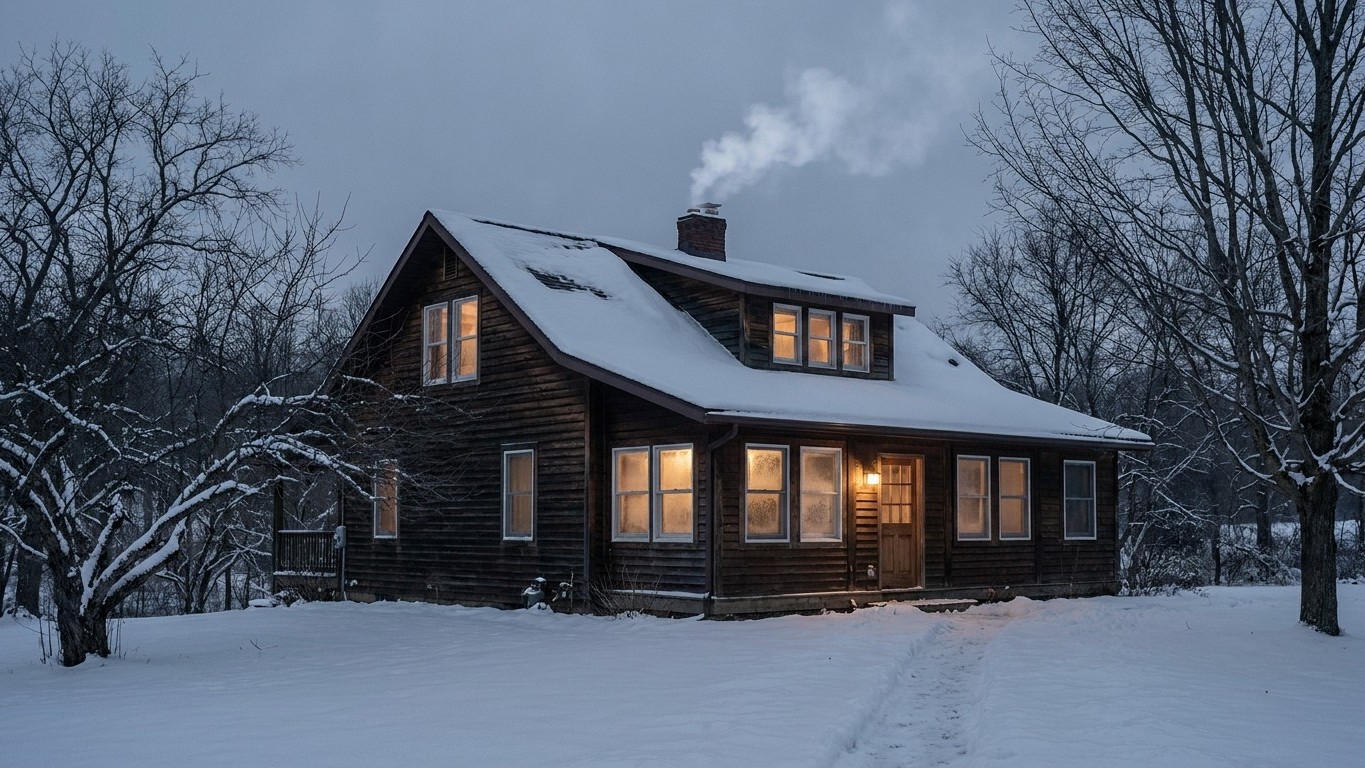

West Virginia winters hover just below freezing most nights from December through February, which means furnaces and wood stoves run in long, steady stretches rather than short bursts. Here’s what that pattern costs a household in fuel, in wood, and in timing.
How cold it gets, and for how long

The mean daily minimum for the coldest month in Charleston sits at 26.1°F, according to NOAA’s 1991-2020 Climate Normals. That’s not the record low some family remembers from a bad ice storm. It’s the average low a thermometer hits on a typical night in the coldest stretch of the year, and it’s the number that actually determines how hard a heating system works.
Twenty-six degrees isn’t brutal by Appalachian or Midwestern standards, but it’s also not a mild dip that a house shrugs off in an afternoon. It’s cold enough that pipes on exterior walls need attention, cold enough that a wood stove needs feeding through the night, and consistent enough that the heating season here stretches long rather than hitting sharp, short spikes. A furnace in Charleston isn’t fighting occasional arctic blasts the way one in Minneapolis might. It’s fighting duration: weeks of nights parked in the mid-20s, one after another.
That distinction matters for how someone sizes their heat source. A house built for occasional deep cold but mild average winters can get away with a smaller margin of error. A house in a region where the mean low sits reliably near freezing for months needs equipment, insulation, and a wood supply that can sustain output, not just handle a cold snap. If a heating system in this part of West Virginia struggles, it’s rarely because of one brutal week. It’s because the system wasn’t built for the long grind of an entire season sitting near that 26-degree floor, night after night, from before Thanksgiving into March — which raises the practical question of When Does the Heating Season Start in West Virginia?
That’s the backdrop for anyone deciding between a furnace, a heat pump, or a wood stove as a primary or supplemental source. Understanding the length of the cold, not just its depth, is the first real planning question.
What a cord of wood is worth here
A cord of well-seasoned hardwood holds about 20 million BTU, according to Michigan State University Extension. That figure is an average, not a guarantee. Species and moisture content move it up or down by a meaningful margin, so two cords sitting side by side in a yard can deliver noticeably different heat if one is oak and the other is something softer, or if one was properly dried and the other wasn’t.
The word “cord” itself is where most firewood buyers get shortchanged. A cord is a volume, not a weight and not a vague pile. It’s a stack measuring 4 feet by 4 feet by 8 feet, which comes out to 128 cubic feet of wood, air gaps included. Anything sold as a “cord” that doesn’t stack out to those dimensions isn’t a full cord, and the buyer is paying for wood that isn’t there.
| Measurement | Value |
|---|---|
| Stack dimensions | 4 ft x 4 ft x 8 ft |
| Total volume | 128 cubic feet |
| Heat content (seasoned hardwood, average) | about 20 million BTU |
MSU frames that 20 million BTU in terms a homeowner can actually use: one cord of seasoned hardwood is roughly equivalent to 145 gallons of #2 fuel oil, or 215 gallons of LP gas. Given a heating season that sits in the mid-20s for months at a stretch, as Charleston’s climate normals show, that comparison is a useful gut check when deciding how many cords to lay in before the cold sets in for good.
None of that heat shows up, though, if the wood is wet. Water inside the cells has to boil off before the wood releases usable energy, and that boiling eats into the very heat a household is trying to capture. A cord bought green and burned green isn’t really delivering 20 million BTU. It’s delivering less, with more smoke and more moisture going up the flue.
How long wood takes to dry in West Virginia
Firewood needs to reach 20 percent moisture or lower before it burns efficiently, per MSU Extension. Green wood, fresh off a tree, can run over 60 percent moisture. Getting from one number to the other isn’t instant, and it isn’t the same everywhere. Humidity, summer heat, and how the wood is stacked all decide the timeline.
Split wood, stacked so air can move freely through the pile, typically reaches that 20 percent threshold after one full summer of drying. That’s the general rule. But it comes with a real condition attached: the wood has to be split and stacked, not left in rounds. A round log dries painfully slowly compared to a split one, because the bark and the tight grain structure trap moisture inside. Two piles of the same species, cut the same month, can be at completely different moisture levels a year later depending on whether someone bothered to split and stack them properly.
Red oak is the one species MSU singles out as an exception. Its cell structure makes it dry more slowly than most other hardwoods, so a full summer often isn’t enough. Anyone burning red oak should plan on a longer seasoning window, not the standard one-summer timeline that works for faster-drying species.
Burning too soon has consequences beyond a weaker fire. Wet wood spends its combustion energy boiling off internal water instead of heating a room, which means a stove has to burn more wood to produce the same warmth. It also produces more creosote, the sticky residue that builds up inside a chimney flue and raises the risk of a chimney fire. A flue that would normally need cleaning once a season can need it twice if the wood going into the stove was never properly dried. None of this requires panic. It just means checking the wood’s age and how it was stored before deciding it’s ready to burn.
Where to check before you buy
Charleston’s climate normals are a solid reference point, but West Virginia’s terrain varies enormously across elevation and exposure. A ridge in the eastern highlands and a river valley near the Ohio border can see meaningfully different winters even within the same state, and the figures above describe conditions at the reference station, not every address in it.
For guidance tailored to a specific county, including which wood species are locally available and how well they season in that particular microclimate, West Virginia University Extension is the resource built for that. It’s also the place to check on outdoor burning restrictions, since those rules are set at the local level and can change from year to year depending on drought conditions, air quality, or municipal ordinance updates. What was allowed last winter isn’t automatically allowed this one, and no statewide figure can substitute for checking the current local rule before stacking a burn pile or firing up an outdoor furnace.
What each heat source costs to run in West Virginia
At West Virginia’s average residential prices, this is what one million Btu of heat delivered into the house costs with each system. It compares fuels on the same unit: it is not a yearly bill, and it leaves out the price of the equipment.
| System | Cost per million Btu delivered |
|---|---|
| Electric resistance (baseboard, 100% efficient) | $45.34 |
| Heat pump at 8.1 HSPF2 (seasonal COP about 2.4) | $19.10 |
| Natural gas furnace at 97% AFUE | $13.72 |
Cheapest to run in West Virginia: natural gas furnace, $5.38 less per million Btu than the heat pump.
Prices: U.S. Energy Information Administration (EIA), average residential prices. Efficiencies: ENERGY STAR criteria. A heat pump’s figure is a seasonal average; in the coldest weather its efficiency drops.