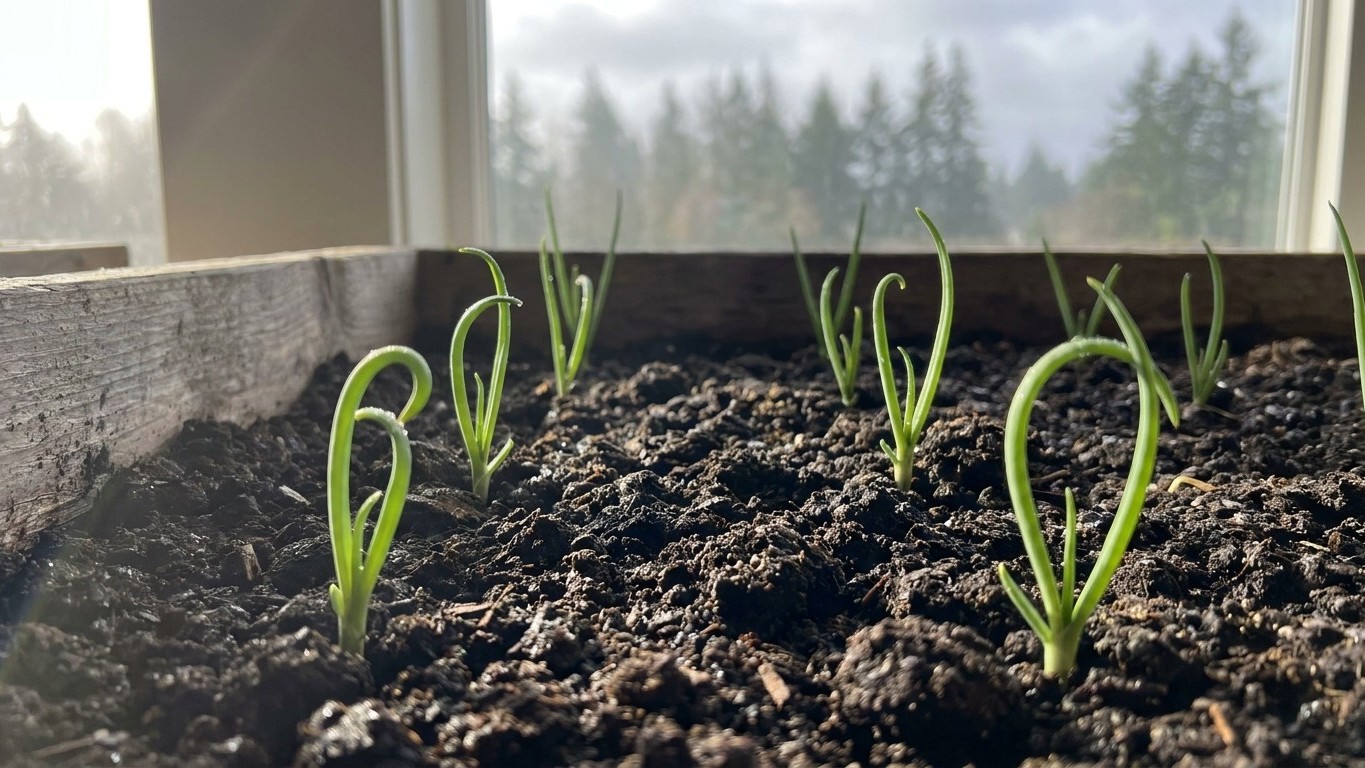

British Columbia sits far enough north that onions don’t run on the calendar most gardeners expect. At Vancouver’s latitude of 49.20°N, the province gets 16 hours and 1 minute of daylight on the summer solstice, which puts it squarely in long-day onion territory. That single fact decides both which varieties will bulb here and when you need to get them in the ground.
The short answer for British Columbia

Plant onions in late winter to early spring, as transplants or sets, and choose long-day varieties. That’s the short version, and it comes straight from the daylight math. Onions don’t bulb because the weather warms up; they bulb when day length crosses a threshold hardwired into the variety. Long-day types wait for 14 to 16 hours of daylight before they switch from making leaves to making a bulb. At 16 hours and 1 minute on the solstice, Vancouver clears that bar with room to spare, which is why long-day onions are the standard recommendation across most of the province.
The reason timing matters so much here is that the solstice trigger arrives on a fixed date no matter when you planted. An onion started in February has all spring and early summer to build leaf mass before that trigger fires in June. An onion started in May has maybe six or eight weeks of leaf growth before the same trigger fires on the same calendar day. Both plants start bulbing at once. Only one of them has anything worth bulbing.
That’s the case for planting as early as your soil and frost dates allow, typically from late February on the mild coast to mid-April in colder interior valleys. Onion seedlings tolerate a light frost far better than most vegetable starts, and sets or transplants give you a head start the seed packet timeline can’t match if your season is already short.
Which varieties fit this latitude
Thirteen long-day and intermediate-day varieties documented on this site have published ranges that cover 49.20°N: Ailsa Craig, Barolo, Blush, Bridger, Frontier, New York Early, Patterson, Red Long of Florence, Redwing, Rossa di Milano, Safrane, Talon, and Walla Walla Sweet. These are the ones bred to still be building leaf mass when a 16-hour day arrives, rather than shutting down early with a fraction of the growth they needed.
What will not work here
Short-day and most intermediate-day onions are the wrong choice for British Columbia, full stop. These varieties are bred to start bulbing at around 12 to 13 hours of daylight, a threshold Vancouver’s days cross well before the solstice, in early spring. The plant senses that trigger and switches modes immediately, whether it has four leaves or fourteen. Plant a short-day onion here and you don’t get a delayed harvest, you get a harvest of walnut-sized bulbs, because the plant simply ran out of growing time before it was told to stop.
Fourteen varieties documented on this site fall below the latitude threshold for British Columbia and should not be planted here:
- Cabernet (intermediate-day, 35-45N), bulbs before reaching useful size at this latitude
- Calibra (intermediate-day, 35-45N), same early-trigger problem
- Candy (intermediate-day, 33-40N), bred for a much shorter summer day
- Elsye (intermediate-day, 32-45N), bulbs too early at this daylight length
- Expression (intermediate-day, 32-45N), same issue
- Gabriella (short-day, 20-35N, no page of its own on this site), a subtropical short-day type, wrong hemisphere of daylight entirely
- Madalyn (short-day, 20-35N, no page of its own on this site), same mismatch
- Monastrell (intermediate-day, 35-46N), falls short of the 49.20N threshold
- Powell (long-day, 43-47N), a long-day variety, but its published range still tops out below BC’s latitude
- Red Carpet (long-day, 40-45N), same shortfall
- Red Rock (short-day, 30-36N, no page of its own on this site), far too southern a trigger point
- Scout (intermediate-day, 32-46N), bulbs too early here
- Sierra Blanca (intermediate-day, 32-45N), same problem
- White Castle (short-day, 30-38N, no page of its own on this site), wrong day-length group entirely
One variety sits in a genuinely gray zone: Red Long of Tropea (intermediate-day, 35-48N) has a published range that ends just 1.2 degrees short of 49.20°N. That’s close enough to call it a coin flip rather than a firm no. It may bulb reasonably well in a warm coastal garden and disappoint in a cooler interior one. Treat published ranges as a gradient, not a hard line, and treat this one as an edge case worth a small trial planting rather than a full row.
What changes across British Columbia
British Columbia is not one climate wearing a single latitude. The province runs roughly from the U.S. border near 49°N up past 60°N at the Yukon boundary, which is over a thousand miles of north-south spread. Vancouver, the reference city behind the 49.20°N and 16h01 figures used above, sits at the very southern edge of that range, on the mild coast. A gardener in Prince George, Fort St. John, or anywhere in the Peace region is planting several degrees farther north, under noticeably longer summer days and a much shorter frost-free window.
| Location | Approximate latitude | Summer day length | What it changes |
|---|---|---|---|
| Vancouver (reference city) | 49.20°N | 16h01 on the solstice | Long-day varieties from this article’s list bulb on schedule; the dates given here apply directly |
| Southern Interior / Okanagan | ~49-50°N | Close to the reference figure | Similar bulbing schedule, but drier, faster-warming soil often allows slightly earlier direct sowing of sets |
| Northern BC (Peace region, Prince George area) | ~54-58°N | Well above the reference figure, into the long summer evenings the north is known for | Long-day onions still work, but the frost-free season is much shorter, so start transplants indoors earlier to bank leaf growth before the same solstice trigger fires |
The coast also moderates winter cold in a way the Interior and North simply don’t, which shows up less in bulbing and more in how early you can safely get plants outside. A late-February start that’s routine near Victoria can mean transplanting into snowmelt mud two months later in the northern Interior. The day-length trigger stays fixed; your window to prepare for it doesn’t.
Checking this against your own garden
Every figure in this article traces back to Vancouver. If you garden anywhere else in British Columbia, the numbers are a starting point, not a verdict on your particular yard. A few things worth confirming before you commit a row to onions:
- Look up your own latitude, especially if you’re gardening in the Interior, the North, or Vancouver Island’s outer coast, where conditions differ from the reference city
- Check your local average last-spring-frost and first-fall-frost dates, since these set the real planting window your onions have to work within
- Note your soil type and drainage, since heavy or slow-to-warm soil can push a safe transplant date back by a week or two even where the calendar says go
- Contact your regional agricultural extension office or a local Master Gardener program for planting-date guidance calibrated to your specific area rather than the province as a whole
- If you’re near the edge of BC’s range, in the far north or a sheltered coastal microclimate, treat the varieties and dates here as a baseline to adjust, not a fixed rule
Onion bulbing runs on daylight, and daylight runs on latitude with mathematical precision. That’s the one part of this equation you can check with total confidence, wherever in British Columbia your garden happens to sit.