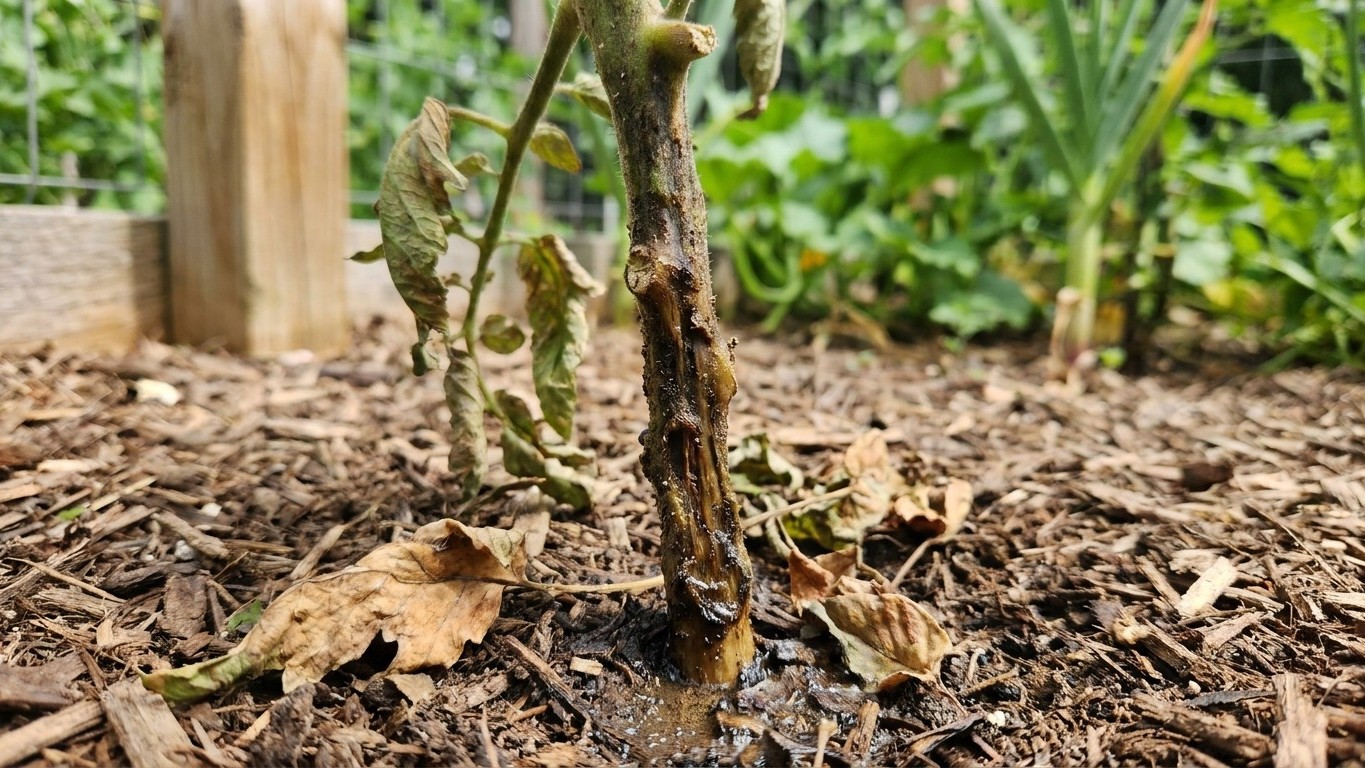

Collar rot is a rot of the bark right at the graft union, where the fruiting variety meets the rootstock near the soil line, caused by a soil-borne water mold in the Phytophthora group. It shows up as a sunken, dark, wet-looking canker girdling the trunk, not as a spot on a leaf or a blemish on the fruit. Pull the mulch and soil back from the base of the trunk this week and look at the graft union itself, especially if the tree is on a dwarfing rootstock like M.9 or M.26, where that union sits low and close to grade.
What you are looking at

The first sign usually isn’t on the trunk at all. A tree with collar rot underway often looks tired from a distance: leaves smaller than they should be, a pale or yellow-green cast to the canopy, new shoots that stop extending by early summer. Fruit set is thin, and the apples that do hang stay undersized. None of that tells you where the problem actually is, so the next step is to walk to the base of the trunk and clear away the mulch or grass.
At the base of the trunk
At the soil line, or a couple of inches above or below it, you’ll find a patch of bark that looks water-soaked and darker than the healthy bark around it, brown to almost black, sometimes with a faint reddish tinge underneath when you scrape it with a thumbnail. Press on it and it can feel soft or slightly sunken rather than firm. In wet years the margin between diseased and healthy bark can ooze a thin, dark fluid. As the canker ages, the bark cracks and can slough off, exposing dead wood underneath.
The location matters more than the color: collar rot sits at the graft union or just below it, the narrow swollen band where the fruiting variety was budded onto the rootstock. On a dwarfing rootstock like M.9, which USU Extension lists as topping out at 8 to 12 feet, that union sits low and is often buried under mulch or backfill without anyone noticing. On a full-size seedling rootstock, which USU puts at 35 to 40 feet at maturity, the same union sits higher and drier, and the disease is less often a problem for that reason alone.
If the canker has worked its way most of the way around the trunk, the girdling is the detail that predicts the outcome: bark loss over half the circumference cuts off enough water and sugar flow that the top of the tree will decline no matter what’s done to the wound itself.
What it is not
A soft, dark patch at the base of an apple trunk gets blamed on collar rot a lot, and it often isn’t. The single detail that sorts the real thing from its look-alikes is exactly where the damage sits and what the wound looks like once you scrape it back.
Telling them apart
- Fire blight cankers form higher up, on limbs and at branch unions, not at the soil line, and come with the giveaway shepherd’s-crook wilt of new shoot tips earlier in the season. See Apple Diseases for how fire blight moves through the canopy.
- Woolly apple aphid colonies build cottony white masses on wounds and at the crown, and under that fuzz the bark is usually knotted and galled rather than sunken and wet-looking.
- Mower and string-trimmer wounds have a clean or ragged mechanical edge and no soft, spreading margin, and they don’t keep advancing week to week the way a Phytophthora canker does.
- Sunscald and winter injury shows up on the south or west side of the trunk, higher off the ground, as a flattened, dried patch of dead bark, not a wet ring right at grade.
- Surface blemishes like sooty blotch and flyspeck stay on the fruit skin and never touch the trunk, so wiping the fruit tells you the crop itself is sound.
Cutting into the bark settles most of these arguments in under a minute. Collar rot tissue is wet and often a dull reddish-brown just under the surface, and the margin between dead and live wood is soft rather than calloused. A mechanical wound or old sunscald injury has usually already dried and sealed at the edge, because the tree walled it off instead of the rot continuing to spread.
The conditions that bring it on
Collar rot is caused by species of Phytophthora, water molds that need free water in the soil to move and infect. A wet spring with saturated ground for days at a stretch, or a low spot in the yard that holds water after every heavy rain, is the single biggest thing that turns a healthy tree into a candidate for this disease. The organism doesn’t need much warmth. It needs water sitting against the bark at the base of the trunk.
What sets up the infection
A few conditions come up again and again in trees that get hit:
- A planting hole that never drained well, in heavy clay or a spot where water visibly pools
- Mulch piled against the trunk in a volcano, keeping the bark constantly damp
- A graft union planted too deep, sitting below grade instead of a couple of inches above it
- Irrigation that wets the trunk directly instead of the root zone further out
- A wound from a mower, a stake tie, or winter injury that gives the water mold an entry point
Any one of these raises the odds. Stacked together, in a wet year, they’re close to a guarantee. A graft union sitting below the soil surface is worth checking specifically, because on a young tree it’s easy for backfill or years of mulch top-dressing to gradually bury a union that started out well above grade.
Established trees under drought stress the season before are also more vulnerable the following wet spring, because a tree that went into winter with a weakened root system has less reserve to wall off an infection once one starts. This is part of why the disease tends to show up in waves tied to two or three years of weather rather than steadily on the same trees every season.
What to do now
Once you’ve found a canker, the first move is simple: pull the soil and mulch back from the base of the trunk and let the crown dry out in open air. Phytophthora needs moisture to keep spreading, and exposing the wound to air and sun slows it down before you do anything else.
If the tree is young and the canker is small, some growers cut away the dead and discolored bark down to healthy, firm wood with a clean knife, leaving the wound open to the air rather than sealing it with tar or paint. A sealed wound holds moisture against the tissue underneath, which works against you. Whether that excision is worth attempting depends on how far the canker has already spread.
When removal is the honest answer
Measure the canker’s spread around the trunk before deciding. A wound covering less than about a third of the circumference gives a tree a real shot at walling off the infection and recovering canopy over a season or two. A canker that has gone more than half the way around the trunk has usually already cut off enough water and nutrient flow that the top will keep declining regardless of what’s done to the wound, and replacement is the more honest plan than nursing it along.
Improve drainage around the root zone this season if standing water is part of the problem: regrade a low spot, pull mulch away from the trunk for good, and hold off on any irrigation that wets the bark directly. Skip nitrogen fertilizer on a tree that’s actively fighting a crown infection, since it pushes soft new growth the tree can’t currently support.
Do not reach for a fungicide drench on your own judgment here. Product registration and label rates for Phytophthora control on apple trees differ from state to state, so call your local extension service before you spray anything, and bring a photo of the canker with you.
Preventing it next season
Most collar rot prevention comes down to keeping water and soil off the bark at the base of the trunk, starting at planting and continuing every year after. Set the graft union two to three inches above the finished soil grade when you plant, not at grade and never below it, and check that height again each spring, since soil settles and mulch builds up over time.
Site and aftercare
Keep mulch pulled back a few inches from the trunk in a doughnut rather than piled against the bark, and choose a planting site that drains within a few hours after a heavy rain rather than one that holds water. If the only available spot is low or heavy clay, planting on a raised mound or berm gets the graft union and lower trunk out of standing water without changing anything else about the site.
Guard the trunk from mower and trimmer damage with a plastic or wire tree guard, since any wound at the base gives Phytophthora an easier way in than intact bark. Ask your local extension service which rootstocks are recommended for wet or heavy soils in your area, since susceptibility to crown and collar rot varies by rootstock and that call is local to your growing conditions, not something to guess at from a catalog.
If a tree is lost to collar rot and you’re replanting, take the chance to plan the orchard’s pollination too. Clemson Cooperative Extension’s HGIC 1350 groups apple varieties by bloom timing, from group A (Anna, Dorsett Golden) through group B (Fuji, Gala, Ginger Gold, Granny Smith, Jerseymac, Mollie’s Delicious, Mutsu, Red Delicious, Yates) to group C (Arkansas Black, Golden Delicious, Jonagold, Ozark Gold, Priscilla, Rome Beauty, Stayman), and a replacement tree needs a partner blooming in the same or an overlapping group to set fruit. A few of those varieties, including Jonagold, Mutsu, Stayman and Winesap, also carry sterile pollen, so per HGIC and UGA Circular 740 they can be pollinated by another variety but can’t pollinate one back, which matters if the tree you lost was doing double duty as the pollinizer for something else nearby.
Common questions
Is collar rot the same thing as crown rot?
No. Collar rot sits above ground, at the graft union and lower trunk. Crown rot, caused by related Phytophthora species, attacks the roots and the base of the trunk below the soil surface, so you often can’t see it until you dig. The two can occur together on the same tree in a wet, poorly drained site.
Can collar rot spread to other trees in the yard?
It can move through soil water and splashing rain, and on pruning tools or shovels that carry infected soil or bark tissue between trees. It isn’t airborne the way some fungal diseases are, so a tree several yards away in well-drained ground is at much lower risk than one sitting in the same low, wet corner of the yard.
Can I replant an apple tree in the same spot after losing one to collar rot?
You can, but fix the drainage problem first or the new tree will likely fail the same way. Phytophthora persists in wet soil for a long time, so if the site itself holds water, a raised planting mound and a graft union set well above grade matter more the second time around.
Does collar rot affect the fruit, or just the tree?
It affects the fruit only indirectly, through the decline of the whole tree. There’s no rot on the apples themselves from this disease. Undersized fruit and poor set are symptoms of the trunk damage cutting off water and nutrients, not a separate infection on the crop.
Related guides
- Sooty Blotch and Flyspeck: Ugly Skin, Sound Apple
- Apple Scab: The Olive Blotches That Come With Wet Springs
- Fire Blight: Shoots That Look Scorched in Midsummer