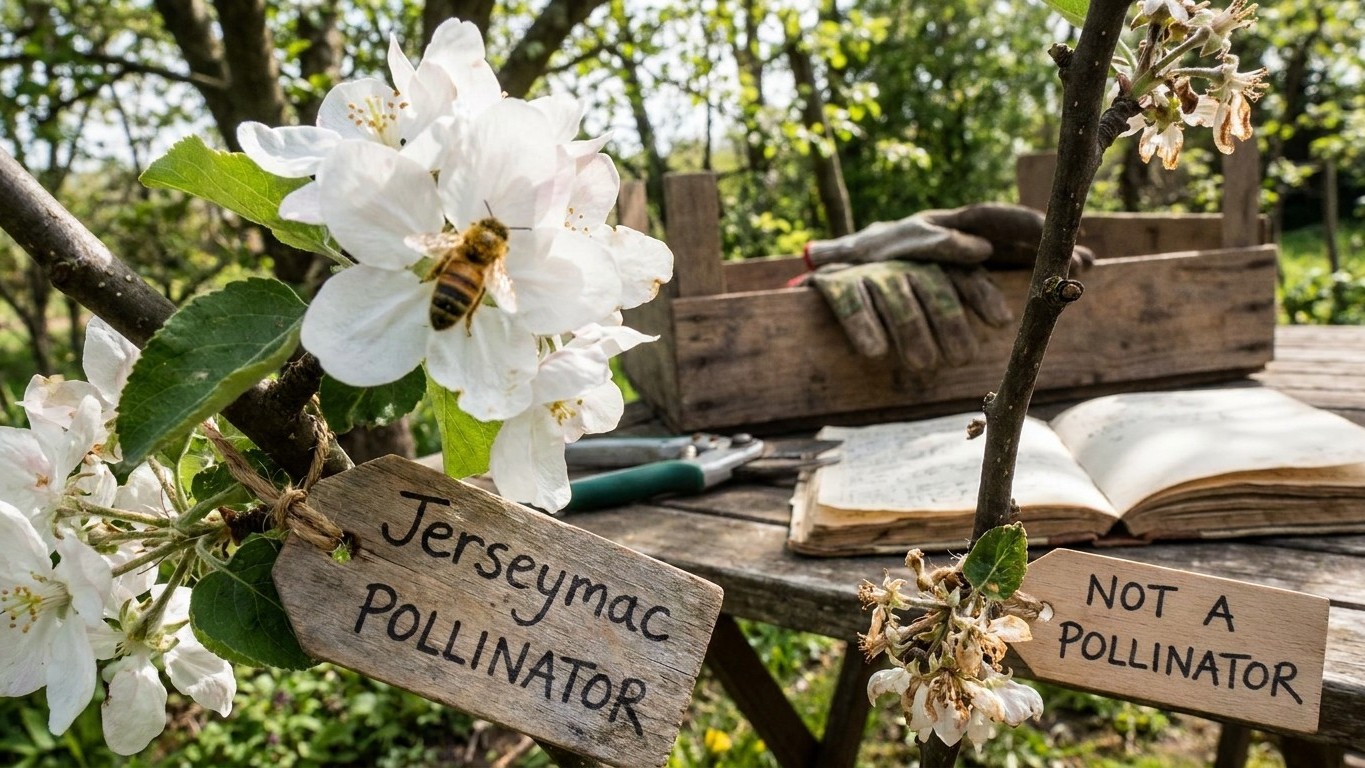

Jerseymac needs a second apple variety flowering at the same time to set a full crop. Clemson Cooperative Extension (HGIC 1350) and the University of Georgia (C740) place Jerseymac in bloom group B, and Fuji, Gala, Ginger Gold, Granny Smith, Mollie’s Delicious, Red Delicious, and Yates all fall into that same window. Plant one of those seven within the same yard or the next one over, and skip Mutsu, whose pollen looks right on paper but does no work in the flower.
The short answer
Jerseymac crops far better next to Fuji, Gala, Ginger Gold, Granny Smith, Mollie’s Delicious, Red Delicious, or Yates. Every one of those seven flowers at the same time as Jerseymac and carries pollen that actually fertilizes it. You do not need all seven in the yard. One is enough, as long as a bee can move between the two trees while they are both in bloom.
Two trees cover the job here, because every variety on that list produces fertile pollen: Jerseymac and its partner fertilize each other in both directions. That is not guaranteed for every apple pairing you might read about. Some varieties shed pollen that a bee happily carries but that never fertilizes anything once it lands, and in that case the grower needs a third tree in the mix, one that can pollinate the sterile variety even though the sterile variety cannot return the job. Jerseymac’s own partners do not have that flaw, so the math stays simple: pick one from the list, plant a second tree, and you have a working pair.
What you plant as that second tree matters less than when it blooms. A three-year-old Gala on dwarfing rootstock does the same pollinating job as a mature Red Delicious on standard rootstock, because rootstock sets the tree’s eventual size and vigor, not what its pollen does. If you are starting from scratch and want the general rules on how far apart trees can sit and how many varieties a small yard actually needs, Apple Pollination lays out the basics before you get into variety-specific pairings like this one.
Why these varieties and not others

Bloom group is the whole mechanism here. Clemson Cooperative Extension assigns Jerseymac to group B, a ranking of flowering order relative to other apple varieties, not a calendar date. In a warm spring in one county the group B trees might open in early April, and in a cooler spring thirty miles away they might open two weeks later. What stays fixed is the order: whatever else is flowering alongside group B apples in your own yard this year will flower alongside them again next year, because the ranking is relative, not absolute. That is why the group letter travels well between climates even though the date attached to it does not.
What the bloom group does not tell you
Sharing a bloom group only confirms timing. It says nothing about whether the pollen that arrives on a bee’s legs will actually fertilize the flower it lands on. Two apple varieties can open on the same afternoon and still fail to pollinate each other, either because one of them carries sterile pollen or because the two are too closely related. A seedling apple cannot be fertilized by the parent tree it came from, even if both are blooming in group B on the same day. None of that shows up in a bloom-group chart. It has to be confirmed variety by variety, which is exactly why Jerseymac’s list of seven compatible partners is worth more than the bloom group number on its own.
This is also why a nursery tag that says “self-pollinating” or “universal donor” should be read carefully. Nearly all apple varieties crop better with a compatible partner nearby, group B or otherwise, and the seven names above are the ones documented to do that job for Jerseymac specifically.
What cannot pollinate it
Mutsu is the trap here. It flowers in the same window as Jerseymac, so at a glance it looks like a fine partner, but Mutsu’s pollen is sterile. It cannot fertilize Jerseymac’s flowers, and Jerseymac’s pollen cannot make Mutsu produce a crop either, since sterile pollen only fails in one direction while the rest of the compatibility problem still applies. A grower who plants nothing but a Jerseymac and a Mutsu, expecting the matching bloom time to be enough, gets flowers on both trees and fruit on neither. Mutsu needs its own separate, fertile partner if you want a crop from it at all, and that partner is a different question from the one this page answers.
Beyond Mutsu, no parentage conflict for Jerseymac shows up in the sources behind this page. That does not mean every apple variety on earth will pollinate it. It means compatibility outside the seven named varieties above is not published, so treat an untested pairing as unproven rather than assuming it will work because the trees happen to bloom together. If your yard already has an Anna or an Idared and you are trying to work out whether either one helps here, check What Pollinates Anna, and What Cannot or What Pollinates Idared, and What Cannot, since a variety’s compatible list is specific to that variety and does not transfer automatically to Jerseymac.
The safest move for a mixed orchard is still the documented list. Fuji, Gala, Ginger Gold, Granny Smith, Mollie’s Delicious, Red Delicious, and Yates are confirmed. Everything else, Mutsu included, is either confirmed unsuitable or simply unconfirmed.
How close the second tree has to be

Pollen moves on bees, not on wind, so distance is a practical question about bee traffic, not a fixed number of feet. The closer the two trees stand, the more reliably a bee moves between them in the few days both are in bloom. Same yard beats same street, and same street beats a partner tree a mile away that the local bee population never bothers to visit twice in one afternoon.
What else can do the job
The second tree does not have to be one you planted. A few things count:
- A neighbor’s apple tree, if it is one of the seven compatible varieties and close enough for bees to cross the property line
- An ornamental crabapple flowering at the same time, since crabapples produce pollen that works on many apple varieties
- A single grafted branch of a compatible variety added onto an existing tree, which puts a second bloom source in the same canopy
What stops all of it is weather, not distance. Cold, wet, or windy conditions during the bloom window keep bees from flying at all, and no amount of careful variety matching fixes a season where the pollinators simply stayed home. A well-chosen partner tree sitting fifteen feet away is still useless on a week of rain, because the bees are the part of the system nobody can plant around.
If there is no room for a second tree
A small lot does not have to mean no crop, but each workaround trades convenience for something else. A multi-grafted tree, with two or three varieties grafted onto one trunk, puts a compatible partner in the same footprint as the Jerseymac itself. It takes years for a young graft to produce enough flowers to matter, and grafts need occasional pruning to keep any one variety from taking over the tree.
Grafting a single pollinator branch onto an existing mature tree is quicker to get flowering, since it is riding on an established root system, but it demands basic grafting skill and a bit of luck with the union taking in the first year.
A columnar apple variety solves the space problem outright, since it takes up only a couple of feet of width, but it still has to be one of the seven compatible varieties and it still has to bloom on schedule with the Jerseymac, so check the catalogue tag for both facts before buying.
An ornamental crabapple planted nearby solves the space problem differently: it is not a fruit crop for the table, it exists purely to bloom and carry pollen. It does not replace a second eating apple in the yard, but it does the pollination job while taking up ornamental garden space rather than orchard space, which is often the easier trade for a small lot.
Common questions
Can I use a crabapple instead of one of the seven named varieties?
Yes, as long as it flowers at the same time as Jerseymac. Crabapple pollen works on many apple varieties, but you still need to check bloom timing against your own trees rather than assume every crabapple lines up with group B.
Will Jerseymac produce any fruit at all with no partner tree?
Some seasons it may set a light crop from stray pollen carried in from a neighbor’s yard, but nearly all apple varieties crop far better with a confirmed compatible partner nearby, and Jerseymac is no exception.
Does Mutsu do anything useful if I already have one?
It can still be a fine apple tree in its own right, but it needs its own separate fertile partner, not Jerseymac, and Jerseymac needs one of the seven varieties listed above, not Mutsu.
How many years until a new partner tree actually pollinates my Jerseymac?
It depends on the age and rootstock of the tree you plant, since both affect how quickly it produces enough open flowers to matter, but a young whip generally needs a few seasons before it is blooming heavily enough to make a real difference.
Does the bloom group number tell me the actual date my trees will flower?
No. Clemson Cooperative Extension’s bloom groups rank flowering order relative to other varieties, and that order holds from region to region, but the calendar date attached to any group shifts with the local climate and the particular spring.