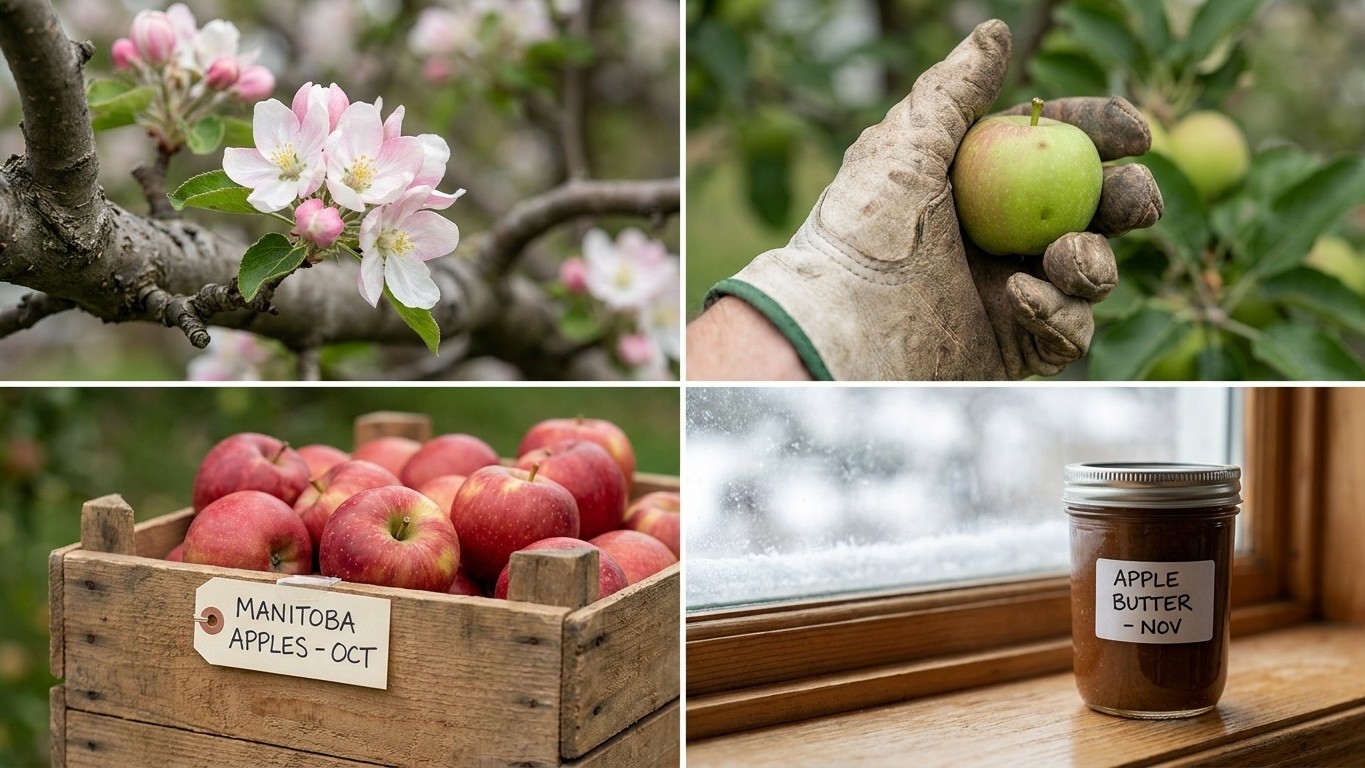

Manitoba’s apple calendar runs on Environment and Climate Change Canada’s 1981-2010 normals for Winnipeg Richardson International Airport: a mean last spring frost of May 23 and a mean first fall frost of September 22, a working season of roughly four months. That window is the frame every stage below has to fit inside, from dormancy to harvest. Check your tree’s actual stage against these dates rather than the month on the wall, and hold off pruning or feeding once you’re within two weeks of either frost line.
The short answer for Manitoba
For Winnipeg and the Red River Valley, the apple season sits between ECCC’s mean last spring frost of May 23 and mean first fall frost of September 22, both from the 1981-2010 normals at Winnipeg Richardson International Airport. That’s the frame the whole calendar has to work inside: dormancy, green tip, pink, bloom, petal fall, fruit set, and harvest, each one triggered by accumulated heat and daylight rather than a date on a calendar. This page assumes the groundwork covered in Growing Apples in Manitoba is already done: a hardy cultivar chosen, planted, and established.
The right answer depends on two separate questions, and a lot of growers only check one of them. The first is whether the tree survives winter at all. Winnipeg’s coldest month runs to a mean daily minimum of -21.4 °C (ECCC, 1981-2010), a threshold that rules out a standard apple bred for a milder region and most rootstocks sold without a hardiness rating for the prairies. The second question is whether the tree flowers and sets fruit reliably once it survives, which comes down to bloom timing relative to that frost date, not just survival.
Cultivars bred for the prairies, such as ‘Battleford’, ‘Goodland’, and ‘Prairie Sensation’, answer both questions at once: hardy enough for the coldest-month minimum, and late enough in bloom that the mean May 23 frost date has usually already passed before the flowers open. A grower who plants an early-blooming apple bred for a warmer province trades that safety margin away, and the trade shows up as blossom or young-fruit damage in roughly half of all years on record, since a mean date is a midpoint, not a guarantee.
The full case for which cultivar suits this climate, and why some apples marketed as “hardy” still struggle north of the Red River Valley, is covered on The Best Apple Varieties for Manitoba. What follows here is the calendar those varieties have to move through once they’re in the ground.
Working through it

Every stage below is read against ECCC’s Winnipeg Richardson International Airport normals: a mean last spring frost of May 23 and a mean first fall frost of September 22, both from the 1981-2010 period, and both mean dates rather than safe cutoffs. What decides whether a given frost matters is the stage the tree is in that week, not the date on the wall.
Dormancy

The tree sits leafless from mid-winter through early spring, buds closed tight and greyish-brown, no green showing anywhere. Cold this deep does no harm as long as the cultivar is rated for Manitoba’s coldest-month mean minimum of -21.4 °C. Pruning is done now, while the tree is fully dormant, so the wound doesn’t push new growth that a later frost could kill.
Green tip

Bud scales split and a sliver of green shows at the tip, usually while nights are still well below freezing. A frost at this stage rarely does damage, since the exposed tissue is minimal. It’s also the point where fertilizer decisions matter: feeding now pushes soft growth that has weeks left to run before the mean May 23 frost date has any chance of clearing.
Pink

Individual flower buds swell and separate, showing pale pink through the bud scales before they open. This stage is far more frost-tender than green tip, and because it typically lands in the weeks bracketing the mean frost date, forcing bloom early with heavy nitrogen is a gamble against a date that arrives later than average one year in two.
Bloom

Open white to pale pink blossoms cluster along the spurs, and this is the stage where a late frost does the most damage. An open flower can be killed outright by a few degrees of frost that a closed bud would shrug off. Cultivars bred for Manitoba bloom late enough that this stage generally falls after May 23 rather than before it, which is the whole reason cultivar choice outweighs planting date in this climate.
Petal fall

Petals brown and drop, and the small ovary at the base of the flower begins to swell. Frost risk drops off sharply once petal fall is complete, since the fruit is no longer sitting exposed on an open flower.
Fruit set

Small green fruit, no bigger than a marble, forms where each successful blossom was. This is when thinning is done if it’s needed, and it’s the first point a grower can count the season’s crop with any confidence, since frost damage from weeks earlier often doesn’t show as lost fruit until now.
Harvest
Fruit reaches full size and its cultivar’s mature color, whether that’s the deep red of ‘Battleford’ or the yellow-green of ‘Goodland’, usually well before the mean first fall frost of September 22 clears the season. Picking is decided by the fruit’s own firmness and background color, not the calendar, since a tree can hold ripe fruit safely for a week or two past the mean frost date if the fruit itself isn’t showing the drop in firmness that signals it’s ready.
What changes across Manitoba
Every figure above comes from the ECCC station at Winnipeg Richardson International Airport, sitting in the Red River Valley, and it describes that valley, not the province. Cold air pools in low, flat ground on clear nights anywhere in Manitoba, so an orchard block on a slight rise will often clear a frost that flattens the same cultivar fifty yards downhill.
The Pembina Valley and the Manitoba Escarpment, along the province’s southern edge, sit at meaningfully higher elevation than the Red River Valley floor, and growers there routinely see every bloom stage lag Winnipeg’s by a week or more in a cool spring. Lake Winnipeg works the opposite way close to its own shoreline: a large body of water gives up stored heat slowly through fall, which can push the first fall frost later right along the lake edge while inland sites a short drive away are already frozen.
North of the Red River Valley, in the Interlake and further into the Parkland and Swan River Valley districts, winters run colder and springs start later. No ECCC normal in this dataset covers those stations directly, so a grower there should assume every stage on this calendar runs behind Winnipeg’s, not ahead of it, and should lean on the hardiest cultivars available rather than assume the Winnipeg dates apply.
None of this changes the order of the stages, only their timing. A tree in the Pembina Valley still moves from green tip to pink to bloom in the same sequence as one in Winnipeg. It just needs its own local frost estimate, which the provincial extension service, covered below, is the right place to check.
The mistakes this climate punishes
Planting an early-blooming cultivar bred for a milder climate is the costliest mistake made in this province. It shows up as blossom or young-fruit damage in the years the frost lands after ECCC’s mean of May 23, which the same 1981-2010 record puts at roughly half of all years. A cultivar that blooms even a week early in Manitoba doesn’t get a week’s head start on the season. It gets a week of extra exposure to a frost date that is a midpoint, not a promise.
Feeding nitrogen after mid-summer is the second. Late feeding pushes soft new shoot growth that hasn’t hardened off by the time the mean first fall frost of September 22 arrives, and that soft tissue is what blackens and dies back first, weakening the tree going into a winter that will test it against a coldest-month mean minimum of -21.4 °C.
Chasing chill hours runs the wrong direction here. Manitoba’s winters are long and cold enough that insufficient chill almost never limits an apple tree in this province; the real filter is survival. A grower who screens cultivars for chill requirement while ignoring the hardiness rating can end up with a tree that would flower fine in the years it lived, and didn’t live long enough to try.
Pruning after the buds have already broken dormancy wastes stored energy the tree needs to push through green tip and pink, and it tends to delay bloom rather than protect it, the opposite of what a nervous grower usually intends. Dormant pruning, done while the tree is fully leafless, is the only pruning that costs the tree nothing.
Waiting past the fruit’s own signs of ripeness to try to beat the mean fall frost date costs the opposite way. Apples left on the tree past ripeness lose firmness and storage life even if no frost ever touches them, so picking by the calendar instead of by the fruit’s actual color and firmness throws away storage quality for no real safety margin.
Checking this against your county
Every date and threshold above comes from one station, Winnipeg Richardson International Airport, and Manitoba is a large province with plenty of ground that station doesn’t describe. Before locking in a planting or harvest date, check current guidance from Manitoba Agriculture, the provincial extension service, for anything specific to your municipality, since local frost pockets, lake effect, and elevation can shift every stage on this calendar by a week or more.
If your municipality isn’t close to a station with its own published normals, watch the stage on your own tree, green tip, pink, bloom, rather than importing Winnipeg’s dates wholesale. Treat the ECCC figures here as the reference point they were measured for, not a promise for your yard.
Common questions
Can you actually grow apples in Manitoba?
Yes, with cultivars bred for the prairies and rated for winter minimums near Winnipeg’s ECCC coldest-month mean of -21.4 °C. Success depends on matching hardiness to the coldest-month figure and matching bloom timing to the local frost window, not on the province as a whole.
What month do apple trees bloom in Manitoba?
There’s no fixed month, because bloom is a stage triggered by accumulated heat, not a date. For hardy prairie cultivars near Winnipeg, bloom generally lands close to or after the ECCC mean last frost of May 23, and it runs later in the Pembina Valley or the Interlake than it does in the Red River Valley.
Do I need to cover apple blossoms if frost is forecast?
Covering is worth doing at the pink and bloom stages specifically, since open or near-open flowers are the most frost-tender part of the whole calendar. Buds still closed at green tip rarely need covering for the same forecast.
How do I know when to pick my apples?
Go by the fruit’s firmness and background color for its cultivar, not by counting toward the mean first fall frost of September 22. Many hardy prairie cultivars hold safely on the tree for a week or two past that mean date if the fruit itself isn’t yet showing the softening that signals it’s ready.