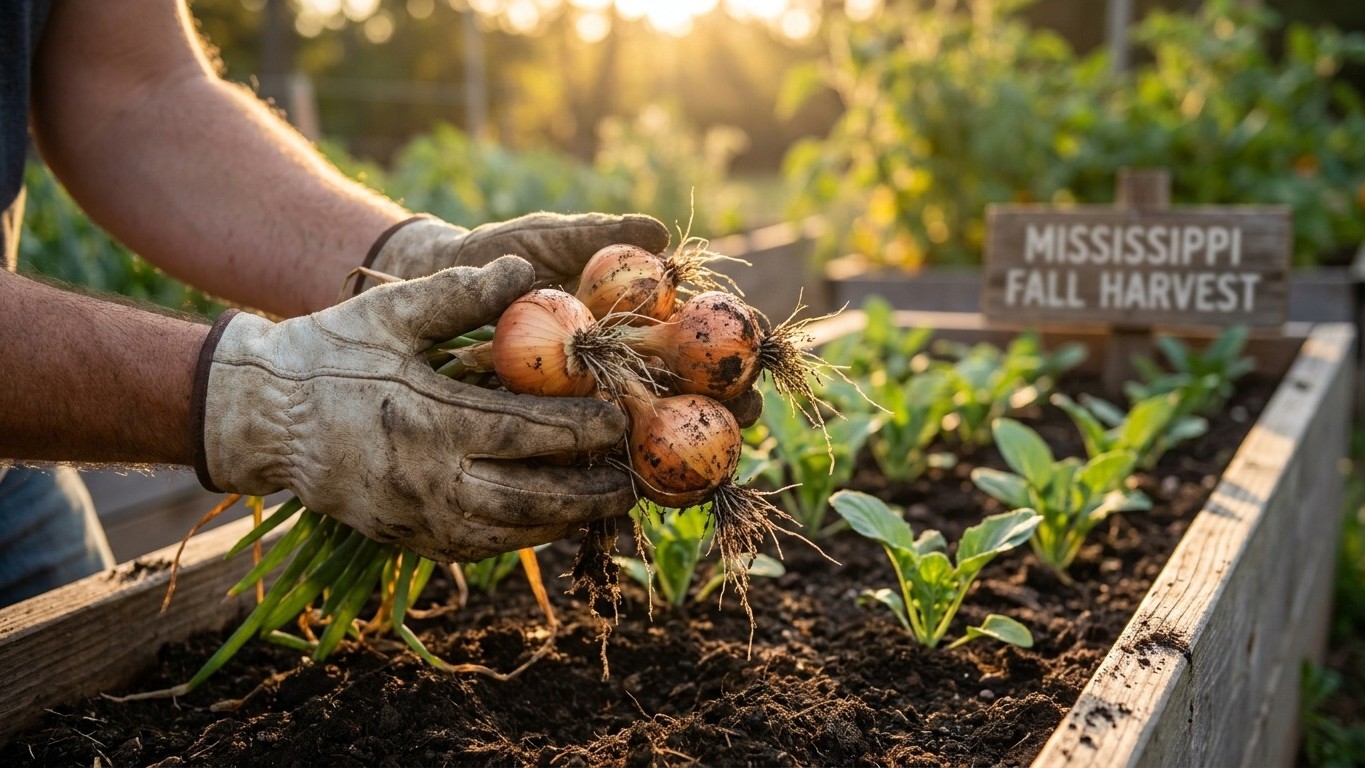

Planting calendar onions Mississippi comes down to two numbers: Jackson sits at 32.32 degrees north, and the longest day of the year there brings just 14 hours and 7 minutes of daylight. That’s the ceiling. Onions bulb on day length, not warmth, and in Mississippi that ceiling rules out most of what a seed catalog offers. Fall planting, short-day varieties, and eating your crop before spring is the pattern that actually works here.
The short answer for Mississippi

At 32.32°N, Mississippi gardens top out at 14 hours and 7 minutes of daylight on the summer solstice. That’s the number an onion plant reads before it decides whether to keep growing leaves or start swelling a bulb. Short-day onions, the group that begins bulbing once daylight reaches roughly 12 hours, are the only varieties guaranteed to work across the whole state. Intermediate-day types, which need something closer to 13 to 14 hours, can also succeed here because Jackson’s peak daylight clears that bar, if only just.
Timing follows from that same daylight math. Mississippi’s mild winters mean the plant doesn’t need to wait out a hard freeze the way a Minnesota or Michigan garden does. Onions here go in during fall, typically October through November, as small transplants or sets that spend the cool months building a root system and a modest cluster of leaves. By the time daylight climbs back past that 12-hour threshold in late winter, the plant already has enough leaf mass to turn into a decent bulb. Gardeners who wait until spring to plant, the way a northern grower would, are starting the clock too late.
Why the calendar looks different two states over
Compare that to a garden at 40°N, where winters are hard enough that fall planting means dead seedlings, not dormant ones. There, growers wait for late winter or early spring and rely on long-day varieties that don’t start bulbing until daylight passes 14 to 16 hours, a threshold that simply doesn’t arrive early enough to rush. Mississippi’s advantage is a head start built into the climate itself: cool but rarely brutal winters let the plant get its growing done before the daylight switch flips.
What will not work here
Planting a long-day onion in Mississippi doesn’t produce a smaller bulb. It produces no bulb at all. Long-day varieties are bred to wait for 14 to 16 hours of daylight before they start swelling, and Jackson’s ceiling of 14 hours 7 minutes leaves almost no room for that trigger to fire. The plant keeps making leaves all season, sensing that the day still isn’t long enough, and eventually just rots in the ground with nothing to show for it. Several intermediate-day varieties published for latitudes above Mississippi share the same fate, since their bulbing threshold sits above what the state’s daylight ever delivers.
These are the varieties documented on this site whose published range starts north of Mississippi and will not bulb here:
- Ailsa Craig (long-day, 38-60N), needs far more summer daylight than Mississippi ever provides.
- Barolo (long-day, 38-55N), will only make leaves, then rot.
- Blush (long-day, 38-55N), bulbing trigger never fires this far south.
- Bridger (long-day, 35-50N), daylight ceiling here is too low.
- Cabernet (intermediate-day, 35-45N), its lower bound already sits north of Jackson.
- Calibra (intermediate-day, 35-45N), same problem, no bulb forms.
- Frontier (long-day, 40-50N), needs a summer solstice well past Mississippi’s.
- Monastrell (intermediate-day, 35-46N), range starts north of the state line.
- New York Early (long-day, 38-50N), leaves all season, then rot.
- Patterson (long-day, 38-55N), no trigger, no bulb.
- Powell (long-day, 43-47N), built for a much longer summer day.
- Red Carpet (long-day, 40-45N), daylight never climbs high enough here.
- Red Long of Florence (intermediate-day, 38-50N), out of range in the wrong direction.
- Red Long of Tropea (intermediate-day, 35-48N), same story.
- Redwing (long-day, 43-65N), a far-northern variety, useless here.
- Rossa di Milano (long-day, 38-50N), no bulb without a longer day.
- Safrane (long-day, 42-50N), needs latitude Mississippi doesn’t have.
- Talon (long-day, 42-50N), same mismatch.
- Walla Walla Sweet (long-day, 35-55N), its range starts right at the state’s edge and rises well past it.
What changes across Mississippi
Jackson’s 32.32°N sits roughly in the middle of the state, but Mississippi itself stretches from the Gulf Coast near 30°N up to the Tennessee border close to 35°N. That’s about five degrees of latitude, enough to matter for a plant that reads daylight down to the minute. A gardener near the coast is planting slightly south of the reference point this page is built on, while someone in the far northern counties is gardening several degrees north of it.
| Location | Approximate latitude | What it changes |
|---|---|---|
| Gulf Coast (south) | ~30°N | Daylight peaks a bit below 14h07; short-day varieties remain the safe choice, fall planting can start slightly earlier. |
| Jackson (reference) | 32.32°N | 14h07 on the longest day; short-day varieties reliable, most intermediate-day types clear the threshold. |
| Northern counties | ~35°N | Daylight peaks a little above 14h07, still well short of what long-day types need; intermediate-day varieties gain a slightly wider margin. |
The practical effect is small but real. Coastal gardeners can lean confidently on short-day varieties and plant a little sooner in fall, since frost arrives later there. Gardeners near the Tennessee line get a touch more summer daylight, which gives intermediate-day types like Elsye or Scout a bit more room to bulb properly, but it still isn’t enough daylight to make long-day varieties viable anywhere in the state.
Sweet now, or onions that last
Mississippi’s daylight pattern doesn’t just decide which varieties bulb. It decides what those onions taste like and how long they’ll keep. University of Missouri Extension puts it plainly: sweet onions do not store as well as pungent ones, because the same volatile sulfur compounds responsible for an onion’s bite are also what protects it in storage. Fewer sulfur compounds means a milder onion on the cutting board, but also a shorter shelf life.
Short-day varieties, the ones suited to Mississippi’s latitude, tend to run sweeter and lighter on those sulfur compounds. Varieties like Texas Grano 1015Y, Vidora, and Red Sensation fit that pattern: excellent fresh, in salads or on a burger, but not built to sit in a pantry through the winter. Intermediate-day varieties such as Sierra Blanca or Expression land somewhat closer to the middle, with a bit more pungency and a bit more staying power, though still nowhere near what a northern long-day onion delivers.
That trade-off shapes what a Mississippi pantry looks like in March. Growers further north, working with long-day varieties packed with sulfur compounds, can pull onions from storage well into late winter. Mississippi gardeners are working a different bargain: onions that taste better right out of the ground, but that are best used within a few months of harvest rather than stretched across an entire winter. Plan the kitchen accordingly, and treat a big harvest as something to cook through, share, or preserve rather than something to bank on for a March recipe.
Checking this against your own garden
None of the figures above describe every backyard in Mississippi. They describe Jackson, at 32.32°N, and a state that actually spans five degrees of latitude and a range of local frost patterns. Before committing to a planting date or a variety, it’s worth confirming a few things specific to your own location.
- Look up your own latitude if you garden well north or south of Jackson, especially near the Gulf Coast or the Tennessee border.
- Check your local average first and last frost dates rather than assuming Jackson’s schedule applies.
- Contact your county extension office for planting windows calibrated to your specific area of the state.
- Note whether your garden sits in a low-lying frost pocket or an urban heat pocket, both of which shift local timing regardless of latitude.
- Confirm the day-length rating printed on any onion variety before buying, rather than relying on regional habit alone.