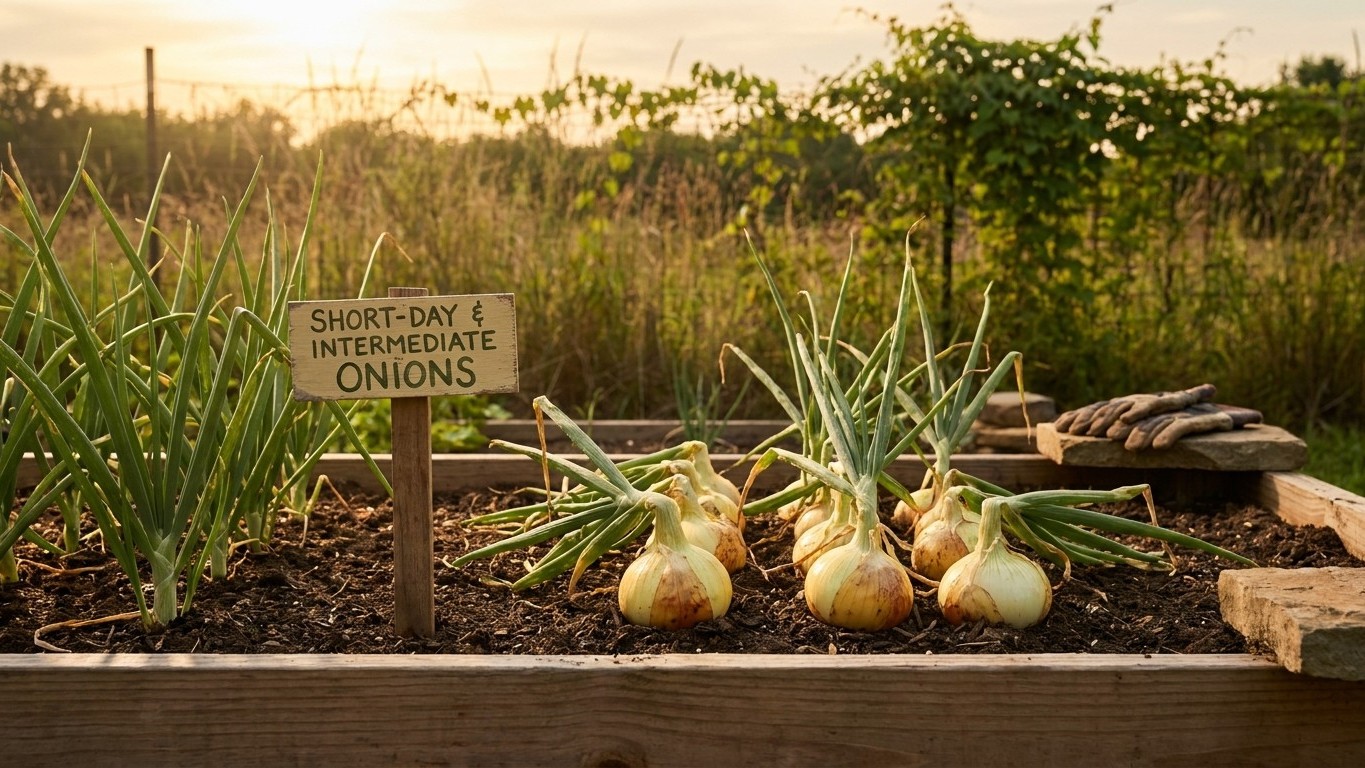

Mississippi’s reference latitude sits far enough south that the longest day of the year never breaks past the mid-14-hour mark. That single fact decides almost everything about which onions will actually make a bulb in your garden and which will just sit there making leaves. Short-day and intermediate-day varieties work here. Long-day types, the kind sold in a lot of national seed racks, mostly do not.
How long your longest day is

Jackson, Mississippi sits at 32.32 degrees north, and on the longest day of the year it gets about 14 hours and 7 minutes of daylight, based on the station coordinates behind the National Oceanic and Atmospheric Administration’s 1991-2020 climate normals. That’s the number an onion plant actually measures. Not the heat, not the soil Temperature, the length of daylight compared to darkness.
Why day length beats warmth
Onions are photoperiodic. A bulb doesn’t start forming because the weather turns hot in June, it starts because the plant senses that daylight has crossed a threshold and switches from growing leaves to storing sugars in the base of the stem. Clemson Cooperative Extension’s Home & Garden Information Center puts the short-day threshold at roughly 12 hours of daylight, which Jackson clears easily well before the solstice. Intermediate-day types need something closer to 12 to 14 hours, and Jackson’s 14-hour-7-minute ceiling gets them there too, just barely in some cases. Long-day onions wait for 14 to 16 hours of daylight before they’ll even think about bulbing, and Jackson’s sky never delivers that. The plant keeps making leaves past the point where it should be building a bulb, and eventually the whole thing just breaks down in the ground.
Check your own edge of the state
Mississippi runs from the Gulf Coast up to the Tennessee line, a stretch of roughly four degrees of latitude. Jackson’s 32.32 degrees is a fair middle reference, but a gardener in Corinth or Booneville is sitting closer to 35 degrees north, with a longer summer day than the figure above. That’s still nowhere near long-day territory, but it does nudge those gardens toward the upper end of the intermediate-day range instead of the lower end. If you’re near the top or bottom edge of the state, look up your own latitude before you assume Jackson’s numbers apply exactly to your yard.
Which varieties bulb in Mississippi
Eleven varieties documented on this site have a published latitude range that covers Jackson’s 32.32 degrees north, which means they’re built for exactly this kind of day length:
- Elsye (intermediate-day, 32-45N)
- Expression (intermediate-day, 32-45N)
- Gabriella (short-day, 20-35N)
- Madalyn (short-day, 20-35N)
- Red Rock (short-day, 30-36N)
- Red Sensation (short-day, 25-35N)
- Scout (intermediate-day, 32-46N)
- Sierra Blanca (intermediate-day, 32-45N)
- Texas Grano 1015Y (short-day, 25-35N)
- Vidora (short-day, 25-35N)
- White Castle (short-day, 30-38N)
One more, Candy (intermediate-day, 33-40N), sits close enough to Jackson’s latitude to be worth mentioning, but it’s within a degree and a half of its own published lower bound, which puts it in a gray zone. It may bulb well in Mississippi gardens, it may not, and the honest answer is that you’re gardening at the edge of what the variety was bred for rather than in the middle of it.
Here’s the list that actually matters more, because it’s the one that explains a lot of past frustration. Nineteen varieties documented across this site are published for latitudes above Mississippi’s, meaning they need more summer daylight than Jackson, or anywhere else in the state, ever provides:
- Ailsa Craig, Barolo, Blush, Bridger, Cabernet, Calibra, Frontier, Monastrell, New York Early, Patterson, Powell, Red Carpet, Red Long of Florence, Red Long of Tropea, Redwing, Rossa di Milano, Safrane, Talon, Walla Walla Sweet
If you’ve ever planted a bag of sets from a supermarket display and ended up with tall, healthy-looking green tops all summer and no onion underneath, followed by a mushy mess in the soil come July, this is almost certainly why. The variety needed 15 or 16 hours of daylight to trigger bulbing, Mississippi topped out around 14 hours, and the plant just never got the signal. It’s not a soil problem, it’s not a watering problem, it’s a mismatch between the seed and the sky.
When to plant onions in Mississippi
Because Mississippi’s day length puts it firmly in short-day and intermediate-day territory, the planting calendar looks different than it does further north. Short-day onions are typically started in fall here, not spring, so the plant builds a strong root system and some leaf growth over the mild winter months and is ready to bulb up as daylight lengthens in early spring.
Working around the frost window
Jackson’s climate normals put the last spring freeze, defined as the date range where the probability of 32°F sits between 30 and 70 percent, between March 6 and March 22. The first fall freeze in that same probability band falls between November 7 and November 22. Those two windows frame the growing season, but they are averages pulled from an airport weather station, not a promise. NOAA’s own 1991-2020 climate normals data for this station makes clear these are statistical bands, and suburban or rural gardens away from the airport’s paved surfaces and heat tend to see their last spring frost arrive later, and their first fall frost arrive earlier, sometimes by a week or two. Anyone gardening outside the immediate Jackson area, especially at higher elevation in the northeastern hill country, should treat these dates as a starting point and confirm against their own county’s frost history.
In practice, that gives Mississippi gardeners a fall planting window that runs from mid-October into November for short-day sets or transplants, well ahead of that November frost band, so the young plants have time to establish before real cold sets in. Intermediate-day varieties like Elsye or Scout have a bit more flexibility and can go in slightly later, sometimes into early winter in the milder southern half of the state. Spring planting is possible but generally produces smaller bulbs, since the plant has less time to build leaf mass before the daylight trigger kicks in.
Sweet onions or onions that keep
Mississippi gardens are built to produce sweet onions, not onions that last through winter, and the reason comes down to chemistry rather than luck. University of Missouri Extension’s guide on growing onions notes plainly that sweet varieties do not store as well as more pungent types, because the same volatile sulfur compounds that give an onion its bite also toughen its cell structure enough to survive months in storage. Fewer of those compounds means a milder onion on your cutting board, and a shorter shelf life in your pantry.
What that means for a Mississippi harvest
Short-day varieties, the group best suited to Jackson’s daylight numbers, tend to run lower in those sulfur compounds than the long-day onions grown in northern states. That’s not a flaw in the seed, it’s the same photoperiod logic showing up in the bulb’s chemistry: a shorter growing season under shorter summer days produces a milder onion. Varieties like Texas Grano 1015Y and Vidora on the list above are known for that mild, sweet profile, good sliced raw on a burger in June, not something you’d expect to still have in a mesh bag come February.
Northern gardens growing long-day onions under 15 or 16 hours of summer daylight get the opposite trade, sharper bulbs loaded with sulfur compounds that keep for months in a cool, dry space. A Mississippi pantry built entirely on short-day onions will likely be through most of its harvest by late winter, with little left by March. Gardeners who want at least some keeping onions alongside the sweet ones often look to the intermediate-day varieties on the first list, like Scout or Sierra Blanca, which tend to land somewhere between the two extremes in both flavor and storage life.