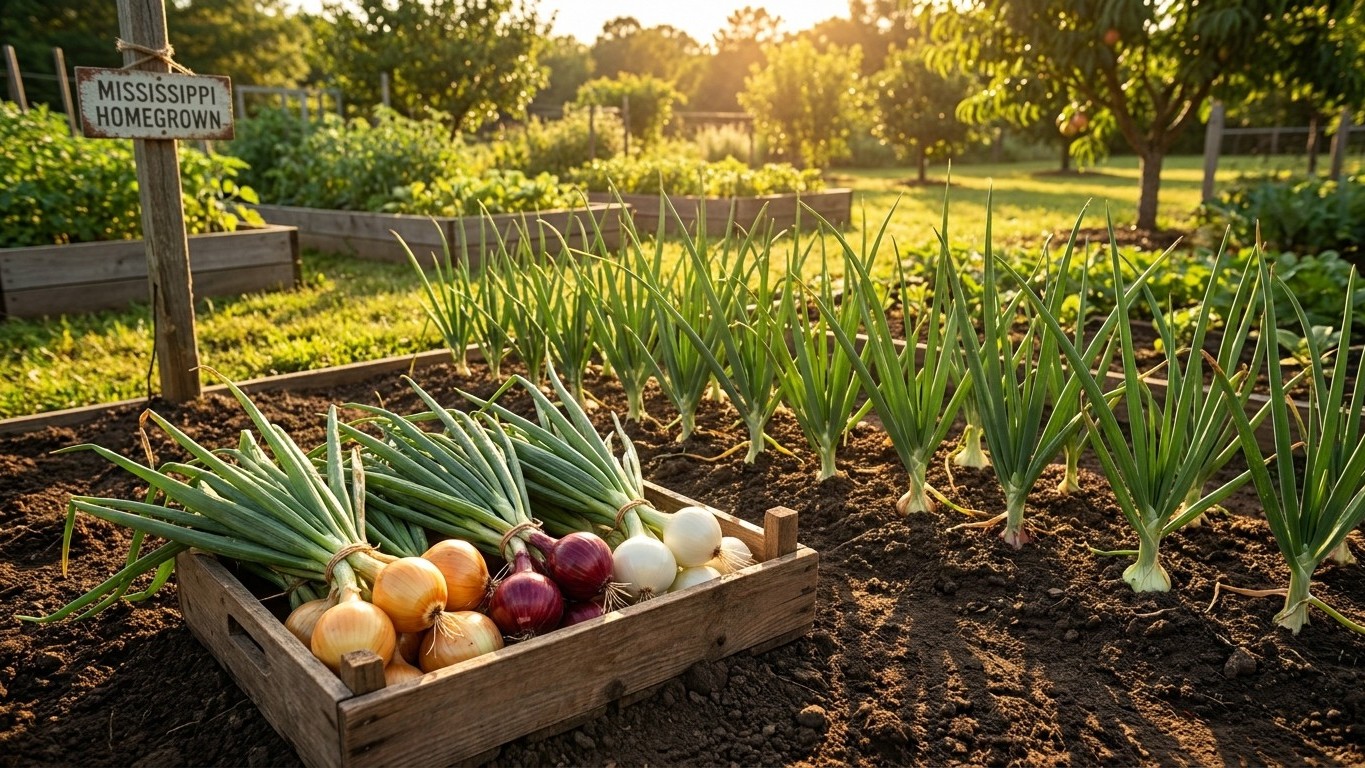

Best varieties onions Mississippi comes down to day length. At 32.32°N, the reference point for this state, the longest day of the year brings 14 hours and 7 minutes of daylight. That number sits squarely in short-day and intermediate-day territory, which means Mississippi gardeners should be planting short-day and intermediate-day onions, full stop, and skipping anything bred for a longer summer.
The short answer for Mississippi

Onions don’t care how hot it gets. They care how long the sun stays up. Once daylight crosses a variety’s threshold, the plant stops building leaves and starts building a bulb, whatever size it happens to be at that moment. At 14 hours and 7 minutes on the longest day, Mississippi sits well inside the range where short-day varieties (which trigger around 12 hours) and intermediate-day varieties (which trigger between roughly 12 and 14 hours) both make sense.
Among the varieties documented for this site, eleven have published ranges that cover 32.32°N. On the short-day side, that includes Texas Grano 1015Y (25-35N), Vidora (25-35N), and Red Sensation (25-35N), all of which bulb early and lean sweet. It also includes Gabriella, Madalyn, Red Rock, and White Castle, four short-day varieties with published ranges that reach this latitude, though none of them has a dedicated page on this site yet.
On the intermediate-day side, Elsye, Expression, Scout, and Sierra Blanca all carry a published range of 32-45N, which puts Mississippi at the southern edge of their comfort zone rather than the middle of it. That’s still a workable spot, but it’s worth knowing you’re near the boundary rather than the center.
One variety sits in what’s best described as a blurred zone. Candy, an intermediate-day type rated for 33-40N, falls just above the reference latitude. It may bulb reliably in Mississippi, particularly toward the northern part of the state, but a gardener in the deep south of the state is close enough to the edge that results could go either way. Treat it as a variety worth trying in a partial bed before committing a whole row to it, not as a sure thing.
What will not work here
This is the part that actually saves a gardener a season. Long-day onions need 14 to 16 hours of daylight to start bulbing, and Mississippi’s longest day never gets there. Plant one anyway and here’s what happens: the onion spends the whole summer making leaves, because the day length that would tell it to stop never arrives. Fall comes, the plant is still leafy and bulb-less, and then it rots in the ground or in storage. That is not a smaller harvest. It is no harvest at all.
The same problem catches several intermediate-day varieties whose published ranges start north of Mississippi’s reference latitude. Nineteen varieties documented on this site fall into this category:
- Ailsa Craig (long-day, 38-60N), needs a day length Mississippi never reaches
- Barolo (long-day, 38-55N), same problem, bred for northern summers
- Blush (long-day, 38-55N), will make leaves all season and nothing else
- Bridger (long-day, 35-50N), requires more daylight than this latitude provides
- Cabernet (intermediate-day, 35-45N), starts north of Mississippi’s range
- Calibra (intermediate-day, 35-45N), same gap, no bulbing trigger here
- Frontier (long-day, 40-50N), a far-north variety, wrong fit entirely
- Monastrell (intermediate-day, 35-46N), daylight requirement too high
- New York Early (long-day, 38-50N), bred for a much longer summer day
- Patterson (long-day, 38-55N), will not bulb south of its published floor
- Powell (long-day, 43-47N), a far-northern variety, no exceptions
- Red Carpet (long-day, 40-45N), daylight threshold never met here
- Red Long of Florence (intermediate-day, 38-50N), starts above this latitude
- Red Long of Tropea (intermediate-day, 35-48N), same shortfall
- Redwing (long-day, 43-65N), an extreme-north variety
- Rossa di Milano (long-day, 38-50N), wrong day-length group entirely
- Safrane (long-day, 42-50N), will not bulb this far south
- Talon (long-day, 42-50N), same issue, day never gets long enough
- Walla Walla Sweet (long-day, 35-55N), a Pacific Northwest classic that has no place in a Mississippi bed
None of these varieties “may struggle.” They will not bulb in Mississippi, and planting them is a wasted season of garden space.
What changes across Mississippi
Mississippi runs roughly from the Gulf Coast near 30°N up to the Tennessee border near 35°N, which is enough spread to matter. The figures in this article come from a weather station near Jackson, at 32.32°N, close to the geographic middle of the state. A gardener on the coast is a couple of degrees south of that point; a gardener near the Tennessee line is a couple of degrees north.
| Location | Approximate latitude | Longest-day daylight | What it changes |
|---|---|---|---|
| Gulf Coast (south) | ~30.2°N | Slightly under 14h07 | Short-day varieties bulb earlier and smaller; intermediate-day types are less reliable |
| Jackson (reference) | 32.32°N | 14h07 | Both short-day and intermediate-day varieties work |
| Northern Mississippi | ~35°N | Slightly over 14h07 | Intermediate-day varieties, including edge cases like Candy, gain a better chance of bulbing |
That two-and-a-half-degree spread doesn’t flip Mississippi into a different day-length group. It stays short-day and intermediate-day country from coast to border. But it does shift which varieties within that group perform best, and it means a gardener near the state’s northern edge is a better candidate for Candy or for the intermediate-day varieties rated 32-45N than someone gardening near Biloxi. It also means planting dates should shift by roughly a couple of weeks between the two ends of the state, since the southern coast warms up earlier in late winter than the hills near Memphis.
Sweet now, or onions that last
Every onion variety makes a trade, and Mississippi’s climate pushes that trade in one direction. The compounds responsible for an onion’s sharp bite are volatile sulfur compounds, and those same compounds are what keep a bulb from breaking down in storage. A variety with fewer of them tastes mild and sweet, but it has less chemical protection once it’s out of the ground. According to University of Missouri Extension, “as a rule, ‘sweet’ onions do not store as well as the more pungent types.”
Short-day varieties, the ones that dominate a Mississippi bed, tend to run sweeter than their long-day counterparts because of how they develop under a shorter window of daylight. That’s good news for a summer table. Texas Grano 1015Y, Vidora, and Red Sensation are exactly the kind of onions you’d want sliced raw on a sandwich in July. It’s less good news for February.
A pantry stocked entirely with short-day onions from a Mississippi garden is not going to make it to March. These onions are built for eating within a few months of harvest, not for riding out a whole winter in a mesh bag. Gardeners who want both a summer’s worth of sweet onions and a stash that lasts into late winter usually plant a mix, leaning on the short-day varieties for immediate eating and setting aside any of the sturdier intermediate-day bulbs, like those from Elsye or Scout, for longer storage. Neither approach is wrong. It’s just a choice about what your kitchen needs in the coldest months.
Checking this against your own garden
The 32.32°N figure describes Jackson, not every backyard in Mississippi. A garden near the coast or near the state’s northern edge sits far enough from that point that the details above deserve a personal check rather than a blanket assumption. A few things worth confirming before you order seed or sets:
- Look up your own latitude, not just the state’s, especially if you garden near the coast or near the Tennessee border
- Check your local average last frost date in spring and first frost date in fall, since these drive planting windows than latitude alone
- Call or visit your county extension office, which can confirm which day-length group performs best in your specific county
- Ask your extension office whether any locally trialed varieties outperform the general short-day and intermediate-day recommendations for your area
- Track your own longest-day daylight hours if you’re gardening at the far north or south edge of the state, since a degree or two shifts the number enough to matter for edge-case varieties like Candy
A state-wide figure is a starting point, not a guarantee. The county extension office is the fastest way to turn that starting point into something specific to your soil, your frost dates, and your stretch of Mississippi.