
New Brunswick’s apple calendar runs on frost, not the month on the wall. Environment and Climate Change Canada’s 1981-2010 climate normals for the Moncton station put the average last spring frost at May 23 and the average first fall frost at October 2, a frost-free window of roughly four months at that one reference point. Half of all years run later than both of those dates, so treat them as a midpoint, never a guarantee. The single action that follows: check the tree’s own stage against these Moncton dates before you spray, prune, or pick, rather than trusting a date on the calendar.
The short answer for New Brunswick
For most of the province, plan around the Moncton station’s two mean dates from Environment and Climate Change Canada’s 1981-2010 normals: last spring frost on May 23, first fall frost on October 2. That’s the frost-free skeleton the rest of this calendar hangs on, and it shifts earlier or later depending on where in New Brunswick you’re actually standing.
Hardiness and chill are not the same filter
Two separate questions sit underneath that skeleton, and mixing them up is where most New Brunswick orchards run into trouble. The first is hardiness: whether the wood survives the winter at all. ECCC’s Moncton normals put the mean daily minimum of the coldest month at -13.9 °C, cold enough to kill a cultivar not rated for real winter exposure. The second is chill: whether the buds have banked enough cumulative cold to break dormancy evenly and bloom on schedule. New Brunswick’s winters run long and cold enough that insufficient chill is rarely the limiting factor here, unlike a milder coastal climate further south. The limiting factor in this province is almost always hardiness, plus the timing of bloom against the last and first frost.
If you haven’t settled on a cultivar yet, that choice has to happen before this calendar means anything to you. A tree rated to survive a -13.9 °C coldest-month minimum and to bloom late enough to dodge a frost that, in half the years on record, lands after May 23, is a different tree from one bred for a gentler province. The Best Apple Varieties for New Brunswick walks through which named cultivars actually clear both bars. Everything below assumes you’re working with one of them, and that you’ve already sorted site drainage and rootstock as covered in Growing Apples in New Brunswick.
Working through it

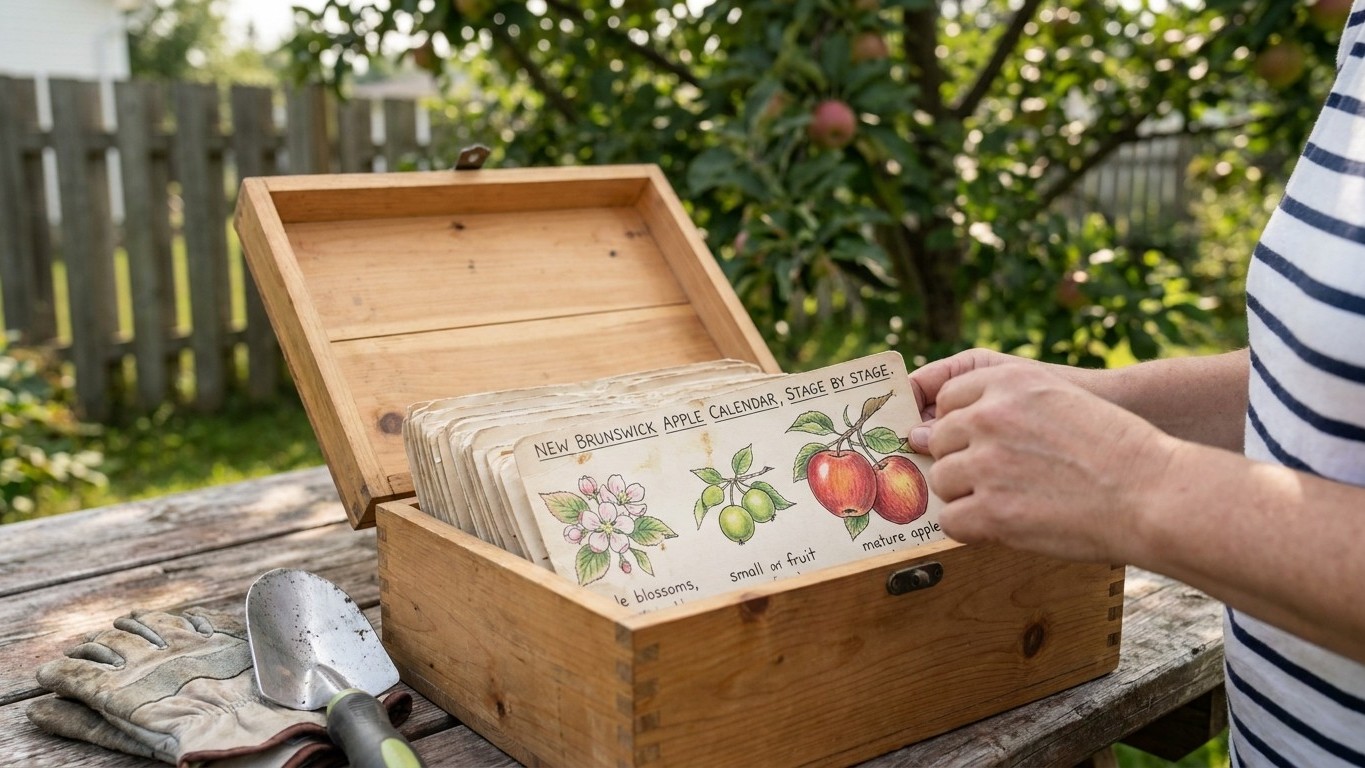
Every stage below is triggered by accumulated heat and the tree’s own internal clock, not by a date on the wall. The two fixed points to anchor them against are Environment and Climate Change Canada’s Moncton normals: an average last spring frost of May 23 and an average first fall frost of October 2. Everything else moves around those two markers depending on the actual spring you get.
Dormancy

From late fall through late winter the tree sits leafless with no visible growth. This is the window for structural pruning, since cuts made now heal before sap rises and don’t invite the fungal problems that summer pruning can. It’s also the easiest time to check trunks for rodent or frost-crack damage while the bark is fully exposed.
Green tip

Buds swell and the first sliver of green leaf tissue pushes past the bud scales, often while real frost risk is still on the ground, since the Moncton mean last frost doesn’t arrive until May 23. This is the stage, not a date, that tells you a dormant-oil or copper spray for scab and overwintering mite populations needs to go on before it, if you use one at all.
Pink

Blossom clusters show color before the petals separate, and this is the most frost-vulnerable stage in the whole calendar, because a late cold snap here can abort the crop before a single flower opens. Since ECCC’s mean date is a midpoint and not a ceiling, a frost after May 23 is not a surprise. It’s the outcome in roughly half of all years, and pink-stage buds are exactly what it damages first.
Bloom

Open blossoms are less cold-hardy than the buds that preceded them, so bloom arriving close to or after the Moncton mean last frost date carries real risk on a low or exposed site. This is also when pollination has to happen, so cool, wet, windless weather at bloom can cost you a crop just as surely as frost does, by keeping bees off the flowers.
Petal fall

Petals drop and the tiny fruitlet behind each flower becomes visible, and cold tolerance improves a little compared with open bloom. Most growers use this stage to time the first thinning pass and the first fungicide cover spray, since the fruit surface is now exposed and vulnerable to scab infection in wet weather.
Fruit set

Fruitlets that survived pollination begin sizing, and a second, harder thinning pass now, spacing fruit rather than removing flowers, is what actually decides fruit size at harvest. This is the longest stage on the calendar, running from early summer through to whichever week the cultivar’s own maturity brings it to harvest.
Harvest
Harvest timing is read off the fruit itself, not off the frost date, but the season still has to run long enough for a given cultivar to finish. Environment and Climate Change Canada’s Moncton normals put the mean first fall frost at October 2, so a late-season cultivar with a long catalogue maturity figure is racing that date every year. Catalogue days-to-maturity figures are counted from bloom or from a nominal transplant date depending on the source, and they shift by a week or two with the season actually delivered, so treat that figure as a range to check against the Moncton frost mean, not a fixed day.
What changes across New Brunswick
The Moncton figures above describe one climate station in the low-lying, central part of the province, and New Brunswick is not one climate. Every other district runs some number of days ahead of or behind Moncton, and the direction depends on elevation, water, and whether cold air has anywhere to pool overnight.
Valley, coast, and upland run three different calendars
The Saint John River valley around Fredericton warms quickly in spring because the river and surrounding lowland absorb heat, but that same low relief lets cold air drain into the valley bottom and settle overnight. A valley-floor orchard can see a harder, later frost at bud break than an orchard on the slope just above it, even in what feels like a mild week.
The Bay of Fundy coast around Saint John and the Fundy Isles is moderated by the ocean on both ends of the season. Summers run cooler and spring arrives later because the water is slow to warm, but that same buffering keeps the coldest winter nights less severe than an inland site sees. An early-blooming cultivar is safer here on the winter-survival side but not necessarily on the spring-frost side, since coastal fog and cool onshore air can hold bloom-stage frost risk later into the season than an inland orchard experiences.
The northern uplands toward Restigouche and the Chaleur region sit at higher elevation and further from any large moderating water body, so both ends of the frost-free window close in from the Moncton figures: spring arrives later and fall frost lands earlier, shortening the season from both directions. No local station in this dataset gives figures for that region directly, so the practical approach there is to build in a margin of at least a week or two on both the spring and fall side of whatever a cultivar’s catalogue maturity figure assumes, and to lean toward the earliest-finishing cultivars rather than the borderline ones.
The mistakes this climate punishes
Most crop losses in this climate trace back to one of a small number of timing errors, and each one shows up at a different stage of the calendar.
- Planting a cultivar not hardy enough for the coldest month. ECCC’s Moncton normals put the mean daily minimum of the coldest month at -13.9 °C. A cultivar bred for a milder province can survive several ordinary winters here and then die back to the rootstock in the one winter that runs colder than average, and the damage doesn’t show until the following spring, when whole limbs fail to leaf out.
- Choosing an early-blooming cultivar without frost protection. Because the Moncton mean last frost of May 23 is a midpoint and not a limit, an early bloomer that opens flowers in the first half of May is exposed, in roughly half of all years, to a frost that lands after its bloom rather than before it.
- Feeding nitrogen late in the season. A summer feeding pushes soft, late vegetative growth that hasn’t hardened off by the time ECCC’s mean first fall frost of October 2 arrives, and that soft new growth is what an early frost actually kills, not the older, already-hardened wood.
- Thinning too late, or skipping it. Fruit left unthinned at the fruit-set stage sizes poorly and ripens later, which matters directly against a fixed fall-frost mean: a crop that needed another ten days to finish is a crop that met the frost instead.
Where each mistake shows up
Winter kill from insufficient hardiness shows at green tip, when a limb that should be swelling stays bare. Frost damage to an early bloomer shows at or just after pink, when blackened blossom centers replace what should have been white flowers. Soft growth from late feeding shows on the first hard morning after the mean fall frost date, when new shoot tips blacken while the older, hardened leaves are untouched. A late, unthinned crop shows at harvest itself, when fruit that should have colored and sized is still small, green, and short of maturity when the season runs out.
Checking this against your county
The Moncton figures used throughout this page come from a single ECCC climate station in the center of the province, and every county layers its own microclimate on top of elevation, water, and slope. Before you commit a bloom-timing decision to a specific week, check whether a station or advisory closer to your own orchard gives different numbers.
New Brunswick’s own provincial agriculture site does not currently allow automated link verification, so for a working starting point use Agriculture and Agri-Food Canada, which lists provincial and regional contacts and current pest and disease advisories for the Maritimes: Agriculture and Agri-Food Canada.
Common questions
When should I spray for apple scab in New Brunswick?
Time it to the stage, not the calendar. The first protective cover typically goes on around green tip and continues through petal fall, since that’s the window when new tissue is most susceptible to infection in wet weather. The actual date for green tip shifts from year to year around the Moncton mean last frost of May 23, so watch the buds rather than the date.
Can I grow apples in the far north of the province, like around the Chaleur region?
Yes, but the margin for error is smaller there. No station figure in this dataset covers that area directly, so growers there should assume both ends of the frost-free window run tighter than the Moncton normals used throughout this page, and should choose cultivars from the earliest-finishing end of what’s viable in the province.
What apple varieties are hardy enough for New Brunswick winters?
Look for a cultivar whose published hardiness clears the Moncton coldest-month mean minimum of -13.9 °C with margin, not one that just barely meets it. Hardiness ratings vary enormously between named cultivars even within the same species, which is exactly what the variety-by-variety comparison is for.
How do I know if a frost is actually going to hurt my blossoms?
Open blossoms and pink-stage buds can be damaged well above the temperature that would frost a lawn, so don’t wait for a hard-freeze warning. A forecast low anywhere near freezing during pink or bloom is worth covering for, because the Moncton mean last frost of May 23 already tells you that frost this late in spring is common, not exceptional, in roughly half of all years on record.