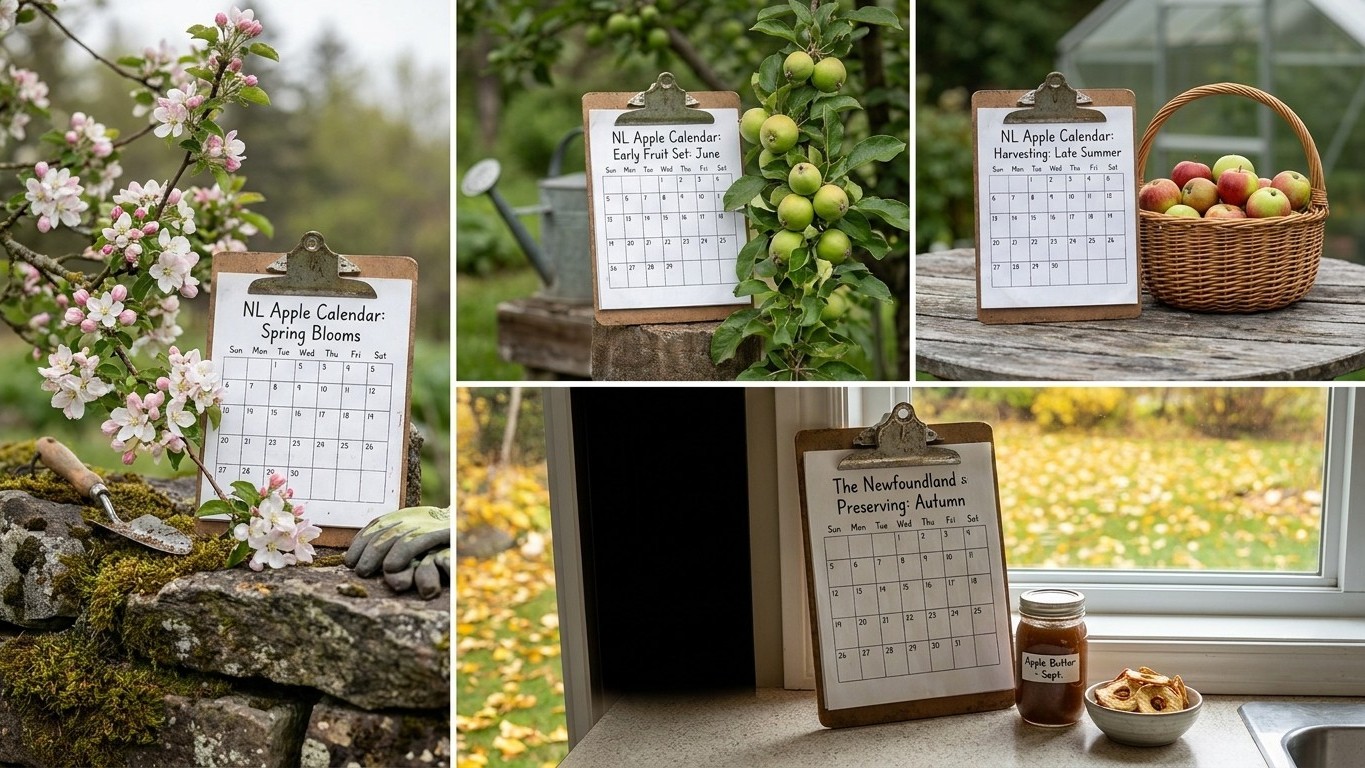

The apple year in Newfoundland and Labrador runs from dormancy breaking in mid to late April through to harvest in late September or October, and every stage in between is timed against St. John’s own frost window. Environment and Climate Change Canada’s 1981-2010 normals put the mean last spring frost at May 30 and the mean first fall frost at October 17, at station ST JOHN’S A, and both are averages that fall later half the time, not safe dates. Check the tree’s actual bud stage before you act on any calendar date, since a tree already in bloom during a late frost needs cover, while a still-dormant tree usually does not.
The short answer for Newfoundland and Labrador
Near St. John’s, apple trees typically sit dormant into April, move through green tip and pink in May, bloom around the time of that May 30 mean last frost, and finish ripening before the October 17 mean first frost, both figures from ECCC’s 1981-2010 climate normals at station ST JOHN’S A. That overlap between bloom and the tail end of the frost window is the single fact that decides most of what follows on this page: in roughly half of years, frost arrives after May 30, and a tree in full bloom at that point can lose its whole crop to a single cold night.
The answer also depends on which cultivar is in the ground. ECCC’s coldest-month mean daily minimum for St. John’s is -8.7 °C, which rules out marginally hardy dessert apples and favours the cold-hardy crab and dessert crosses bred for short, cool seasons. Anyone still choosing a cultivar should work through The Best Apple Varieties for Newfoundland and Labrador before locking in a bloom date from this page, because a variety’s bloom timing and days-to-maturity shift everything downstream.
Distance from the St. John’s reference station matters just as much as the cultivar. A site on the Avalon Peninsula close to the coast tracks these normals reasonably well. A site inland, at elevation, or further west or north will run its own stages later, sometimes by weeks, and nothing on this page should be read as a fixed date for those locations. If the tree itself has not been planted yet, the groundwork in Growing Apples in Newfoundland and Labrador covers site and rootstock choices that shift every stage described below.
Working through it

Each stage below is anchored to the ECCC St. John’s normals, but the stage itself, not the date on the wall, is what should govern any decision made in the orchard.
Dormancy

The tree sits fully dormant from leaf drop in autumn through into April. This is the only stage in which the tree tolerates hard cold without damage, and it is the stage for structural pruning, since cuts made now heal before sap starts moving. Dormancy also runs longest at the coldest sites, so a tree at elevation or inland may still be safely dormant when a coastal tree near St. John’s has already broken bud.
Green tip and pink


Green tip usually shows in the weeks before the mean last frost date. This is the point where the tree becomes vulnerable to cold for the first time in the season, though the damage threshold is still fairly high. By pink, days ahead of the May 30 ECCC mean, the flower buds are exposed and considerably more frost-sensitive than at green tip. A grower watching for frost risk should treat pink, not a date on the calendar, as the point to start checking overnight forecasts closely.
Bloom, petal fall and fruit set


Bloom is the highest-risk stage of the entire year, because it sits right against that May 30 mean last frost from ECCC’s St. John’s normals, and in roughly half of years frost still occurs after bloom has opened. An open blossom hit by frost simply fails to set fruit, with no visible damage to the rest of the tree, which is why a lost bloom season is often blamed on “a bad year” rather than diagnosed correctly. Petal fall and fruit set follow within one to two weeks of bloom and mark the point where frost risk drops sharply, since a small green fruitlet tolerates far more cold than an open flower.
Harvest
Harvest for early cultivars can begin in late September, well ahead of the October 17 mean first fall frost from ECCC, while later-maturing cultivars are racing that frost date directly. A tree still holding unripe fruit into mid-October is gambling on a fall that runs later than average, which happens in half of all years but cannot be counted on in any single one.
| Stage | Rough timing (St. John’s normals) | Frost sensitivity | What to do |
|---|---|---|---|
| Dormancy | Into April | Very low | Prune, plan cultivar changes |
| Green tip | Weeks before May 30 mean | Moderate | Start watching overnight lows |
| Pink | Days before May 30 mean | High | Have frost cover ready |
| Bloom | Around the May 30 mean | Highest | Cover or delay irrigation on frost nights |
| Fruit set | 1-2 weeks after bloom | Low | Thin fruit, resume normal feeding |
| Harvest | Late Sept to before Oct 17 mean | N/A | Pick before an early frost softens fruit |
What changes across Newfoundland and Labrador
The ECCC figures used above come from station ST JOHN’S A, on the Avalon Peninsula, and that is a coastal, ocean-moderated site. Other parts of the territory run on a different clock entirely.
Inland and upland districts away from the coast lose the ocean’s moderating effect on both ends of the season. Cold air also drains into low-lying valleys on clear nights, so a site at the bottom of a slope can see a harder frost than a site just a short distance upslope, even at the same latitude, a pattern well known to growers everywhere but one that matters more here because the frost-free window is already tight. Anyone gardening away from the immediate coast should treat the May 30 and October 17 ECCC means as a starting point to test against their own site, not as the answer.
Labrador sits at a much higher latitude and further from the ocean’s warming influence, and its growing season runs shorter and colder than the island’s, though no figure in this territory’s climate normals covers a Labrador station specifically for this page to cite. A grower there should assume every stage described above lands later, and should lean toward the hardiest, shortest-season cultivars discussed in the varieties guide rather than assume the island’s timing applies.
Even on the Avalon Peninsula itself, a site set back from the shoreline, or one at modest elevation, will typically see green tip and bloom later than St. John’s, and a first fall frost that can arrive earlier than the October 17 mean. The safest approach on any site outside the immediate St. John’s area is to track local bud stage directly rather than count days from a reference station’s normal.
The mistakes this climate punishes
The single most expensive mistake in this climate is planting or keeping a cultivar that blooms early relative to the local frost window. Because ECCC’s May 30 figure for St. John’s is a mean, not a guaranteed cutoff, an early-blooming tree will lose its crop to frost in roughly half of all years, and the failure shows up as an empty tree in August with no obvious cause back in May.
The second is feeding, especially with nitrogen, too late in the season. Late feeding pushes soft new growth right as the tree is heading into the first fall frost window around October 17, and that soft tissue is the part that gets damaged first, weakening the tree’s cold hardiness going into winter. This shows up the following spring as dieback on the previous year’s growth, often misdiagnosed as a disease problem.
The third is choosing a cultivar on hardiness rating alone without checking days to maturity against the local season length. A late-ripening dessert apple might tolerate the -8.7 °C coldest-month mean minimum that ECCC records for St. John’s just fine in winter, but if it needs more frost-free days between bloom and harvest than the window between the May 30 and October 17 means allows, the fruit simply never finishes ripening. This mistake shows up every autumn as small, hard, sour apples still hanging on the tree past the point of no return.
A fourth, smaller mistake is skipping a windbreak on an exposed site. Wind at bloom does not just knock petals off, it also keeps pollinators from working the flowers on marginal days, which compounds the frost risk already built into the bloom-timing problem above.
Checking this against your county
Every figure on this page comes from a single reference station at St. John’s, and a province this size does not share one climate. Before setting a bloom or harvest date by this calendar, check current advice from Newfoundland and Labrador’s Department of Fisheries, Forestry and Agriculture at the provincial extension service, which can speak to conditions in a specific district rather than one coastal station.
That check matters most for anyone outside the Avalon Peninsula, where the ECCC normals used throughout this page were recorded, and for anyone planting a cultivar not already covered in the varieties guide linked above.
Common questions
Can I actually grow apples in Newfoundland and Labrador or is it too cold?
Apples are grown successfully on parts of the island, particularly the Avalon Peninsula, using cold-hardy cultivars matched to the short season. The limiting factor is not whether apples can grow but whether a specific cultivar’s bloom timing and days to maturity fit the frost window at your site.
How do I know if my tree is at green tip or pink?
Green tip is when you can just see a sliver of green leaf tissue pushing through the brown bud scales. Pink follows when the flower buds swell further and show visible pink colour before the petals separate, and it is the more frost-sensitive of the two stages.
What do I do if frost is forecast right at bloom?
Cover what you can reach with row cover or old sheets overnight, and avoid watering right before a frost since wet soil radiates less stored heat back to the canopy than dry soil in some setups, though results vary by site. There is no reliable way to protect a mature standard tree in full bloom, which is why cultivar choice matters more than reactive measures.
Does a late spring mean a late fall too?
Not reliably enough to plan around. The ECCC normals used here are long-term averages, and a season that runs late in spring is not guaranteed to run late in fall as well, so the safer approach is to pick a cultivar with days-to-maturity that fit comfortably inside the average window rather than betting on a long autumn.