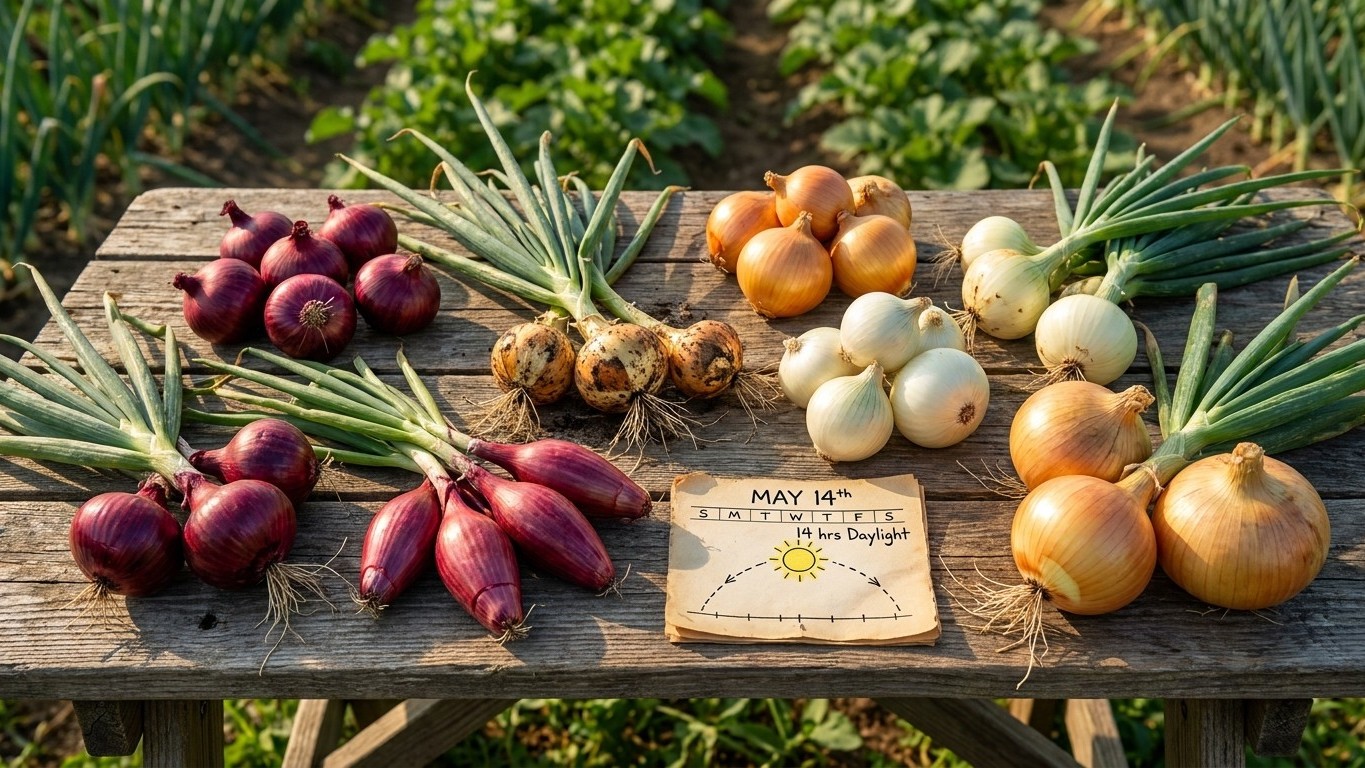

North Carolina sits at 35.22 degrees north, measured at the Raleigh-Durham reference station, where the longest day of the year delivers 14 hours and 23 minutes of daylight. That figure lands the state squarely in intermediate-day onion territory, with a handful of long-day and short-day varieties workable at the edges. Here’s which ones, and why the rest are a waste of a garden bed.
The short answer for North Carolina

Onions don’t bulb because the weather warms up. They bulb because the day gets long enough to flip a switch in the plant, and that threshold is genetic. Short-day types start bulbing once daylight hits roughly 12 hours, intermediate types wait for something in the 13 to 14 hour range, and long-day types hold off until 14 to 16 hours. At 35.22N, the sun gives Raleigh-Durham 14 hours and 23 minutes on the solstice, which is enough to satisfy every intermediate-day variety and just barely enough for the long-day varieties whose published range starts at 35 degrees north.
That puts thirteen documented varieties squarely in play for a garden at this latitude. Most of them are intermediate-day types: Cabernet, Calibra, Candy, Elsye, Expression, Monastrell, Red Long of Tropea, Scout, and Sierra Blanca all list a range that covers 35.22N comfortably. Two long-day varieties, Bridger and Walla Walla Sweet, list ranges starting right at 35 degrees north, meaning North Carolina is close to their southern edge rather than their sweet spot. And two short-day varieties, Red Rock and White Castle, also cover this latitude on the upper end of their own range.
The practical takeaway: build a North Carolina onion patch around intermediate-day varieties as the reliable core, treat the long-day pair as a reasonable experiment rather than a sure thing, and keep the short-day pair in mind if you want an early harvest that comes out of the ground before the summer heat really sets in. Nothing here is a coin flip the way it would be for a gardener in Minnesota trying to grow a short-day onion, or a gardener in south Texas trying to grow a long-day one. North Carolina’s daylight sits in a window wide enough to support all three groups, just not all thirty-one varieties documented for this site.
What will not work here
Thirteen varieties documented on this site are published for latitudes that start above 35.22 degrees north. That’s not a soft warning. It means the summer solstice in North Carolina never delivers enough daylight to trigger bulbing in these varieties, and a plant that never gets its bulbing signal doesn’t produce a smaller bulb as a consolation prize. It keeps making leaves through the entire growing season, and once the heat and humidity of a Carolina summer set in, that leafy, ungrown plant rots at the base before it ever forms anything worth pulling.
- Ailsa Craig (long-day, 38-60N), the range starts nearly three degrees north of Raleigh-Durham, well outside the daylight window here.
- Barolo (long-day, 38-55N), needs daylight hours this state’s solstice does not reach.
- Blush (long-day, 38-55N), same threshold problem, no bulbing trigger.
- Frontier (long-day, 40-50N), built for latitudes with several more hours of summer light.
- New York Early (long-day, 38-50N), despite the name, it’s a northern-latitude variety.
- Patterson (long-day, 38-55N), one of the more common storage onions, but not for this latitude.
- Powell (long-day, 43-47N), a narrow, far-northern range that excludes North Carolina entirely.
- Red Carpet (long-day, 40-45N), same story, the day never gets long enough here.
- Red Long of Florence (intermediate-day, 38-50N), an intermediate-day variety that still starts north of this state.
- Redwing (long-day, 43-65N), a range that runs into subarctic territory; nowhere close to 35.22N.
- Rossa di Milano (long-day, 38-50N), needs several more hours of daylight than North Carolina provides.
- Safrane (long-day, 42-50N), a northern-latitude bulbing requirement.
- Talon (long-day, 42-50N), the last of the group, also outside the daylight window here.
Plant any of these in a North Carolina garden and the season goes the same way every time: healthy green tops, no bulb swelling underground, then a soft, rotting base once the plant runs out of season. Seed catalogs rarely spell that out, so the variety name and the picture on the packet are the only clues, and neither one tells you the latitude the breeder had in mind.
What changes across North Carolina
North Carolina runs from roughly the Virginia line near 36.5 degrees north down to the South Carolina border and barrier islands near 34 degrees north, a spread of more than two degrees of latitude. The 35.22N figure used above belongs specifically to Raleigh-Durham, sitting almost exactly in the middle of that range, which makes it a reasonable stand-in for most of the Piedmont but not for the far north or far south edges of the state.
| Region | Approximate latitude | What it changes |
|---|---|---|
| Northern NC (near the Virginia border) | ~36.5N | Slightly more daylight on the solstice than Raleigh-Durham; Bridger and Walla Walla Sweet move further from their southern edge and bulb more reliably. |
| Raleigh-Durham (reference station) | 35.22N | Baseline for this page; intermediate-day varieties are the dependable choice. |
| Southern NC (near the SC border and coastal counties) | ~34N | Slightly less daylight than Raleigh-Durham; the blurred-zone short-day varieties become worth trying, while the long-day pair loses reliability. |
That southern edge matters for a specific reason. Five short-day varieties, Gabriella, Madalyn, Red Sensation, Texas Grano 1015Y, and Vidora, list ranges that top out within a degree and a half of 35.22N. None of them are published for the full state, but a gardener in the southeastern counties or along the coast, sitting closer to 34 degrees north, is closer to the middle of their range than someone in Raleigh-Durham is. That doesn’t guarantee a bulb. It means the odds shift in that gardener’s favor compared to someone at the northern edge of the state trying the same variety.
Sweet now, or onions that last
Every onion grower eventually runs into the same trade-off, and it isn’t about taste preference so much as chemistry. The compounds that give an onion its bite are volatile sulfur compounds, and those same compounds are what protect the bulb once it’s in storage. A variety bred to be mild has fewer of them, which makes it better sliced raw on a sandwich in July, and worse at surviving a pantry shelf through the winter. University of Missouri Extension puts it plainly: sweet onions do not store as well as the more pungent types.
North Carolina’s daylight profile pushes gardeners toward the sweeter end of that spectrum. Intermediate-day and short-day varieties, the ones best suited to this latitude, tend to run milder than the long-day storage onions grown further north in states like Minnesota or Michigan, where the growing season builds sulfur content over a longer, cooler stretch. That’s not a flaw in the North Carolina garden. It’s a direct consequence of the same daylight math covered above.
What that means for the pantry: a North Carolina onion crop is built for eating within a few months of harvest, not for stretching into spring. A gardener who wants onions on hand in March has two options, neither of which changes the underlying chemistry. One is to lean toward the varieties on the more pungent end of the intermediate-day group, since even within that group, some hold longer than others. The other is to accept the trade and plan the harvest as a summer-through-fall supply rather than a year-round one, using preservation methods like drying, freezing, or pickling to bridge the gap the fresh bulbs can’t cover on their own.
Checking this against your own garden
Every figure above comes from one station near Raleigh-Durham, and North Carolina is wide enough that a garden fifty or a hundred miles away sees a meaningfully different day-length profile and a different frost calendar. Before ordering seed based on this page alone, it’s worth confirming a few things specific to your own address.
- Look up your own latitude if you’re not within an hour’s drive of Raleigh-Durham, especially if you’re near the Virginia line or the South Carolina border.
- Check your local frost dates, since these determine when transplants can safely go in the ground even after the variety question is settled.
- Call your county’s Cooperative Extension office, which tracks conditions specific to your soil and microclimate rather than a statewide average.
- If you’re in the far south or coastal counties, ask your extension agent specifically about the blurred-zone short-day varieties named above, since local trial results often exist even when catalog ranges are vague.
- Note your garden’s actual sun exposure, since a partially shaded bed effectively shortens the daylight the plant experiences, regardless of what the calendar says.