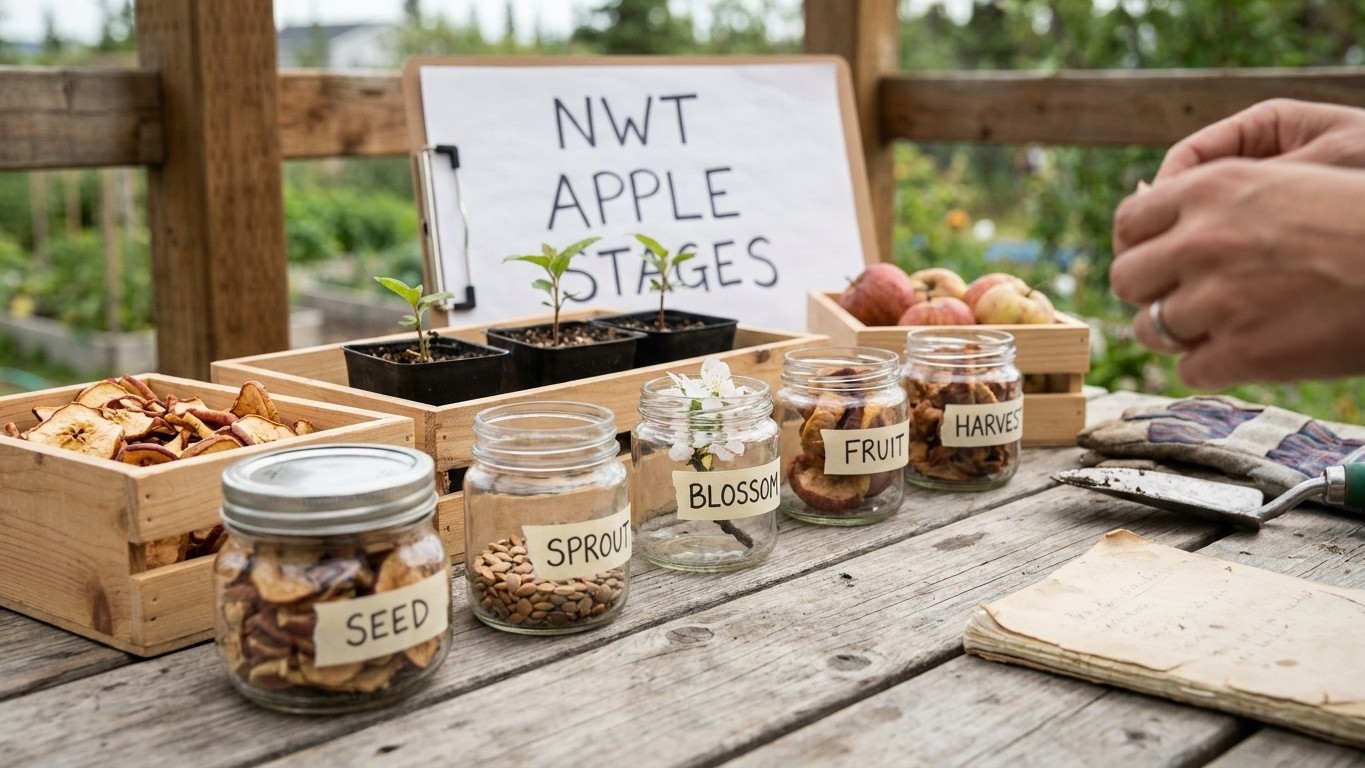

Northwest Territories apple growing runs on a frost window measured at Yellowknife, not on a fixed date. Environment and Climate Change Canada’s 1981-2010 normals for station Yellowknife A put the average last spring frost at May 25 and the average first fall frost at September 18. Because both are averages, frost arrives later than May 25 in roughly half the years on record. Check your tree’s bud stage against that window before you act, not the date on the wall.
The short answer for Northwest Territories
The apple season around Yellowknife runs from an average last spring frost of May 25 to an average first fall frost of September 18, both from Environment and Climate Change Canada’s 1981-2010 Canadian Climate Normals for station Yellowknife A. That leaves an average frost-free stretch of roughly 115 days. Because ECCC states these as mean dates rather than guaranteed cutoffs, frost falls later than May 25 in about one spring out of two, and earlier than September 18 in about one fall out of two. A grower who plants, sprays or pulls protection on the mean date rather than the range around it loses trees or fruit in a good number of those years.
What actually decides the calendar is bud stage, not month. A tree sitting at green tip shrugs off a light frost that would blacken the same tree in full bloom a week later. So the working answer to almost any timing question here is “when the buds reach stage X,” checked against how far the season has run ahead of or behind ECCC’s Yellowknife mean dates that year.
The other hard limit: winter cold
Bloom and harvest dates only matter for a tree that survives the winter in between. ECCC’s normals put the mean daily minimum of the coldest month at Yellowknife at -29.5 °C, a threshold that rules out any apple whose catalogue hardiness rating stops short of deep prairie-style cold. Growing apples in Northwest Territories at all starts with choosing rootstock and cultivar against that number, then fitting bloom and harvest into the frost window second. See Growing Apples in Northwest Territories for the groundwork on siting, rootstock and windbreak before working through this calendar.
Working through it

Each stage below is triggered by accumulated warmth, not a page on a calendar, so treat the dates as what typically happens near Yellowknife’s ECCC mean frost dates, and expect the sequence to shift earlier or later with the actual spring.
Dormancy

The tree sits leafless and inactive through winter and into early spring, tolerating the full depth of the season’s cold, including the -29.5 °C mean minimum ECCC records for the coldest month at Yellowknife. This is the window for pruning, since cuts made on a dormant, frozen tree heal cleanly and there is no soft new growth to damage.
Green tip

Buds swell and split to show a sliver of green, usually once the ground has thawed and daytime warmth has run for a stretch. This is the first stage genuinely vulnerable to frost, though still the most frost-hardy of the green stages, and it typically arrives while the calendar is still well short of the May 25 mean last frost, so protection materials should already be on hand.
Pink

Flower buds cluster tightly and show color before opening, more sensitive to cold than green tip and closer, timing-wise, to the mean frost date. A grower watching the sky at this stage should have frost cloth or a windbreak plan ready rather than improvised.
Bloom

Open blossoms are the single most frost-fragile stage on the whole calendar, and in a short-season climate like this one, bloom often lands close to or after the May 25 mean last frost rather than safely ahead of it. A frost during open bloom can wipe out the entire fruit set for the year even though the tree itself survives undamaged.
Petal fall and fruit set


Once petals brown and drop, the small green fruitlet left behind is somewhat tougher than the open flower but still frost-tender. This is the point to thin excess fruit, and it is also the point to start counting forward: with an average of roughly 115 frost-free days total, and bloom often eating several weeks of that already, only a limited stretch of warm growing time remains to size and ripen fruit before the September 18 mean first fall frost.
Harvest
Fruit is picked once it reaches full size and full color for its cultivar, ideally before, not after, the mean first fall frost of September 18. Because that window is tight territory-wide, the cultivars that actually fit the Yellowknife calendar are early-ripening hardy types rather than late-season storage apples bred for longer seasons further south. The Best Apple Varieties for Northwest Territories page lists which cultivars ripen inside that window rather than past it.
What changes across Northwest Territories
The May 25 and September 18 mean frost dates above describe one place, the Yellowknife A station on the shore of Great Slave Lake, not the whole territory. A large lake, latitude, and distance from any moderating water all shift the real dates in either direction.
- North Slave / Yellowknife area: the reference station itself, with Great Slave Lake’s open water holding heat into autumn along the immediate shoreline and softening the first hard freeze there compared with inland ground nearby.
- South Slave (Fort Smith, Hay River area): lower latitude than Yellowknife, which generally means more growing warmth over the season, though no ECCC figure in this dataset quantifies the exact difference for those stations.
- Mackenzie Valley communities: river-valley sites can trap cool air on still nights, running colder at ground level than the open shoreline at Yellowknife even at similar latitude.
- Beaufort Delta / Inuvik area: substantially higher latitude, with a shorter growing season on both ends of the summer than Yellowknife, meaning any grower there should assume a later spring green-up and an earlier fall frost, not the same dates.
None of these regional adjustments come with a published ECCC normal in the source used for this page, so treat them as direction, not magnitude. The one figure that travels is the coldest-month minimum: a hardiness rating that survives -29.5 °C at Yellowknife is a reasonable starting filter territory-wide, but the frost-date arithmetic still needs to be redone locally rather than borrowed.
The mistakes this climate punishes
An early-blooming cultivar is the single most common way to lose a crop here. If a variety’s bloom lands well ahead of the May 25 mean last frost, and that particular spring runs true to form or later, the flowers open into a frost that a later-blooming cultivar would have avoided entirely. This shows up as a tree that looks perfectly healthy in June with almost no fruit on it.
Feeding a tree late in summer pushes soft, actively growing shoot tips right into the season’s first cold snap. Around Yellowknife, where the mean first fall frost falls September 18, any nitrogen applied much past midsummer risks tissue that has not hardened off before that date arrives, and unhardened tissue is what dies back hardest and can open the door to dieback further down the branch the following spring.
Planting for winter cold that never actually arrives, and ignoring the one that does
Because the -29.5 °C coldest-month minimum ECCC records at Yellowknife is severe, some growers over-correct and plant a rootstock or cultivar rated for far colder extremes than the site ever sees, sacrificing vigor and fruit size for a margin they do not need. The safer read of the numbers is to match hardiness to the actual mean minimum on record, not to the worst winter anyone remembers, and to spend the saved vigor on ripening fruit inside the short frost-free window instead.
The last mistake is skipping frost protection at pink and bloom because the calendar still shows weeks until the mean date. Since May 25 is a mean, not a guarantee, a frost arriving on schedule or even a little early can still land squarely on an already-open bloom in a variety chosen for early flowering, and by the time the damage is visible on the petals there is nothing left to do for that year’s crop.
Checking this against your county
Every date and threshold on this page is anchored to one station, Yellowknife A, and every community elsewhere in the territory should confirm local timing before relying on it. The Government of the Northwest Territories’ Department of Industry, Tourism and Investment maintains agriculture services that a grower can use to ask about site-specific conditions before committing to a planting plan: the territorial agriculture services.
Keeping a simple log of your own bud-stage dates for a few seasons is the cheapest way to replace a borrowed Yellowknife figure with one that actually belongs to your own yard.
Common questions
Can apples even survive winter in the NWT?
Some cultivars can, but only ones with catalogue hardiness rated for extreme cold, since ECCC’s normals put the mean minimum of Yellowknife’s coldest month at -29.5 °C. A cultivar bred for a milder province’s winter is not a safe bet here regardless of how the summer season fits.
How do I know when my tree is at “pink” versus “bloom”?
Pink is the stage where the flower cluster shows color but the petals have not separated from each other yet, still forming a tight ball. Bloom is once individual petals have opened flat and you can see the stamens inside each flower, and it is more frost-fragile than pink.
Should I trust May 25 as my planting date?
No, treat it as the midpoint of a range rather than a safe line, since Environment and Climate Change Canada’s own definition means frost falls after May 25 in about half the years on record at Yellowknife. Wait for the tree’s own bud stage, and keep frost cloth ready past that date rather than putting it away on it.
Does chill hours matter as much as hardiness up here?
Winter chill is rarely the limiting factor in this climate, since the cold is more than deep enough to satisfy any apple’s dormancy requirement. The tighter constraint is the short frost-free stretch between the May 25 and September 18 mean dates, which limits how much ripening time a fruit actually gets after bloom.