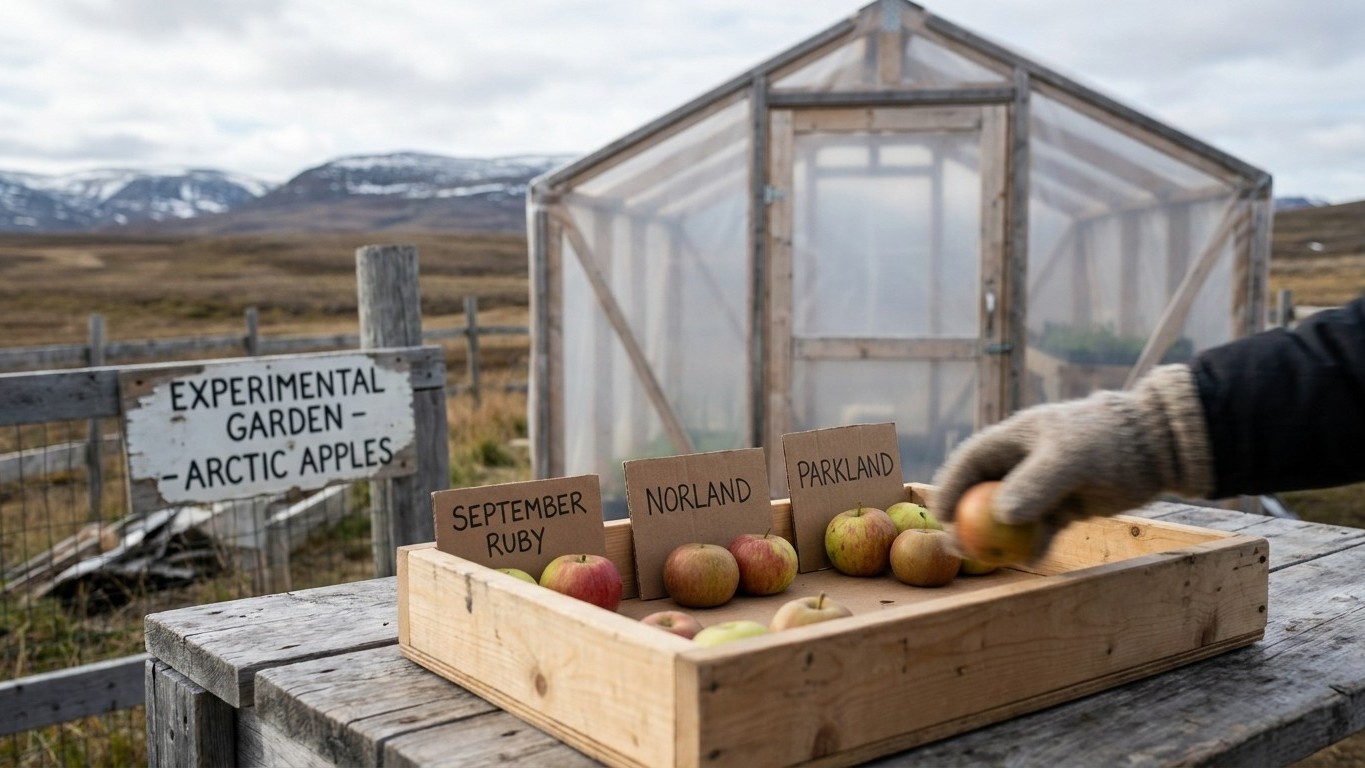

No apple variety in general cultivation is documented as reliable outdoors in Nunavut. Environment and Climate Change Canada’s 1981-2010 normals for Rankin Inlet put the mean daily minimum of the coldest month at -34.3 °C, well past what apple wood is bred to tolerate, and the frost-free window between the average last spring frost and the average first fall frost runs from June 19 to September 13, under three months. The one method with a real track record here is a dwarf apple tree grown in a large container and moved indoors for winter, not planted in the ground.
The short answer for Nunavut
There is no apple cultivar documented as winter-hardy enough to survive an unprotected Nunavut winter. That verdict rests on one figure: ECCC’s Rankin Inlet normals for 1981-2010 record a mean daily minimum of -34.3 °C in the coldest month. That is not the record low, it is the average low across the whole month, and apple wood grown for commercial nurseries is not bred to shrug that off year after year.
The growing season matters as much as the cold. ECCC’s Rankin Inlet normals put the average last spring frost at June 19 and the average first fall frost at September 13. Both are means, not guarantees. In one year out of two, frost arrives later than either date. That leaves a frost-free window of under three months in an average year, and a shorter one in a cold one. A tree that survives the winter still has to leaf out, flower, set fruit and hold that fruit through a summer this short, which asks a lot of a woody perennial bred for temperate summers.
What the answer depends on is whether the tree goes into the ground or into a container. In the ground, the roots sit through the full winter minimum with no buffer beyond snow cover, and Rankin Inlet’s figure is the one that decides the outcome. In a container that comes indoors for winter, the tree only has to survive whatever temperature its storage space holds, and that is a number the grower controls. That distinction, not the cultivar name on the nursery tag, is what actually decides whether a Nunavut apple tree lives to a second year.
Working through it

This page assumes you have already covered the basics in Growing Apples in Nunavut, and it goes straight to which growing method suits the cold. Ranking varieties usually starts with days to maturity or disease resistance. Here the first filter is simpler: does the wood live through the winter at all. Two separate questions decide that, and in this territory they pull in opposite directions.
Hardiness: the filter that decides survival
Hardiness is a tree’s tolerance for cold, and it rules a variety in or out before flowering or fruit ever enter the conversation. Nursery catalogs rate apple hardiness in general terms, and the toughest widely sold cultivars are marketed for winters milder than the one Rankin Inlet’s normals describe. No apple variety in our catalogue database carries a hardiness rating that matches a coldest-month mean minimum of -34.3 °C, so none can be named here as a safe in-ground planting. That is a gap in what is documented, not a claim that every cultivar in existence has been checked.
Chill: not the problem in this climate
Winter chill is the separate question of whether a tree accumulates enough cumulative cold to break dormancy and flower evenly the following spring. Most apple cultivars need a moderate amount of chill, and a mild winter can actually leave them short of it. That is not Nunavut’s problem. A place with a coldest-month mean minimum of -34.3 °C, per ECCC’s Rankin Inlet normals, delivers far more cumulative cold than any apple cultivar asks for. If a Nunavut-grown apple tree fails to flower, storage-cold damage is the more likely cause, not a lack of chill.
Container culture: the path that actually works
The realistic way to grow an apple in this territory is a dwarf tree in a large container, moved outdoors for the frost-free window and into an unheated but insulated space, a garage or a lined shed, for winter. That method sidesteps the hardiness filter almost entirely, because the roots never experience the ground-level winter minimum. The trade-off is real: a containerized tree stays smaller, bears less fruit than an equivalent tree in the ground, and needs repotting every few years as roots fill the pot. It also needs to go back outside close to the average last spring frost of June 19 and come back in well before the average first fall frost of September 13, both from ECCC’s Rankin Inlet normals, with the caution that either date can run more than a week later or earlier in a given year. For the week-by-week version of that move-out, move-in schedule, see The Nunavut Apple Calendar, Stage by Stage.
| Factor | What apple trees need | What Rankin Inlet provides | Verdict |
|---|---|---|---|
| Winter survival (hardiness) | Wood that tolerates the coldest-month minimum without dieback | Mean coldest-month minimum of -34.3 °C (ECCC, Rankin Inlet) | No catalogued cultivar rated for this; in-ground planting not realistic |
| Frost-free season | Enough weeks after leaf-out to flower, set fruit and ripen it | Average last frost June 19 to average first frost Sept 13 (ECCC) | Under three months in an average year, workable in a container only |
| Winter chill | A defined number of cold hours to break dormancy evenly | Far more cumulative cold than any apple cultivar requires | Not a limiting factor here |
What changes across Nunavut
Rankin Inlet sits on the west coast of Hudson Bay in the Kivalliq region, and its normals describe that spot, not the whole territory. Nunavut spans a huge stretch of latitude, and conditions at one end have little in common with the other.
Communities on Baffin Island, in the Qikiqtaaluk region, such as Iqaluit, sit farther south than Rankin Inlet and would be expected to see a milder winter minimum on general latitude grounds, though no ECCC normals figure for that station is used in this piece, so treat that as a directional expectation, not a number to plan around. The Kitikmeot region around Cambridge Bay lies west of Rankin Inlet at a broadly similar latitude, and the High Arctic communities of Resolute Bay and Grise Fiord sit hundreds of kilometres farther north again, well past the tree line, where the case for anything beyond an indoor container weakens further still.
Coastal exposure changes the picture too. A community on open water, Rankin Inlet included, gets some moderation from the sea in the shoulder seasons, while inland or elevated ground away from that moderating water can swing colder overnight even at a similar latitude. None of that changes the core verdict for container growers: whatever the local minimum turns out to be, a dormant containerized apple only has to survive the temperature of wherever it winters, and that is a decision the grower makes, not one the climate makes for them.
The mistakes this climate punishes
Some errors cost a season. In this climate, most of them cost the tree.
Errors that show up first
- Planting a young apple tree straight into the ground on the strength of a nursery tag rated for a temperate-zone winter, without checking that rating against Rankin Inlet’s own coldest-month figure of -34.3 °C.
- Feeding nitrogen into late summer, which keeps growth soft right when the average first fall frost of September 13 (ECCC, Rankin Inlet) is due, and soft wood is the wood a hard freeze kills first.
- Moving a container tree outdoors before the average last spring frost of June 19 has passed, on the assumption that the calendar date matters more than the tree’s own stage of growth.
- Assuming poor flowering is a chill problem and exposing the tree to more cold than it needs. In a climate already far past any apple’s chill requirement, a bad flowering year almost always traces back to winter storage damage, not insufficient cold.
- Skipping the repotting a container tree needs every few years, so roots fill the pot and go into winter already stressed, with less soil mass to buffer the storage-space temperature.
Reading the tree, not the calendar
The date on a calendar is a reference point, not a trigger. What decides the move indoors or outdoors is the tree’s own stage of growth measured against these frost windows, and both windows are averages that shift by more than a week from one year to the next. A grower who watches bud break and leaf drop, and treats June 19 and September 13 as the middle of a range rather than a fixed line, loses fewer trees than one working strictly off the wall calendar.
Checking this against your county
Rankin Inlet’s figures are the most complete public normals for this territory, but Nunavut runs from Hudson Bay to the High Arctic islands, and no single station stands in for all of it. Before committing a container, or a plot of ground, to an apple tree, check current guidance from Agriculture and Agri-Food Canada at agriculture.canada.ca, the federal department, since the territorial site did not return a working page at the time of writing. Local greenhouse programs and community garden groups often hold more specific, on-the-ground experience with what survives a given hamlet’s winter than any published normal can offer, and that local record is worth more than a general figure for a decision this size.
Common questions
Can I just plant a hardy crabapple instead of a regular apple?
Crabapples are often bred hardier than eating apples, but none of the varieties in our catalogue are documented against a coldest-month minimum like Rankin Inlet’s -34.3 °C. Treat any crabapple purchase the same way you would treat a full-size apple: as a container specimen wintered under shelter until you have local evidence it survives in the ground.
Will a potted apple tree actually make fruit this far north?
It can, once it is established over a few seasons, but the frost-free window between the average last frost of June 19 and the average first frost of September 13 is tight for anything with a long fruit-development period. Expect flowering and early fruit set before you expect a full-sized, fully ripe crop.
Do I need two trees to get apples, or is one enough?
Most apple cultivars need cross-pollination from a second tree flowering at the same time, and a lone container tree in a community with no other flowering apples nearby has nothing to cross with. Growers keeping a single tree often hand-pollinate with a small brush, moving pollen between blossoms, rather than relying on insects to find a second tree that does not exist.
What temperature actually kills a dormant apple tree in a pot?
There is no sourced, cultivar-specific figure for that in the data behind this page, so do not treat any number you see quoted online as settled. What is known is that Rankin Inlet’s ECCC-recorded coldest-month mean minimum of -34.3 °C is far colder than unprotected roots in a pot should ever be asked to sit through, which is the whole reason the pot goes into an insulated space for winter rather than staying outside under mulch alone.