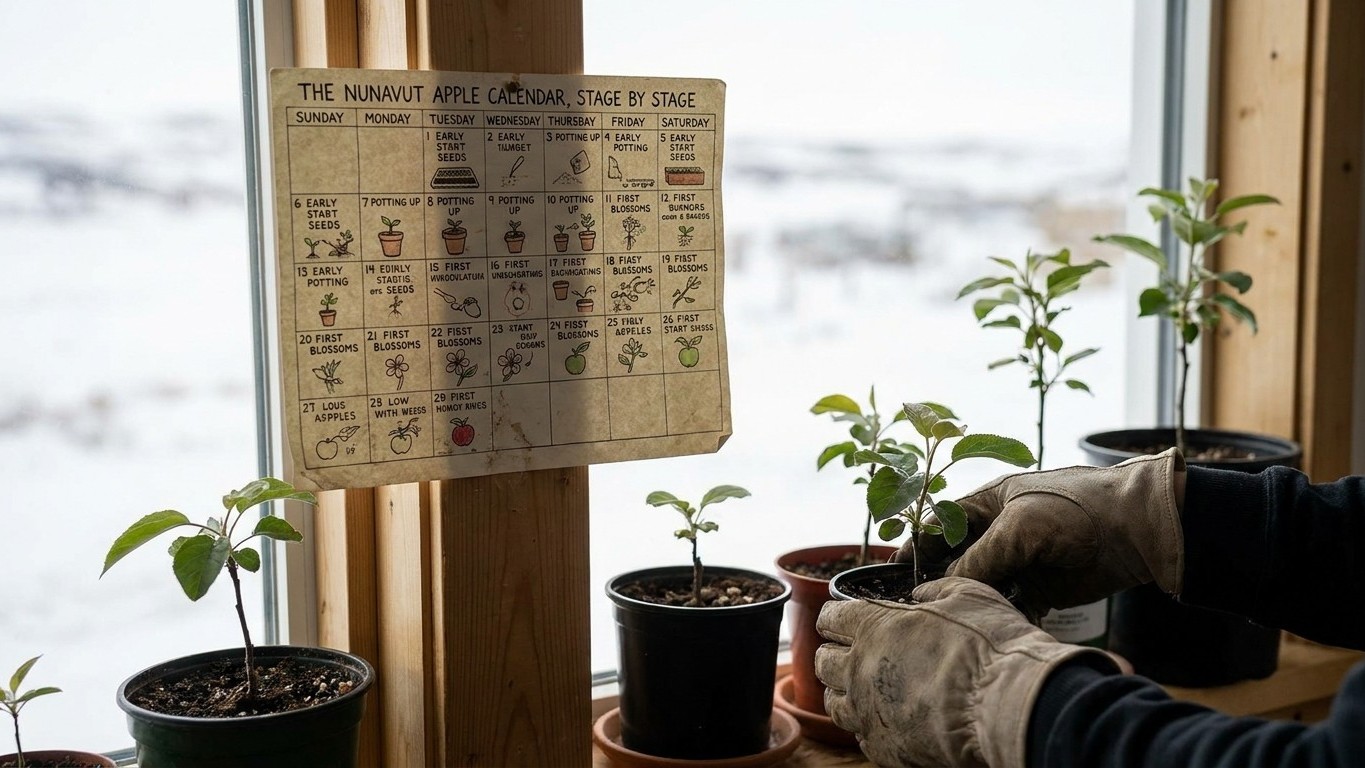

Rankin Inlet’s frost-free stretch runs barely twelve weeks, roughly mid-June to mid-September, and that’s on a good year — nowhere near enough for an apple tree to bloom, set fruit, and ripen outdoors from bare ground. Winters here drop past thirty below, cold enough to kill a rooted tree left exposed in its pot. So the calendar that actually works isn’t a spring-to-fall planting guide at all; it’s a year-round pattern of moving a potted, cold-hardy tree between shelter and daylight, timed stage by stage to this territory’s particular cold.
The short answer for Nunavut
The frost-free window at Rankin Inlet averages about 86 days: Environment and Climate Change Canada’s 1981-2010 climate normals put the mean last spring frost at June 19 and the mean first fall frost at September 13. That’s the entire span in which an apple tree can safely stand outdoors, and it’s already too short for a full bloom-to-harvest cycle on almost any cultivar. The same station records a mean daily minimum of -34.3 °C for the coldest month, cold enough to freeze a potted root ball solid and kill it outright if the tree is left outside over winter.
The practical answer isn’t a planting date. It’s a container schedule: raise a hardy, compact cultivar in a large pot, keep it in an unheated but frost-buffered space through the winter, and only wheel it outside once the mean frost date has passed. What that answer depends on is how conservatively you treat June 19. ECCC’s figure is a mean, not a guarantee: in roughly half the years on record, frost at Rankin Inlet has arrived after that date, so a grower who moves the tree out on June 19 sharp is gambling on the better half of the odds.
It also depends on which cultivar you’ve already chosen, since hardiness zone and bloom timing decide whether the tree can use the short window at all. The broader overview of growing apples in Nunavut covers the container and shelter setup this calendar assumes, and it’s worth reading first if you’re starting from a bare pot and no tree at all.
Working through it

Every stage below is timed off the tree’s own development, not the calendar, because the tree doesn’t know what month it is. A cool spring pushes every stage later than a mild one, so read bud appearance rather than the date on the wall. All of it still has to fit inside the roughly 86-day gap between ECCC’s mean last frost of June 19 and mean first frost of September 13 at Rankin Inlet, and that gap is the frame the whole schedule works around. Before you start, pick a cultivar bred for a short season and a hard winter. Our page on the best apple varieties for Nunavut lists cultivars from the prairie breeding programs that were built for exactly this problem.
Dormancy

Runs from leaf drop in fall through the tree’s own wake-up in spring, which covers most of the year here. The pot has to come indoors or into an unheated but insulated space, because a container’s root ball has no soil mass around it to buffer against Rankin Inlet’s mean coldest-month minimum of -34.3 °C. Roots die at temperatures dormant wood tolerates without trouble, so protecting the pot, not the branches, is the job all winter.
Green tip

The first sign of life is a speck of green pushing through the brown, scaled winter bud. This is the earliest point at which the tree can safely go back outside, and it should not happen before the mean last frost of June 19 has passed, since a hard freeze on newly exposed green tissue at this stage can set the whole season back by weeks.
Pink

Buds swell and show color days after green tip, often faster here than in a milder climate, because the long summer daylight this far north pushes growth hard once it starts. This is the point to check the tree over for winter damage and start watching the forecast closely, since pink tissue is even more frost-tender than green tip.
Bloom

Full flower. Pollinators are scarce this far north, so a soft brush moved from flower to flower on a warm afternoon is worth the ten minutes it takes. It’s the difference between a tree that flowers and one that also sets fruit.
Petal fall and fruit set

Petals drop and the small green swelling left behind is the fruitlet. A frost after petal fall can still happen even though the mean last-frost date has passed, because half of all years run later than that mean, and frost at this stage can abort the fruit set entirely, undoing the season in one night.
Harvest

A full-size apple typically needs well over 100 days from bloom to a ripe fruit, longer than the entire span between Rankin Inlet’s mean frost dates. A tree that blooms in late June often cannot finish ripening outdoors before the mean first frost of September 13. That is why the container schedule includes bringing the tree indoors to finish ripening in a bright, cool space once the outdoor season runs out, rather than leaving it on the branch until frost cuts it short.
What changes across Nunavut
Rankin Inlet, the reference station behind every date on this page, sits on the Hudson Bay coast in the Kivalliq region. Coastal water moderates the sharpest winter cold slightly but also delays spring, since the bay itself stays ice-covered and keeps the air cold well past the point when an inland site would already be warming. A grower on that same coast should expect the true green-tip date to lag the ECCC mean rather than lead it.
Iqaluit, in the Qikiqtaaluk region on Baffin Island, sits well north and east of Rankin Inlet and has no comparably documented frost-normal figure in the data behind this page. Treat any date claimed for that community as unverified until checked directly against a local source, and expect it to run behind Rankin Inlet’s numbers, given the higher latitude.
Communities in the Kitikmeot region, such as Cambridge Bay, sit further from open water and closer to a continental swing: brief hotter summers and harsher winters than a coastal station records even at a similar latitude. Wind exposure matters more than elevation across most of the territory, since little of Nunavut’s inhabited land rises to any real height. An open, wind-scoured yard loses a container’s stored heat faster than a spot tucked against a building wall, regardless of which region it sits in.
None of that changes the underlying rule. Wherever you are in the territory, a container schedule, not an open-ground planting, is what the climate allows, and the local frost dates only shift when you move the pot, not whether you need the pot at all.
The mistakes this climate punishes
Moving the tree outside strictly on June 19 because that date is on this page. It’s a mean, and ECCC’s own record shows frost lands later than the mean in roughly half of all years at Rankin Inlet. A grower who treats June 19 as fixed loses green tip or bloom to a frost that was always a live possibility, then blames the tree rather than the calendar.
Buying a cultivar rated for a milder hardiness zone because it was the one on the shelf. Many widely sold apples are bred for conditions well south of anything Nunavut experiences, and Rankin Inlet’s mean coldest-month minimum of -34.3 °C will kill wood that a warm-zone cultivar was never asked to survive. This shows up not in the first winter, when the tree may go dormant looking fine, but the following spring, when buds fail to open at all.
Feeding the tree in late summer to push one more flush of growth. New growth stays soft and unhardened for weeks, and if that flush is still soft when the first fall frost arrives, on average September 13 at Rankin Inlet, the flush blackens overnight and the tree enters winter carrying dead tissue instead of stored reserves. Stop feeding by mid-summer so the tree has time to harden before the season turns.
Trusting a container’s shelter without checking what temperature that shelter actually holds. An unheated shed or garage slows the drop but does not stop it, and a root ball is far less cold-hardy than the dormant wood above it. The fix is insulation packed around the pot itself, not just four walls around the pot.
Planting straight into open ground because the tag reads hardy to zone 2 or 3. Those ratings assume the insulating snow cover typical of the regions they were bred for. A wind-scoured Nunavut site can lose that snow cover entirely, leaving roots exposed to the ambient air minimum with none of the buffering the zone rating assumed.
Checking this against your county
Every date and figure on this page comes from one station, Rankin Inlet, and Nunavut has no single climate. Before committing a tree to a container schedule, check current guidance from Canada’s federal agriculture department at agriculture.canada.ca. The territorial department’s own site did not respond to a routine check at the time this page was written, so the federal source is the one we can point to with confidence. A local greenhouse society or community garden group, where one exists, will usually have the most current word on what has actually survived a winter nearby, and that is worth more than any normal on a page like this one.
Common questions
Will an apple tree survive outdoors year-round in Nunavut?
No local source documents an apple tree surviving a full Nunavut winter unprotected in open ground. Rankin Inlet’s mean coldest-month minimum of -34.3 °C, recorded by ECCC, exceeds what even the hardiest catalog-rated cultivars are bred to withstand outside a container-and-shelter routine.
Do I need two apple trees for pollination in a sunroom or greenhouse?
Most apple cultivars need pollen from a different cultivar to set fruit reliably, which is true wherever apples are grown, not just in the north. With few outdoor pollinators this far north, a second tree or hand pollination with a small brush matters more here than in a milder climate where bees do the work for free.
Can I order an apple tree from southern Canada and have it survive shipping?
It depends on how the nursery packs the roots and how long the tree sits in transit cold. Ask the nursery directly about their cold-weather shipping practice and aim for a delivery window that lands after your local thaw, so the tree isn’t sitting in an unheated depot during the coldest weeks.
What hardiness zone is Nunavut, and does that number even help here?
Canada’s plant hardiness system and the zone numbers printed on most nursery tags are a coarse filter, useful for ruling out obviously unsuited cultivars but not built around a single Nunavut climate. Rankin Inlet’s own measured normals, the mean frost dates and the coldest-month minimum, tell you more about what a specific tree in a specific yard will actually face than a zone number alone.