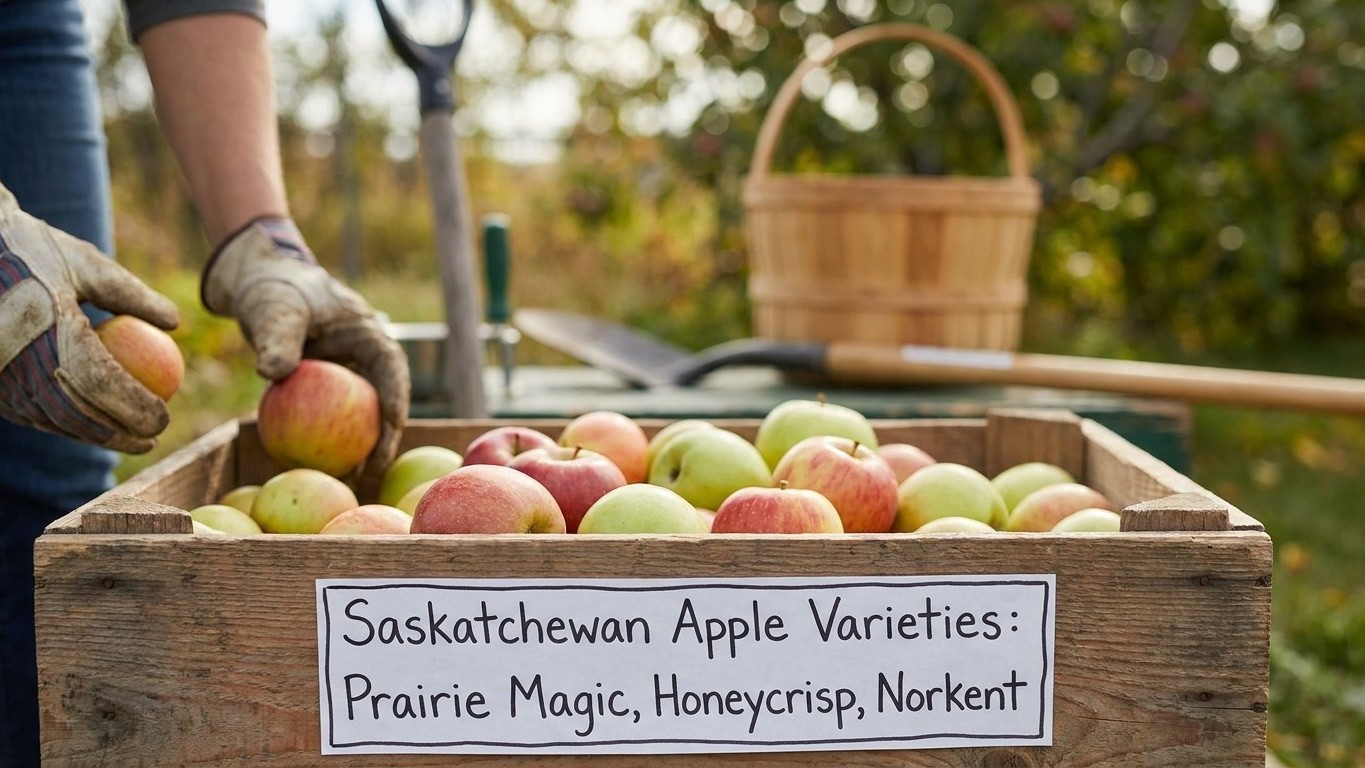

Saskatchewan can grow apples, but only apples bred to survive winter minimums far below what a garden-center label from Ontario or British Columbia was ever tested against. At Saskatoon, Environment and Climate Change Canada’s 1981-2010 normals put the mean daily minimum of the coldest month at -20.7 °C, and that is an average, not the extreme cold a hard winter delivers. The frost-free window there runs, on average, from May 18 to September 18. Before buying a tree, confirm its rootstock and cultivar are both rated for prairie winter extremes, not just labeled “cold hardy” on a generic tag.
The short answer for Saskatchewan
An apple tree survives a Saskatchewan winter only if its wood, not just its rootstock, is rated for cold beyond what most commercial nursery stock is tested against. Environment and Climate Change Canada’s 1981-2010 climate normals for the Saskatoon SRC station put the mean daily minimum of the coldest month at -20.7 °C. That’s an average daily low, not the extreme, so most winters drag well past it for a night or several. Any apple sold as hardy needs a track record against that kind of exposure, not a marketing claim.
The second filter is timing, and it has nothing to do with survival. ECCC’s Saskatoon SRC normals put the mean last spring frost at May 18 and the mean first fall frost at September 18, a frost-free window of roughly four months at the midpoint. Because these are mean dates, frost falls later than May 18 in about half of all years, and earlier than September 18 in the other half. An apple that blooms early and gets caught by a later frost loses its crop for the season even if the tree itself is fine.
So the answer is not one variety. It’s a pair of conditions a tree has to clear: winter survival at minimums colder than the Saskatoon average, and a bloom-to-harvest window that fits inside a frost-free season that shifts by weeks from year to year. If you haven’t yet picked a site or worked out spacing and rootstock, Growing Apples in Saskatchewan covers that groundwork before cultivar selection matters.
Working through it

Ranking apples for this climate starts with what kind of rootstock and top-graft combination the tree is sold on, because the two parts of a grafted apple tree don’t always share the same hardiness. A tender cultivar grafted onto a hardy rootstock can lose its top to a cold winter and regrow as suckers from the rootstock, which is not the tree the buyer thought they planted. Ask the nursery directly whether the cultivar wood itself, not just the rootstock, has been tested through winters at or below the Saskatoon normal.
Categories, from most reliable to least
Working from most reliable to least, three broad categories cover what’s realistically available here.
- Very hardy, small to medium-fruited selections bred specifically for extreme prairie winters. These tolerate minimums well past the Saskatoon average and bloom later, missing most late frosts, though the fruit is smaller and often tarter than a grocery-store apple.
- Mid-hardy dessert types that need a sheltered site (a south wall, a windbreak, a slope that drains cold air) to make it through the coldest nights. They trade some winter margin for better eating quality.
- Low-hardy dessert cultivars bred for milder regions. These are the ones that die back or fail outright in an average Saskatoon winter and belong in an extreme microclimate project, not a standard planting.
| Category | Winter hardiness needed | Bloom timing risk | What you trade for it |
|---|---|---|---|
| Very hardy, prairie-bred | Survives well past Saskatoon’s average winter minimum | Low, blooms later and usually clears the May frost window | Smaller, tarter fruit |
| Mid-hardy dessert types | Needs a sheltered microclimate to match the average minimum | Moderate, mid-season bloom can still meet a late frost | Better eating quality, less winter margin |
| Low-hardy dessert types | Fails in an average winter without heavy protection | High, early bloom is exposed to most late frosts | Grocery-store fruit quality, unreliable survival |
Because named cultivar recommendations shift as breeding programs release new selections and nurseries change what they stock, the reliable way to pick a specific name is to ask a nursery or the extension service which of its current offerings falls in the first category above, and to ask for its documented winter-survival record, not just a hardiness zone printed on the tag.
Whichever category you land on, pollination is a separate cost. Most apples need a second tree or a crabapple blooming within a few days of theirs to set fruit, so factor a pollinizer into the plan before committing to just one tree. For how dormancy, bloom, and hardening line up week by week against the Saskatoon frost dates, see The Saskatchewan Apple Calendar, Stage by Stage.
What changes across Saskatchewan
Every figure above is read at the Saskatoon SRC station, and Saskatchewan is not one climate. Latitude, elevation, and how much open water sits nearby all shift the frost window in one direction or the other.
Regions north of Saskatoon, toward Prince Albert and the boreal fringe, run a shorter season on both ends. Spring green-up and bloom typically start later there, and the first fall frost tends to arrive earlier than the Saskatoon mean, because the frost-free season shortens with latitude across the prairie. An orchard in that part of the province needs a category-one, very-hardy selection and should treat the Saskatoon dates as optimistic, not as its own normal.
South toward the border, around Estevan and the Weyburn area, winters run milder on average, and the frost-free window tends to open earlier and close later than at Saskatoon, giving mid-hardy dessert types a better chance without heavy shelter. Wind exposure matters as much as latitude on open prairie ground. An orchard on a bare rise with no windbreak sees more winter desiccation and dieback than one tucked against a shelterbelt, even at the same latitude and the same average winter minimum.
Large water bodies moderate frost risk nearby. The area around Lake Diefenbaker, the reservoir in the south-central part of the province, holds heat into fall and can push the first frost later for orchards close to its shoreline, the same effect lake-adjacent orchards see elsewhere in Canada. None of these adjustments have their own published normals here, so treat them as the direction to expect rather than a number to plan around, and confirm against a station closer to your own site if one exists.
The mistakes this climate punishes
Four mistakes account for most of the apple failures reported on the prairies, and each shows up at a predictable point in the tree’s life.
Trusting the mean frost date as a safe date
ECCC’s May 18 mean last frost for Saskatoon is a midpoint, not a guarantee. In roughly half of all years the last frost lands after that date. A cultivar that blooms early gets caught in exactly the years the calendar looked safest, because a grower who plants or exposes blossom right around the mean date has no margin left for the years that run late. The mistake shows up as bloom that browns and drops with no fruit set, usually noticed in late May or early June.
Planting for the average winter, not the cold one
The -20.7 °C mean daily minimum for Saskatoon’s coldest month is an average across many winters, and a single hard winter drops well past it. A cultivar chosen because it “survived last winter” on a mild year has not actually been tested. This mistake surfaces two or three winters after planting, when a colder-than-normal January kills wood that looked established.
Feeding late and pushing soft fall growth
Nitrogen applied in mid to late summer keeps a tree pushing new, soft growth into fall instead of hardening off before the first freeze. That new wood is the first to die back when temperatures drop, and it also opens entry points for canker. The fix is to stop feeding well before the mean first fall frost of September 18, giving the tree weeks to harden rather than days.
Buying rootstock hardiness and cultivar hardiness as the same thing
A hardy rootstock can survive a winter that kills the grafted top completely, and the tree that resprouts from below the graft is not the cultivar that was purchased. This shows up as a tree that “comes back” after a hard winter but never produces the fruit the tag promised, sometimes years later when it finally blooms.
Checking this against your county
Every figure in this piece comes from the Saskatoon SRC weather station, and your county’s frost dates, winter minimums, and realistic cultivar list can run differently, especially if you’re north, south, or near a large body of water relative to Saskatoon. Saskatchewan’s Ministry of Agriculture keeps current guidance on tree fruit and orchard planning through its agribusiness and farmer resources, and that’s the place to confirm which named cultivars are currently recommended for your district before you buy. A call to a nursery that specializes in prairie fruit trees, and that can cite its own trial results rather than a catalogue hardiness rating, is worth as much as any published figure.
Common questions
Can you even grow apples in Saskatchewan?
Yes, provided the cultivar’s winter hardiness is proven against minimums colder than the Saskatoon average and its bloom time falls late enough to usually clear the mean May 18 last frost. The failures reported around the province are almost always a mismatched cultivar, not proof that apples can’t grow there.
Do I need two apple trees to get fruit?
Most apple cultivars need a second tree, or a nearby crabapple, blooming within a few days of theirs to pollinate properly. A single tree with no compatible bloomer nearby usually flowers well and sets little or no fruit.
How do I know if a tree died from cold or something else?
Cold damage typically shows as bark that splits or blackens on the trunk’s south or southwest side, sometimes called sunscald, or as wood that stays dead brown well after nearby buds have opened in spring. Disease and drought damage tend to show up patchily across the canopy instead of concentrated on one side of the trunk.
Is a dwarf apple tree a good idea on the prairies?
Dwarfing rootstocks are shallower-rooted and generally less winter-hardy than standard or semi-standard rootstocks, which matters more here than the convenience of a smaller tree. A semi-standard or standard rootstock, even with the extra size to manage, is usually the safer bet where winter survival is the limiting factor.