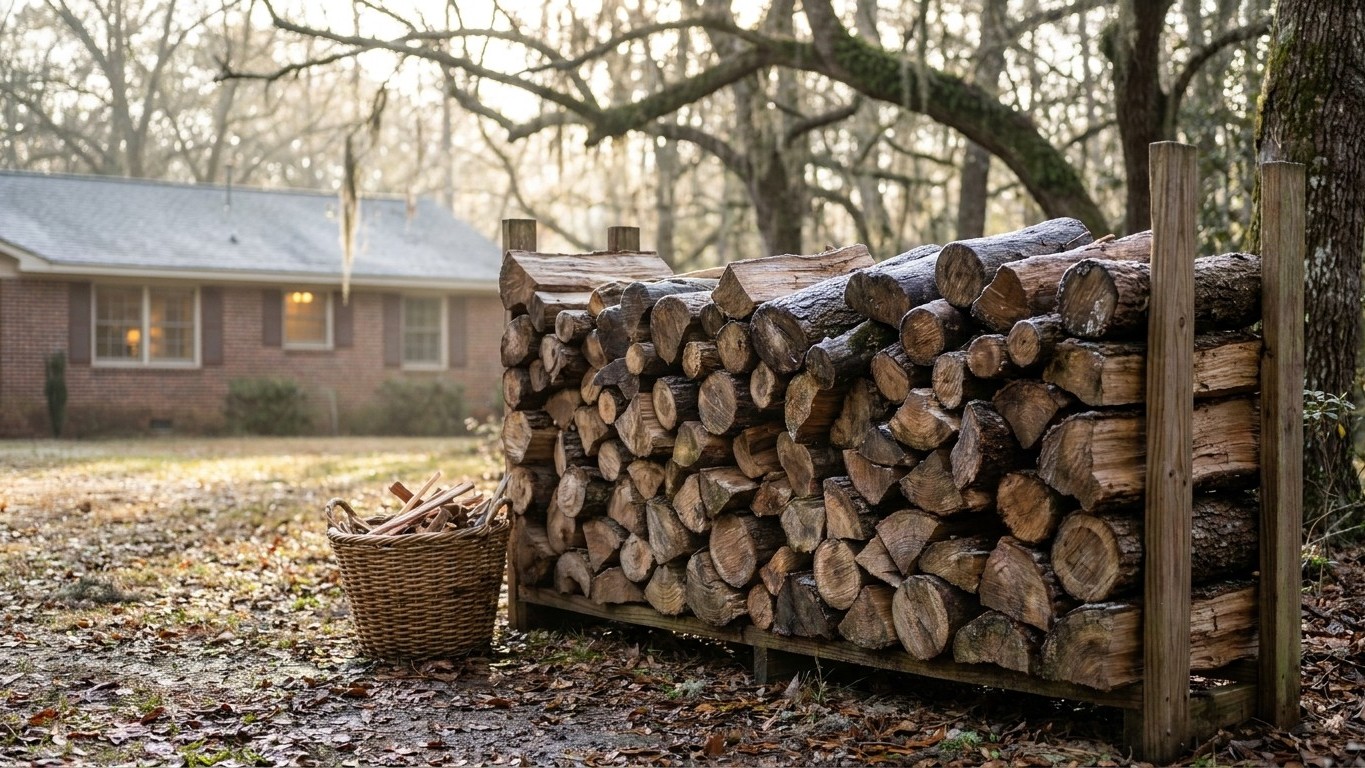

South Carolina’s coldest month averages a low of 38.9°F, based on NOAA Climate Normals for Charleston. That single number tells you almost everything about heating with wood here: nights rarely drop into brutal territory, but they dip below freezing often enough that a fire matters. This guide sorts out which wood earns its space in your rack, how much you’ll actually burn, and how long it needs to dry before it’s worth stacking.
How cold it actually gets here

Charleston’s 38.9°F average low for the coldest month comes from NOAA’s 1991-2020 Climate Normals, and it’s the figure that matters more than any record cold snap you’ve heard about. This isn’t the coldest it’s ever been. It’s the typical overnight low during the worst stretch of an average winter, and it sets a realistic baseline for how hard your firewood needs to work.
That number puts coastal and low-country South Carolina firmly in mild territory. A low near 39°F means most nights don’t threaten pipes or demand a stove running all night to keep a house livable. For a lot of homeowners here, a wood fire is closer to a comfort layer than a survival tool: something to take the chill off a damp evening, cut a heating bill during a cold snap, or make a porch usable in January.
But South Carolina isn’t one climate. The upstate, from the foothills around Greenville up toward the Blue Ridge escarpment, runs noticeably colder than the coastal plain the Charleston normal represents. If you’re heating a cabin or a drafty older farmhouse in Oconee or Pickens County, treat the 38.9°F figure as a floor, not a ceiling, and expect more nights where wood heat is doing real work rather than just setting a mood.
Write your firewood plan for the reader you actually are. If you’re in Charleston, Myrtle Beach, or anywhere along the coast, a modest supply of well-seasoned wood covers the handful of genuinely cold nights each winter, and you can afford to prioritize a wood that burns clean and smells good over one that’s simply dense. If you’re further inland or at elevation, the calculation shifts toward density and burn time, because you’ll be feeding the fire on more nights and you’ll want it to hold through to morning.
Either way, the state’s overall mild profile means firewood in South Carolina is rarely about outlasting a polar vortex. It’s about matching the wood to how often you’ll actually need it, and not overbuying a wood that’s harder to source and season than the winter here requires.
Which woods are worth the effort here
A cord is a fixed volume: 4 feet by 4 feet by 8 feet, or 128 cubic feet, stacked. That means the wood packed into that space is what determines how much heat you get, and denser species simply fit more burnable mass into the same stack. Michigan State University Extension puts well-seasoned hardwood at roughly 20 million BTU per cord on average, which is about the heat equivalent of 145 gallons of #2 fuel oil or 215 gallons of LP gas. That average hides a real spread, though, and in a mild climate like South Carolina’s, matching the wood to the job matters more than chasing the single densest species you can find.
Dense woods for the coldest nights
Dense hardwoods, the oaks and hickories common across South Carolina’s piedmont and upstate, run above that 20 million BTU average because their wood fiber is simply heavier per cord. That density is exactly what you want on the handful of nights each winter when the temperature actually threatens the low 30s or dips into the 20s inland: a dense, well-seasoned log burns longer and holds coals overnight better than a lighter species, which matters if you’re relying on the stove to still have embers by morning. The tradeoff is that dense wood takes longer to season and is more work to split.
Light woods for starting fires and shoulder season
Softer, lighter woods fall below the average and burn faster and hotter up front, but they don’t hold a fire the way dense hardwood does. That makes them useful for getting a fire going quickly or for the shoulder-season evenings common in South Carolina, when you want warmth for an hour or two rather than an all-night burn. They’re a poor choice if you’re depending on wood as your primary heat source through a cold stretch.
Availability often decides more than any table does. A dense species you can’t buy seasoned, or don’t have time to season yourself, is worse in practice than a lighter wood you can actually get dry and ready to burn. Ask any seller what moisture content their wood tested at before you commit to a cord.
| Wood type | BTU per cord (vs. 20M average) | Smoke | Sparks |
|---|---|---|---|
| Dense hardwoods (oak, hickory) | Above average | Low once fully seasoned | Low |
| Medium hardwoods (ash, maple) | Near average | Moderate | Low to moderate |
| Softwoods and lighter species (pine) | Below average | Higher, especially if not fully dry | Higher, due to resin content |
How much wood a winter takes
There’s no honest single number for “cords per winter” in South Carolina, because the right answer depends on your specific house, not the state average. A published figure that ignores your insulation, your climate zone within the state, and whether wood is your only heat or a supplement to a furnace is basically a guess dressed up as data. The only useful approach is to estimate from your own variables.
- Your local cold figure: a low-country home near the 38.9°F coastal normal burns through far less wood than an upstate house that regularly sees nights well below freezing.
- How well your house holds heat: a poorly insulated older home, drafty windows, an uninsulated attic, can burn through roughly double what a tight, well-sealed house uses in the exact same climate.
- Whether wood is primary or supplemental heat: a household using a woodstove as the main heat source needs several times more cords than one lighting an occasional evening fire alongside a working HVAC system.
Run those three down the list for your own place before you order or cut anything. Start with the coldest-month figure for your part of the state, then be honest about your house’s insulation, then decide how much of your heating burden the wood is actually carrying. A drafty farmhouse near Greenville depending on wood as the main heat source could easily need three or four times what a tight, newer coastal home uses for occasional evening fires, even though both are technically in the same state and the same NOAA normals region.
Buy or cut in stages rather than committing to a full winter’s supply at once, especially your first season tracking your own usage. It’s far easier to add another half-cord in January than to have paid for and stacked wood you didn’t need.
Drying wood in this climate
Seasoning matters more than species, and it matters everywhere, but South Carolina’s climate changes the timeline. Green wood can start at over 60 percent moisture, and burning that means the fire has to boil off water before it produces any usable heat, according to Michigan State University Extension. The target, regardless of what part of the state you’re in, is 20 percent moisture or less.
South Carolina’s long, humid summers work against fast drying. What actually pulls moisture out of a log isn’t sunshine, it’s airflow and time, so a stack shaded by trees but exposed to wind will often dry faster than one sitting in direct sun with no air moving through it. Split wood before stacking, and stack it loosely enough that air passes between the rows, off the ground on pallets or rails.
Red oak is the named exception worth knowing if you’re burning it: MSU notes it dries more slowly than most species because of its cell structure, so give it extra time beyond what you’d allow other hardwoods. Never assume any species is ready on a fixed number of months. It depends entirely on how it was split, stacked, and exposed to air, not just the calendar.
The most common mistake in South Carolina is cutting wood in spring and expecting it to be ready for the winter that follows. Split, stacked green wood typically needs a full summer of airflow to reach 20 percent moisture, which means spring-cut wood is usually ready for the winter after the one you’re planning for, not the one immediately ahead. If you’re stacking now for this winter, you’re really seasoning for next year, and this year’s fires should come from wood that’s already had its summer.