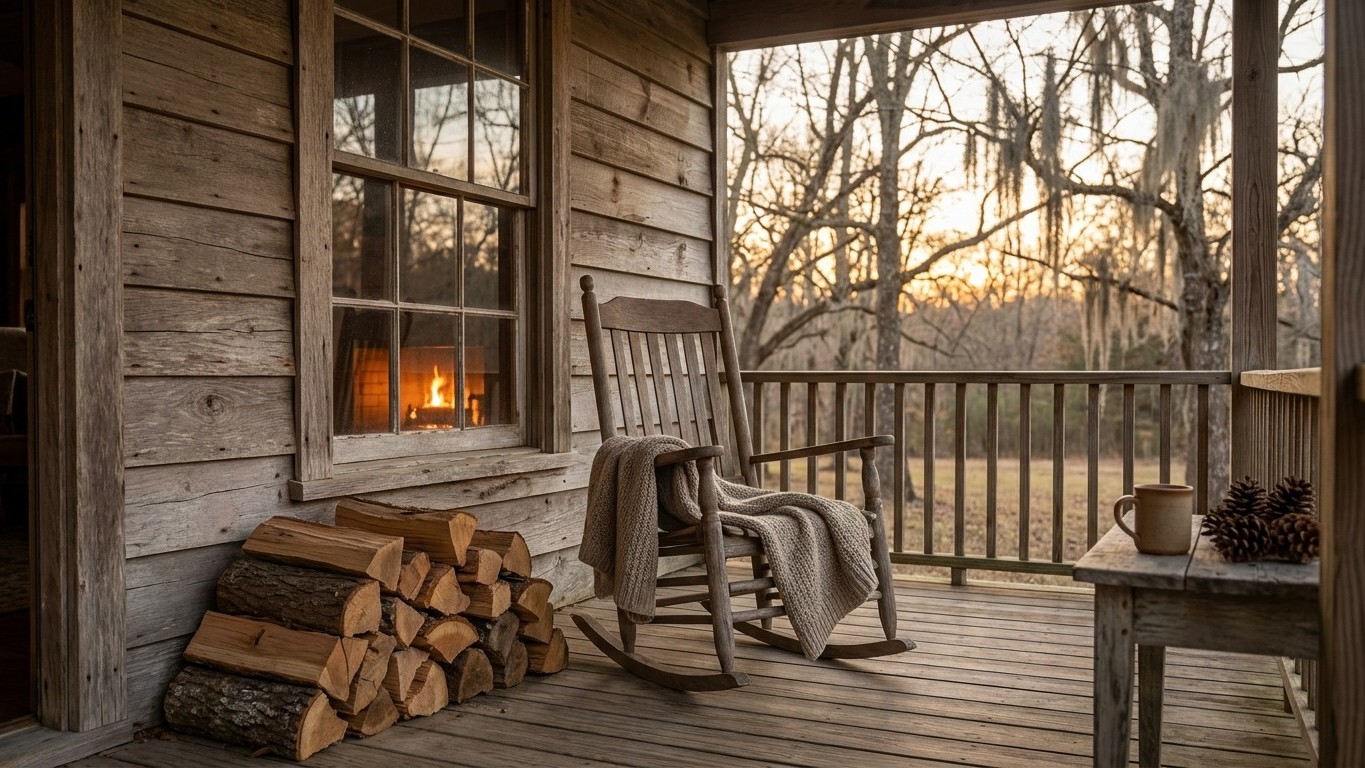

Louisiana winters rarely bite hard enough to make firewood a survival tool. The mild-climate reality changes which woods make sense, how much you actually need to buy or cut, and how much time drying takes before a log is worth burning. Here’s how to match wood to a Gulf Coast winter instead of a Minnesota one.
How cold it actually gets here

The average low during Louisiana’s coldest month sits at 46.1°F, based on NOAA’s 1991-2020 Climate Normals for the New Orleans reference station. That’s not a record cold snap, and it’s not a monthly average either. It’s the typical overnight low during January, the coldest stretch of the year. For a state that gets lumped into “the South” without much nuance, that number does a lot of explaining.
Forty-six degrees is firmly above freezing. A house here doesn’t need to survive nights in the teens or single digits the way homes in the Upper Midwest or New England do. It means pipes rarely freeze from cold alone, furnaces run in short bursts rather than around the clock, and a wood stove is more often lit for the mood of a fire than because the alternative is hypothermia.
That reality should shape how you think about firewood in Louisiana. This isn’t a state where a family stacks four or five cords by October and prays it’s enough to reach March. It’s a state where wood heat is a supplement, an ambiance choice, or a backup for the handful of nights each winter when a cold front actually pushes temperatures down into the 20s or 30s for a night or two. Those events happen, sometimes hard, sometimes for several days running, but they’re the exception in the seasonal data, not the rule.
What this means for your firewood plan
Write your firewood plan for the reader who wants a good fire on a chilly, wet evening, not for the reader trying to keep a cabin above freezing through a five-month freeze. That changes priorities. Volume matters less than it would in a colder climate. Convenience, smoke output, and how pleasant the wood is to burn in an open fireplace start to matter more, because for a lot of Louisiana households, the fireplace is doing atmosphere duty more than it’s doing furnace duty.
It also means the wood you burn doesn’t have to be the densest, longest-burning species available. If you’re only feeding a fire for a few hours after dinner on a cool night, a moderate hardwood that’s easy to source and split gets the job done just as well as the densest species in the state. Save the dense stuff, discussed next, for the nights that actually call for it.
Which woods are worth the effort here
Even in a mild climate, wood density still decides how much heat you get out of a given stack, because a cord is a fixed volume: 4 feet by 4 feet by 8 feet, 128 cubic feet, no matter what species fills it. A cord of dense, well-seasoned hardwood carries more actual wood mass packed into that volume than a cord of a lighter species, and more mass means more fuel to burn. Michigan State University Extension puts the heat value of a cord of well-seasoned hardwood at about 20 million BTU on average, roughly equal to 145 gallons of #2 fuel oil or 215 gallons of LP gas. That’s an average across hardwood species, and it moves depending on which wood you’re burning and how dry it actually is.
Louisiana’s forests lean heavily toward hardwoods, oak and hickory among the most commonly available, with pine widely present as a softer, faster-burning option. Dense hardwoods are worth the extra effort of splitting and seasoning them properly when you want a fire that holds through a longer evening or overnight on one of those genuinely cold nights the state does get. Lighter woods and softwoods earn their keep differently: they’re easier to split, they catch faster, and they’re a smart choice for starting a fire or for the mild shoulder-season evenings that make up most of a Louisiana “winter.” They’re not built to hold a bed of coals all night, and treating them that way just means more trips out to the woodpile.
| Wood type | Heat value | Smoke | Sparks | Best use |
|---|---|---|---|---|
| Dense hardwoods (oak, hickory) | Near the top of the ~20 million BTU/cord average when well-seasoned | Lower once fully dry | Fewer | Cold nights, overnight burns |
| Softer woods (pine and similar) | Below the hardwood average | Higher, especially if not fully seasoned | More, due to resin content | Starting fires, mild evenings |
None of this matters if you can’t actually get the wood seasoned locally. A species with a strong reputation for heat that you can only find green, or that a local seller can’t guarantee has been dried, is a worse choice than a more modest wood you can reliably source already seasoned. Availability and drying time, covered further down, decide as much of the outcome as the species itself.
How much wood a winter takes
There’s no honest single number for how many cords a Louisiana household needs each winter, because the answer depends on three things that vary from one house to the next, not on the state’s climate alone. Any published figure that skips those variables is guessing.
- The cold figure for your area. A winter that mostly hovers in the 40s and dips into the 20s a handful of nights needs far less wood than one with sustained hard freezes, even within the same state.
- How well your house holds heat. Insulation, window quality, and how airtight the house is change consumption dramatically. A drafty older home with single-pane windows can lose heat fast enough that a fire barely keeps pace, while a tightly sealed, well-insulated house stretches the same wood supply much further.
- Whether wood is your main heat source or a supplement. A household burning wood purely for a cozy evening fire alongside a working central heating system uses a fraction of what a household actually relying on a wood stove as primary heat would need.
The mechanism that makes these variables matter isn’t subtle: a poorly insulated house facing a harder-than-average winter can burn through double the wood that a tight, well-sealed house uses in that same climate. That gap has nothing to do with the fireplace or stove and everything to do with how much heat is escaping through the walls, roof, and windows before the fire even gets a chance to warm the room.
Run your own estimate down that list rather than trusting a flat number. Start with how cold your specific area typically runs, adjust up or down based on how drafty or tight your home actually is, then decide honestly whether wood is doing real heating work or supplementing a furnace that’s already carrying most of the load. That gives a far more useful estimate than any blanket “X cords per winter” figure floating around online.
Drying wood in this climate
Seasoning matters more than species selection almost everywhere, and Louisiana’s humid climate makes that lesson sharper, not softer. Green wood can hold over 60 percent moisture, and that water has to boil off before the wood releases any usable heat, according to Michigan State University Extension. Every bit of energy spent boiling off trapped water is energy that isn’t heating your room. The target, regardless of climate, is 20 percent moisture or less by the time you burn it.
What actually dries wood is airflow and time, not direct sun exposure. Split wood stacked so air can move freely through the pile typically reaches that 20 percent mark after one full summer of seasoning. Louisiana’s humid, wet summers stretch that timeline compared to a drier climate, where the same wood might season faster. Stacking matters as much as the calendar: wood left in unsplit rounds, or piled tightly with no airflow, will still be wet inside well past when split, well-stacked wood of the same species would be ready.
Red oak is a specific exception worth knowing if it’s part of your wood supply. MSU notes it dries more slowly than most hardwoods because of its cell structure, so it needs more time seasoned than the general one-summer guideline suggests.
All of this points to the most common mistake Louisiana wood burners make: cutting or buying wood in spring and expecting it to be ready for the following winter. Given the humid summer drying season and the one-summer minimum most hardwoods need, spring-cut wood is usually still too wet come November or December, and burning it green wastes fuel and fills a chimney with more smoke and creosote than dry wood would. Wood meant for this winter needed to be split and stacked well before summer even started; wood cut this spring is really an investment in next winter’s fire, not this one’s.