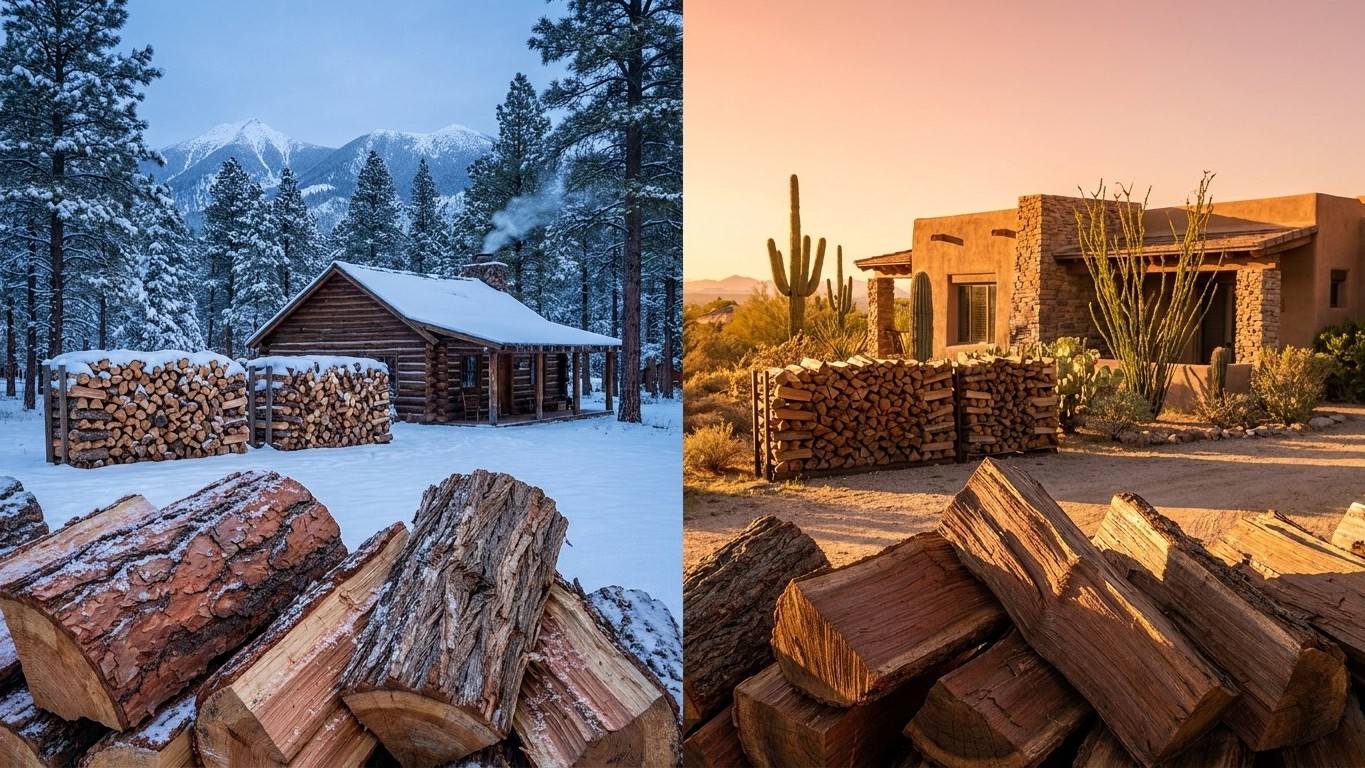

Arizona doesn’t have one firewood answer because it doesn’t have one winter. In Flagstaff or Show Low, you’re heating a home through real snow and nights in the teens. In Phoenix or Tucson, a fire is mostly for ambiance on the dozen or so nights that dip into the 40s. That split changes which wood makes sense, how much you need, and even whether you’re legally allowed to cut it yourself. Mesquite, Emory oak, and alligator juniper cover most of what works statewide, while common pines require more caution than people expect.
Why Arizona’s Firewood Needs Depend on Where You Live

Arizona spans more elevation range than almost any other state, from around 100 feet near Yuma to over 12,600 feet on Humphreys Peak. That’s the difference between a Gulf Coast climate and a Rocky Mountain one, inside a single state’s borders. Coconino County, home to Flagstaff, averages real winter cold and regular snowfall. Maricopa County, home to Phoenix, rarely sees frost at all.
That elevation gap shapes what grows locally, which matters because trucking firewood long distances adds cost fast. In the high country around Flagstaff, Payson, and the White Mountains, ponderosa pine, pinyon pine, alligator juniper, and Gambel oak grow within a short drive. In the low desert around Phoenix and Tucson, native hardwood options are thinner on the ground, so mesquite (which does grow locally in desert washes) becomes the standout choice, while a lot of oak and juniper sold there gets hauled in from northern counties or from New Mexico.
Heating needs also differ by a wide margin. A household in Flagstaff burning wood as a primary or major supplemental heat source might go through 3 to 5 cords over a winter. A Phoenix homeowner using a fireplace a few nights a month might burn through less than half a cord. That changes the math on whether it’s worth seasoning your own wood or just buying it dry a bundle at a time.
The Best Native Woods for Arizona Winters
Four species do most of the work across the state, and each has a distinct personality in the firebox.
Mesquite
Velvet mesquite (Prosopis velutina) is the wood most associated with Arizona, and for good reason. It’s extremely dense, burns hot, and produces long-lasting coals, which makes it a favorite for both heating and grilling or smoking. The tradeoff is that it’s harder to split than oak and it pops and sparks more than most hardwoods, so a screen in front of an open fireplace isn’t optional. Mesquite also tends to have twisted, knotty grain since desert trees grow slowly and irregularly, so expect more work at the splitting stage. It’s abundant in the Sonoran Desert, often available from land-clearing operations and ranch properties around Tucson, Phoenix, and Casa Grande.
Emory Oak and Arizona White Oak
Emory oak (Quercus emoryi) and Arizona white oak (Quercus arizonica) grow in the state’s mountain ranges, particularly in the southeastern sky islands around the Chiricahuas and the Santa Ritas, and into the Mogollon Rim country. Both burn cleaner and steadier than mesquite, with less spark and a more moderate, even heat that’s easier to manage overnight. Oak needs a full season, ideally six months to a year, split and stacked off the ground, to season properly. Buy it wet and you’ll fight smoke and poor heat output all winter.
Alligator Juniper
Named for its thick, checkered bark that resembles reptile skin, alligator juniper (Juniperus deppeana) is common across central and southeastern Arizona’s woodlands. It burns hot with a pleasant aromatic smell, similar to how cedar smells but slightly different in character, and it’s a solid mid-tier choice between mesquite’s intensity and oak’s steadiness. It does produce more resin than oak, so chimney maintenance matters more if you burn a lot of it.
Pinyon Pine
Pinyon pine is prized less for heat output and more for fragrance and quick, easy lighting. It’s a softwood, so it burns faster and cooler than the hardwoods above, but it’s an excellent choice for kindling or for shoulder-season fires when you don’t need maximum BTUs. Much of the pinyon available in northern Arizona right now comes from trees killed by bark beetle outbreaks, which have affected pinyon-juniper woodlands across the Colorado Plateau over the past two decades. Beetle-killed standing dead wood is often already partially seasoned, which can make it a bargain if you’re sourcing it yourself with a permit.
Woods That Cause More Problems Than They Solve
Ponderosa pine is the most abundant tree in Arizona’s high country, covering vast stretches of the Coconino, Kaibab, and Apache-Sitgreaves National Forests. It’s also one of the most commonly burned woods in Flagstaff and the White Mountains simply because it’s everywhere and cheap. The catch is that pine’s high resin content builds creosote in a chimney faster than hardwood does, and undried pine is especially bad about it. If you’re burning ponderosa, plan on a chimney inspection at least once a season, and never burn it green. Well-seasoned ponderosa, split and dried for six months or more, is a reasonable secondary wood, just not one to rely on exclusively for overnight heat retention.
Cottonwood and willow, found along Arizona’s rivers and washes, are poor firewood choices no matter how convenient they are to find. Both are low-density woods that burn fast, produce little heat, and leave behind more ash than hardwoods. They’re fine for a quick evening fire but a bad investment of splitting labor if you’re trying to heat a home.
Palo verde and saguaro, iconic as they are to the Arizona landscape, aren’t firewood at all in any practical sense. Palo verde has green, moisture-heavy wood that resists seasoning, and saguaro is a cactus with a fibrous, largely hollow woody skeleton that burns unpredictably and is also protected under state law in most cases. Neither belongs in a firebox, and cutting a saguaro without authorization can carry legal consequences under Arizona’s native plant protections.
Permits, Restrictions, and Where to Get Wood Legally
Arizona’s national forests, including the Coconino, Kaibab, Prescott, Tonto, and Apache-Sitgreaves, sell personal-use firewood permits that allow cutting standing dead or downed timber in designated areas. These permits are inexpensive relative to buying split wood commercially, but they come with real rules: specific harvest zones, seasonal windows, vehicle access limits, and species restrictions that vary by forest. The Coconino National Forest’s firewood permit page lays out current zones and requirements, and checking directly with the ranger district before heading out saves a wasted trip, since maps and open areas change from year to year based on fire activity and beetle-kill salvage zones.
Fire restrictions add another layer specific to Arizona’s drought cycles. During dry stretches, which have become more frequent and severe, the state and federal forests impose Stage 1 or Stage 2 fire restrictions that can limit or ban open campfires and sometimes even chainsaw use for cutting, regardless of whether you have a valid firewood permit. The Arizona Department of Forestry and Fire Management tracks current restriction levels statewide, and it’s worth a check before any wood-gathering trip in late spring through early summer, when restrictions are most common.
For homeowners who’d rather buy than cut, sourcing shifts by region. In Flagstaff and the White Mountains, local sellers offering seasoned oak, juniper, and pine are common, and buying from someone within the same elevation band usually means the wood is already adjusted to local humidity and won’t need much additional drying time. In Phoenix and Tucson, mesquite dominates the market, often sold by the same suppliers who provide it for barbecue and smoking, and buyers should ask specifically whether the wood has been seasoned for heating use versus sold green for quick grilling fires, since the two markets don’t always overlap in quality expectations.
One detail that catches new Arizona residents off guard: moving firewood across state lines, or even between some counties, can run into pest quarantine rules aimed at stopping the spread of invasive insects like the emerald ash borer, even though ash isn’t a major Arizona firewood species. If you’re relocating from another state and tempted to bring your old woodpile along, check current interstate movement guidance first, since enforcement and rules shift as new pest detections occur nationally.