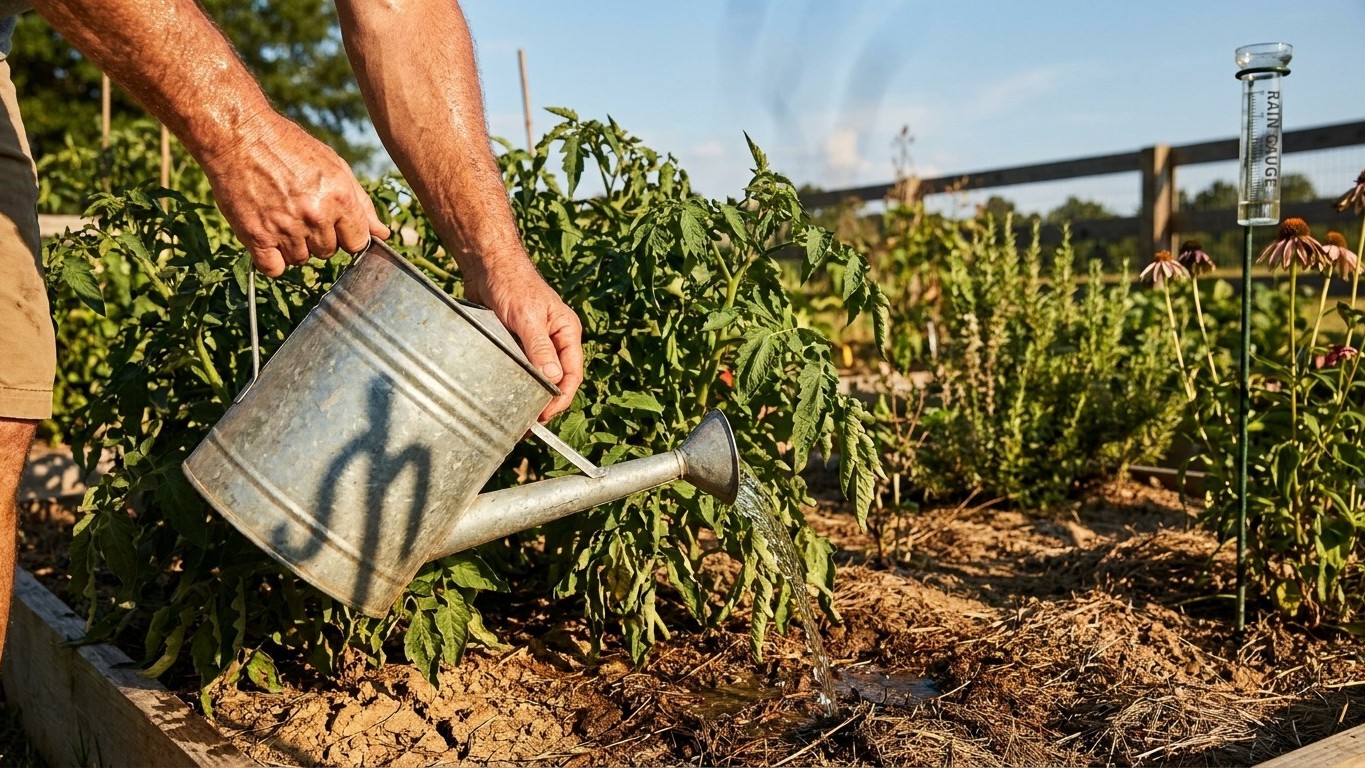

Alabama gardens live and die on heat, not drought. The state’s National Weather Service data show an average of 58.5 days a year hitting 90F or higher at the Huntsville reference station, and that number alone should shape your watering schedule more than any rule of thumb you picked up gardening somewhere else.
What the climate asks of you

Start with what’s actually verified: Huntsville averages 58.5 days a year at 90F or above, based on NOAA’s 1991-2020 Climate Normals. That’s nearly two full months of heat stress stacked on top of whatever rain does or doesn’t fall. Across most of the state, USDA hardiness zones run 7a to 9a, a wide band that means a garden in the Tennessee Valley faces a different frost calendar than one near Mobile Bay.
Here’s the honest gap: there’s no single, sourced summer rainfall total for the whole state that covers every county fairly. Alabama summers bring frequent afternoon thunderstorms, the kind that dump water in one zip code and skip the next entirely. That unevenness is exactly why a rain gauge in your own yard tells you more than a statewide average ever could. Your county Extension office, reachable through the Alabama Cooperative Extension System, can hand you the actual monthly rainfall normals for your specific location, and it’s worth the five-minute call before you set up a watering routine.
Why the heat figure matters more than it looks
Nearly 60 days above 90F means soil surface temperatures spike hard, and shallow water evaporates before roots ever touch it. That single fact rules out casual, light watering. It also means the driest stretch of your particular summer, whichever month that turns out to be where you live, is the month your garden depends entirely on you rather than the sky. Track it for one season with a $5 rain gauge and you’ll know more about your yard’s real needs than any regional average could tell you.
| Verified fact | Value | What it means for watering |
|---|---|---|
| Days above 90F/year | 58.5 (Huntsville) | Long heat stretches demand deep, infrequent soaking, not daily sprinkles |
| USDA hardiness zones | 7a-9a | Frost dates and growing season length vary widely by region |
| Last spring frost (Huntsville) | March 19 to April 3 | Rural and elevated gardens often see frost one to two weeks later |
| First fall frost (Huntsville) | Nov. 2 to Nov. 16 | Rural gardens often see frost one to two weeks earlier |
How much, how often
Deep and infrequent beats daily and shallow, every time. A quick daily sprinkle wets only the top inch or two of soil, which trains roots to stay near the surface, right where the heat bakes hardest during those 58.5 days above 90F. Water deeply instead, so moisture reaches six to eight inches down, and roots follow it there, out. For a closer look at building a routine that holds up during the hottest stretches, see Watering Through a Dry Spell in Alabama. The same principle applies to Watering Pots and Containers in Alabama, where limited soil volume means heat stress hits even faster than in ground beds of the danger zone.
The simplest test for whether it’s time to water doesn’t involve a gadget. Push a finger, or better, a garden trowel, two inches into the soil near the plant’s base. Dry at that depth means water now. Still damp means wait another day and check again. This beats any fixed calendar schedule, because it responds to what’s actually happening in your specific bed rather than what a sprinkler timer assumes.
Soil texture changes the math. Sandy soil, common in parts of southern Alabama, drains fast and holds little, so it needs shorter, more frequent soakings even in a rainy week. Heavy clay, more typical inland, holds water for days but drowns roots if watered again before it’s had a chance to dry, and should never be dug or tilled while still wet, since that compacts it into something closer to brick. If you don’t know your soil type, a simple jar test at home, or a call to your county Extension office, will tell you in a few minutes.
A watering routine that actually works here
- Water early morning, ideally before 9 a.m., so leaves dry before the day’s heat sets in and fungal disease has less chance to take hold.
- Aim the hose or drip line at the base of the plant, never overhead, since wet foliage overnight invites mildew and blight.
- Deliver roughly one inch of water per week to established beds, split into one or two deep sessions rather than daily light passes.
- Check soil moisture at two inches deep every two to three days during any stretch that reaches the 90F range, and water as soon as it tests dry.
- Extend intervals during cooler, wetter weeks, and shorten them on sandy soil, where that same inch drains through in half the time.
Restrictions and rules
Watering restrictions in Alabama are set locally, not by a single statewide law, and they shift depending on reservoir levels, drought status, and the specific water utility serving your address. Some municipal systems impose odd-even day watering during dry spells, others restrict outdoor watering to early morning or evening hours only, and rules can appear or disappear within a single season depending on rainfall.
Because rainfall is genuinely uneven across the state, and because no single number covers every county fairly, it’s worth checking with your local water provider before you set an automatic timer, especially if you live in a faster-growing suburban system where demand strains supply during peak summer. A phone call or a quick look at your utility’s website will tell you what’s currently allowed, and that answer can change from one month to the next.
Where the 58.5-day heat stretch runs long, utilities are more likely to ask for voluntary or mandatory cutbacks, simply because demand for irrigation spikes at the same time reservoirs are under the most stress. Treat any watering schedule as provisional until you’ve confirmed it against current local rules, not last year’s.
Using less
Water conservation in an Alabama garden isn’t about one big fix. It’s a handful of small changes that add up, and each one saves water in a slightly different way.
- Mulch: a two- to three-inch layer of wood chips or straw over the root zone slows evaporation dramatically, often cutting how often you need to water by a third or more during peak heat.
- Drip irrigation: delivers water directly to roots instead of spraying it into the air, where much of it evaporates before it ever reaches soil, especially during those 90F-plus afternoons.
- Grouping plants by water need: puts thirsty vegetables together and drought-tolerant natives together, so you’re not overwatering one bed just to keep another alive.
- Organic matter in the soil: compost worked into sandy soil helps it hold water longer between waterings; worked into clay, it improves drainage so roots don’t sit waterlogged.
- Rain barrels: where local code permits them, a barrel under a downspout captures runoff for free. As a rule of thumb, an inch of rain falling on 1,000 square feet of roof yields roughly 600 gallons of runoff, so even one solid summer thunderstorm can fill a standard barrel. Because Alabama’s rainfall is genuinely uneven storm to storm, don’t count on a full barrel lasting through an entire dry stretch. Check your own rain gauge, not a statewide average, to know how often yours refills.
Common questions
How often should I water my garden in Alabama during summer?
Aim for roughly one inch of water a week delivered in one or two deep sessions, then adjust based on the two-inch soil test rather than a fixed calendar, since rainfall is uneven across the state and your yard may need more or less than a neighbor a few miles away.
What time of day should I water?
Early morning, before 9 a.m. if possible. This gives water time to soak in before the day’s heat, and lets any leaves that got wet dry off before evening, cutting down on fungal problems that thrive in Alabama’s humid summers.
Does Alabama have statewide watering restrictions?
No single statewide rule applies everywhere. Restrictions are set by local water utilities and change with drought conditions and reservoir levels, so check with your specific provider rather than assuming a rule you heard about elsewhere applies to your address.
How do I know if my soil is sandy or clay?
A simple jar test works: fill a clear jar partway with soil, add water, shake, and let it settle overnight. Sand settles first at the bottom, clay stays suspended longest and settles as a fine layer on top. Your county Extension office, through the Alabama Cooperative Extension System, can also test soil samples directly if you want a more precise reading.