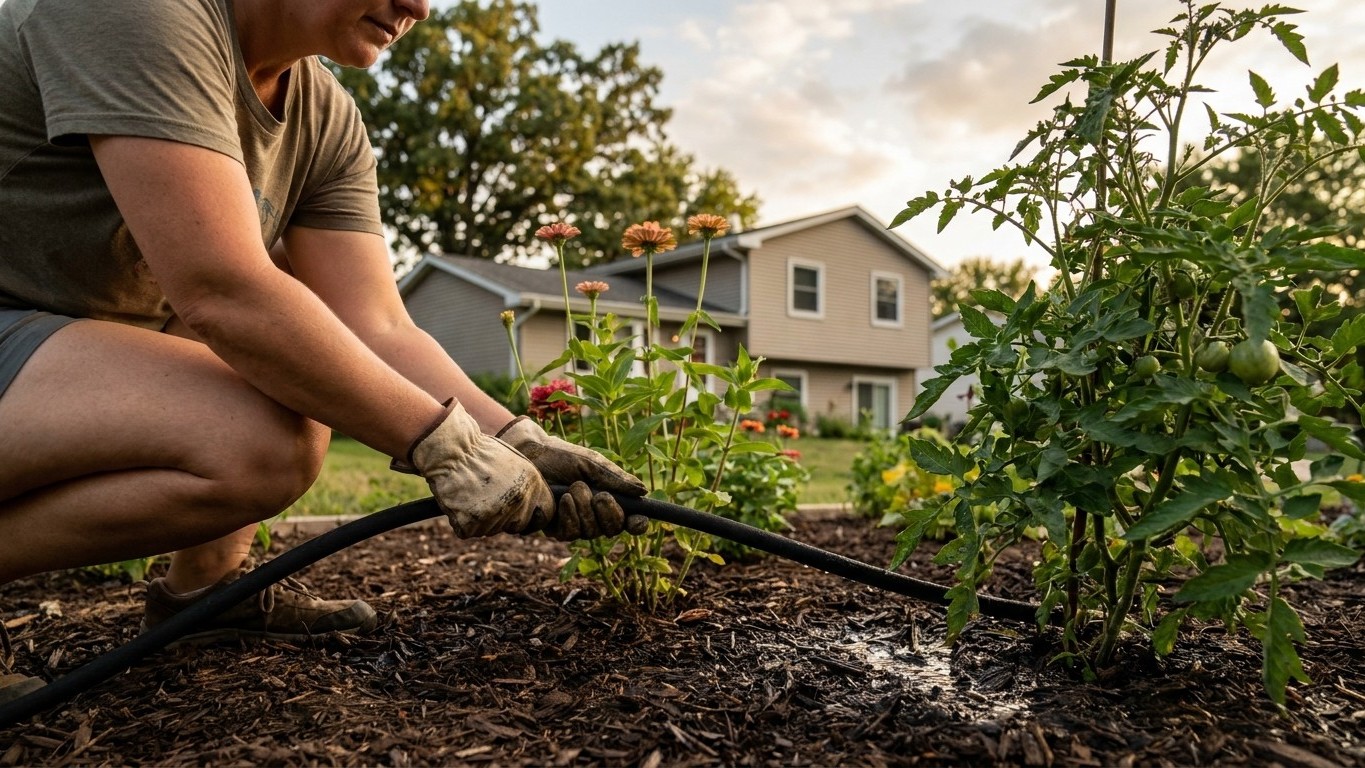

Illinois gardens need roughly an inch of water a week during the growing season, delivered slowly and at the roots rather than sprinkled overhead. How much of that inch falls from the sky and how much you have to carry with a hose depends on where in the state you garden and what your soil holds onto. Local water utilities can also restrict when you’re allowed to run a sprinkler, so the how-often question isn’t only about plants.
What the climate asks of you

The one number that anchors an Illinois summer is heat frequency, not rainfall total: the state’s reference station, in Chicago, logs an average of 14.0 days a year at 90F or hotter (NOAA NCEI Climate Normals, 1991-2020). That’s not a scorching desert number, but it’s enough heat stress, spread across July and August, to push shallow-rooted plants into wilt on the hottest afternoons even when the soil looks damp an inch down.
Rainfall totals for June, July and August are where Illinois stops being one climate and starts being several. The state runs about 400 miles from the Wisconsin border to the Ohio River, and summer rain patterns shift noticeably across that distance, with convective thunderstorms dropping wildly different totals from one county to the next in the same week. Rather than hand you a single statewide figure that would flatten those differences into something misleading, the honest move is to check your own county’s summer rainfall normal through the University of Illinois Extension or the NOAA climate normals for the station nearest you, and build your watering habit around that number specifically.
What doesn’t change from county to county is the arithmetic once you know your local rainfall figure: subtract what the sky delivered this week from the one-inch target, and that’s what you owe the garden by hose or drip line. If your area’s rain arrives in a few heavy bursts rather than spread evenly, don’t assume it evens out. A two-inch downpour followed by ten dry days still leaves the garden thirsty by day six or seven, because most of that downpour ran off or drained past the root zone within a day. For a closer look at keeping plants steady between those bursts, see Watering Through a Dry Spell in Illinois.
Soil texture decides how far that inch actually reaches. Sandy soils, common in parts of northern and central Illinois left behind by glacial outwash, let water drain through fast, so the same rainfall that would carry heavy clay for a week might be gone in two or three days. Clay-heavy ground, which covers large stretches of the state, holds water far longer, but that’s a double-edged trait: it also drowns roots if you add more before it’s had a chance to dry. Knowing which type you’re standing on matters more than any single rainfall figure, and the same logic applies in miniature to anything grown in pots, where soil volume is tiny and drainage habits matter even more; see Watering Pots and Containers in Illinois for that side of the equation.
How much, how often
Deep and infrequent beats a daily light sprinkle every time. A quick five-minute spray each evening feels productive, but it wets only the top inch or two of soil, and roots follow the water, staying shallow and exposed to the next heat spike. A soaking that reaches six to eight inches down pushes roots deeper, where the soil stays cooler and moister between waterings, and that’s what actually gets a plant through one of those 90-degree days.
The simplest way to know when to water isn’t a calendar, it’s your finger. Push it two inches into the soil near the base of the plant. Dry at that depth means it’s time. Still damp, and you can wait. A garden trowel works the same way if you want to check a little deeper, especially for established shrubs and perennials with roots further down.
Here’s a sequence that works across most Illinois soils, adjusted at the point where your ground type changes the answer:
- Check the soil two inches down at the base of the plant, not at the mulch surface, before deciding to water at all.
- Water early morning, ideally before 9 a.m., so moisture soaks in before the heat of the day and foliage dries before evening, which cuts down on fungal disease.
- Apply water at the base and root zone, not overhead. Wet leaves in the evening sit damp overnight, and that’s an invitation to mildew and blight.
- On sandy soil, water more often but in shorter sessions, since the ground can’t hold a full week’s supply at once. Twice a week is a reasonable starting rhythm in a dry stretch.
- On clay soil, water less often but let it run longer and slower, ideally through a drip line or soaker hose, so it has time to soak in rather than pool and run off. Never work or soak clay that’s still wet from the last rain; it compacts and squeezes out the air roots need.
- In a month where your local rainfall normal is at its lowest point in the summer, treat watering as the primary water source for the garden rather than a backup to rain, and set a fixed schedule instead of waiting for the sky.
Restrictions and rules
Watering restrictions aren’t a single statewide policy in Illinois. They’re set locally, usually by a municipal water utility or a regional water district, and they tend to show up during dry stretches or when reservoir and well levels drop, not on a fixed calendar. Some communities restrict outdoor watering to specific days of the week based on odd or even street addresses; others simply ask residents to avoid watering during peak midday demand hours. Because these rules change from one summer to the next and even one town to the next, the only reliable source is your own water provider or municipal website, checked before you set an automatic timer.
In parts of the state where summer rainfall runs on the drier end and irrigation carries more of the garden’s water needs, restrictions are more likely to appear during a hot, dry stretch, simply because utilities are managing higher demand against the same supply. That’s worth checking before you invest in an automatic sprinkler system built around unlimited daily watering. A quick call or website check to your local utility, done once at the start of the season, saves you from redesigning a watering plan mid-July when a notice goes out.
The University of Illinois Extension also tracks drought conditions and can point you toward county-level resources, including any state guidance that gets issued during a serious dry year. That’s a better first stop than guessing based on what a neighboring town does, since rules genuinely differ by water source and system capacity.
Using less
Cutting water use in an Illinois garden comes down to a handful of habits that each do a specific job, rather than one big fix. Layered together, they can meaningfully shrink how much you need to carry by hose, even in a dry August.
- Mulch, two to three inches deep. It slows evaporation from the soil surface directly, which means the water you already applied lasts longer between sessions, especially valuable on sandy ground that drains fast.
- Drip irrigation or soaker hoses. Water goes straight to the root zone instead of evaporating off leaves or drifting in wind, which is where a sprinkler loses a real share of what it puts out.
- Group plants by water need. Thirsty vegetables and drought-tolerant natives on the same zone means one or the other is always getting the wrong amount. Separate them and you stop overwatering the tough plants to satisfy the needy ones.
- Work organic matter into the soil. Compost improves how sandy soil holds water and how clay soil drains it, moving both toward a middle ground that needs less correcting from you.
- Rain barrels, where local rules allow them. An inch of rain falling on a thousand square feet of roof works out to roughly 600 gallons of runoff. In a wetter summer month, that’s real capacity to fill barrels for later use; in the driest summer month, when rainfall drops off, that same roof may deliver next to nothing, and a barrel sized for June can sit empty by August. Plan barrel capacity around your area’s driest month, not its wettest, or you’ll run dry exactly when you need the reserve most.
Common questions
What time of day should I water my garden in Illinois?
Early morning, before 9 a.m. if possible. Water soaks in before the day’s heat arrives, and any moisture left on leaves dries off in the morning sun rather than sitting overnight, which cuts down on fungal problems.
How do I know if my soil is sandy or clay?
Squeeze a handful of moist soil. Sandy soil falls apart immediately and feels gritty. Clay soil holds its shape, feels smooth or sticky, and can be rolled into a ribbon between your fingers. Your local University of Illinois Extension office can also help identify your county’s typical soil type.
Does Illinois have a statewide watering schedule I need to follow?
No. Restrictions, when they exist, are set locally by individual water utilities or municipalities, usually tied to demand or drought conditions, not a single state rule. Check with your own water provider for current rules in your area.
When should I stop worrying about frost and start my regular watering routine?
At the Chicago reference station, the last spring frost typically falls between April 11 and April 22, and the first fall frost between October 24 and November 3 (NOAA NCEI 1991-2020 Climate Normals). Suburban and rural gardens often see frost arrive later in spring and earlier in fall than these dates, sometimes by one to two weeks, so check your own county’s frost data before planting tender crops or easing off on watering discipline.