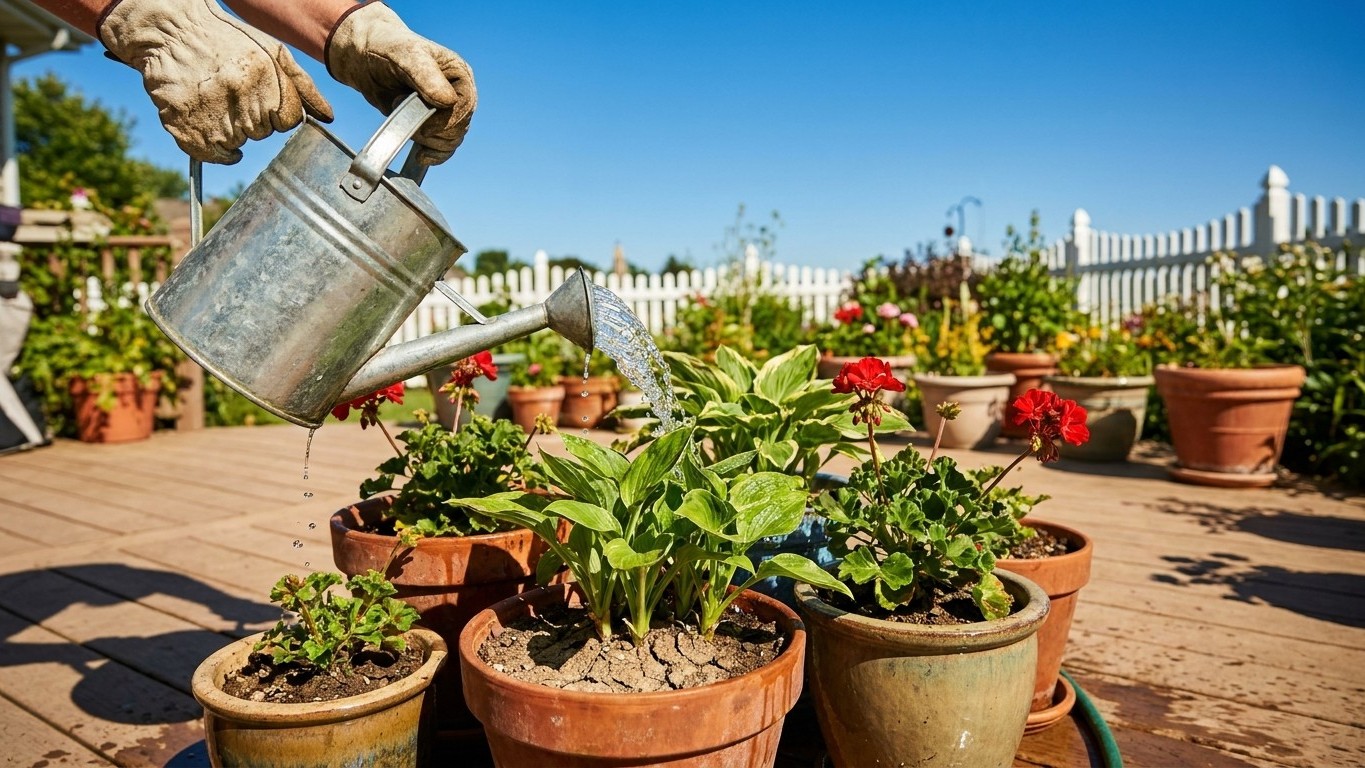

July delivers 3.71 inches of rain across the state’s reference station, the driest month of the Illinois summer, while the same station logs 14.0 days a year at 90F or hotter. Those two numbers together mean a garden gets most of its water from the sky, but a two-week stretch of heat can pull moisture out of the soil faster than July’s rain replaces it.
What changes here

A vegetable bed or a border of perennials wants roughly an inch of water a week to keep growing without stress. In July, the driest summer month, 3.71 inches falls over 31 days, which works out to about 0.84 inch spread across an average week. That leaves a gap of roughly 0.16 inch a week that the gardener has to make up with a hose or a can, if the goal is that full inch.
June runs slightly wetter at 4.1 inches for the month, and August comes in at 4.25 inches, so July is the tight spot in an otherwise fairly generous summer. Across the full June-through-August stretch, the state averages about 12.1 inches, out of 37.9 inches for the year, so summer isn’t dry by national standards. The gap shows up in short windows, not across the whole season.
The 14.0 days a year at 90F or above matter because heat, not rainfall totals, decides how fast that water disappears. A thunderstorm that drops half an inch in twenty minutes during a 90-degree afternoon mostly runs off a hard, sun-baked surface or evaporates before it soaks past the first inch of soil. That’s why a rain gauge reading and a soil check after a storm tell a gardener more than the monthly average ever will.
Soil texture changes how far that same inch travels. On sandy ground, water drains through within hours and roots dry out fast, so the same weekly inch has to arrive in smaller, more frequent doses. On heavy clay, that inch can sit in the top few inches of soil for the better part of a week, which cuts watering frequency but raises the risk of soggy, oxygen-starved roots if more water gets added before the ground has had a chance to drain.
How to water when it matters
Deep, infrequent watering at the base of the plant, done in the morning, beats a quick daily sprinkle for one simple reason: it trains roots to grow downward chasing moisture, instead of staying shallow near a surface that dries out in an afternoon of 90-degree heat. Morning watering also gives leaves time to dry before evening, when cooler air and lingering moisture on foliage create the damp conditions fungal disease needs to take hold.
Checking the soil beats guessing. A finger pushed two inches down, or a trowel lifted from the root zone, tells a gardener whether the plant actually needs water or whether the surface just looks dry while moisture still sits below. Surface soil in July heat can look bone-dry within hours of a soaking rain even when roots are still fine.
- Push a finger or trowel two inches into the soil near the plant’s base before watering at all; if it’s dry at that depth, water now, if it’s still damp, wait a day and check again.
- Water slowly and directly at the base of the plant, avoiding the leaves, until the top six to eight inches of soil are moist, not just the surface crust.
- On sandy soil, plan on watering every two to three days during a stretch of 90-degree weather, since the ground drains fast and holds little reserve.
- On clay soil, stretch that to once every five to seven days, and always check with a finger first since clay can still be wet from the last watering.
- Start from about one inch of water per week as a baseline, delivered in one or two sessions rather than daily doses, then adjust up or down based on what the finger test shows.
- Water in the early morning, ideally before 9 a.m., so leaves dry off before evening and roots have moisture banked before the day’s heat peaks.
That one-inch figure is a starting point, not a rule carved in stone. A raised bed with amended, loose soil dries faster than a slow-draining clay yard, and a container dries faster than either. The finger test settles the argument every time the calendar and the ground disagree.
What goes wrong
Watering a little every day
A light daily sprinkle wets only the top inch or so of soil, and roots follow the water, staying shallow instead of reaching down. Those shallow roots then bake the moment a hot spell hits, because they never developed access to the moisture sitting deeper in the ground. Deep, less frequent watering avoids training roots into that trap.
Watering the leaves at night
Wetting foliage in the evening leaves it damp for hours in cooler, still night air, which is exactly the environment fungal spores need to germinate and spread. Powdery mildew and other leaf diseases show up more often on plants watered at dusk than on ones watered at the base in the morning.
Trusting a rain shower that barely wet the surface
A fast summer storm during one of those 14 days above 90F can dump water that runs off a hard surface or evaporates before it reaches root depth. A gardener who skips watering because “it rained” without checking two inches down can leave a bed dry for days longer than it looks.
Skipping mulch
Bare soil in direct summer sun loses moisture to evaporation fast, undoing much of what a careful watering session just delivered. A two- to three-inch layer of mulch slows that loss and keeps soil temperature more even, which matters most during the stretch of 90-degree days when evaporation runs hardest.
Watering on a schedule instead of by soil condition
On heavy clay, watering again before the ground has drained from the last session pushes air out of the soil and can leave roots sitting in water they can’t use, a slower but just as damaging mistake as letting sandy soil go bone-dry for a week.
Local help
The University of Illinois Extension publishes guidance on garden watering, soil types and local growing conditions county by county. Watering restrictions during dry stretches vary by municipality and water provider, so check with the local utility or district before setting an automatic watering schedule for the summer.
Common questions
How often should I water my garden in Illinois during the summer?
Start with about one inch of water a week, delivered in one or two deep sessions rather than daily. Adjust based on soil type and a finger check at root depth, since sandy soil dries faster and clay holds water longer.
Is July really the driest month for Illinois gardens?
At the reference station, July averages 3.71 inches of rain, the lowest of the summer months, compared with 4.1 inches in June and 4.25 inches in August.
Does the number of 90-degree days matter for watering?
Yes. The reference station logs 14.0 days a year at 90F or above, and those days drive faster evaporation, meaning rain that falls during a heat spell often doesn’t reach root depth the way it would in cooler weather.
What’s the best time of day to water in Illinois?
Morning, ideally before 9 a.m. It gives leaves time to dry before evening, which cuts down on the damp conditions that let fungal disease take hold overnight.