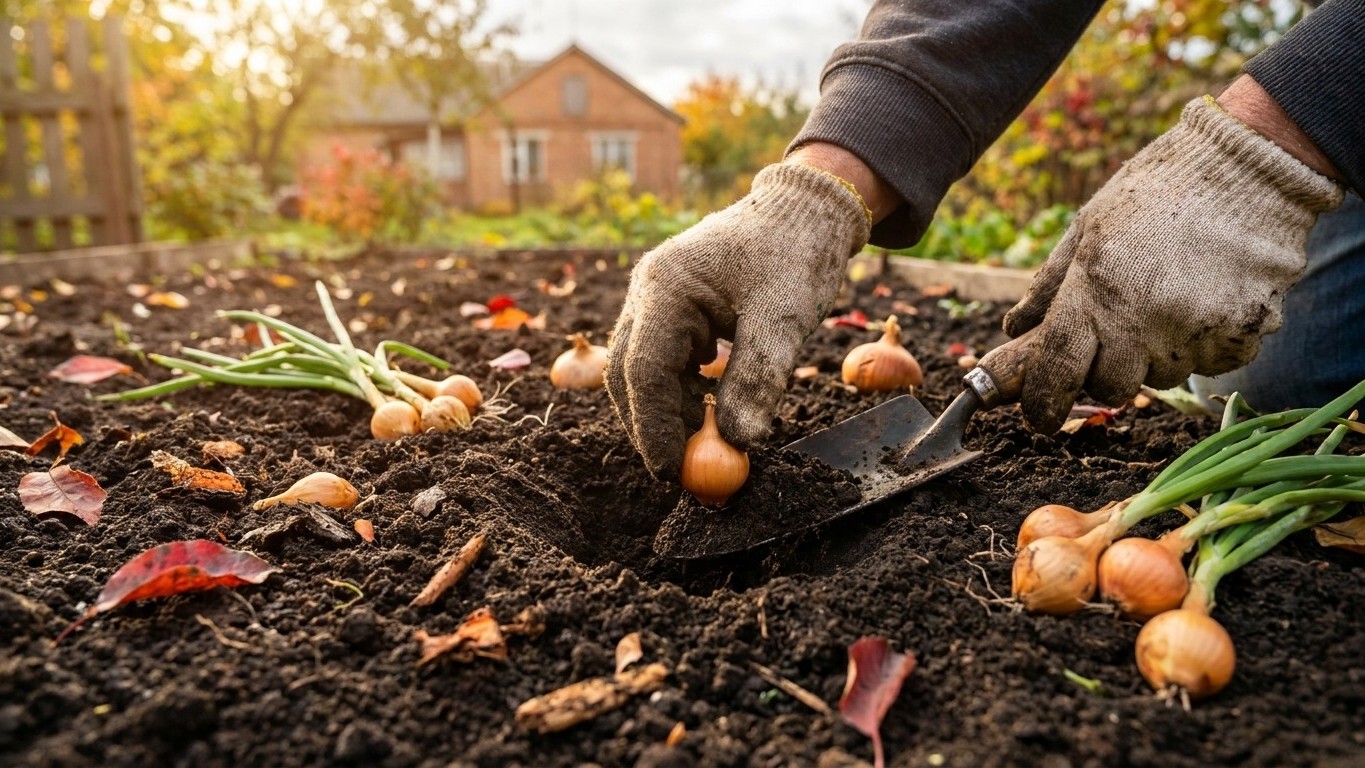

Alabama gardeners get one real shot at a full-size onion bulb each year, and it opens with the calendar, not the thermometer. At 34.64 degrees north, the reference climate station near Huntsville sees 14 hours and 19 minutes of daylight on the longest day of the year. That number, not the last frost date, decides when to plant and what will actually bulb once it’s in the ground.
The short answer for Alabama

Onions don’t form bulbs because the weather warms up. They form bulbs because the day gets long enough to trigger it, a mechanism confirmed by Clemson Cooperative Extension, which puts the bulbing threshold for short-day varieties at roughly 12 hours of daylight. Alabama’s climate hits that threshold early in the season, which is exactly why the planting calendar here looks backward compared to most of the country.
In most of Alabama, onions go into the ground in fall, typically October through November, as young sets or transplants. They spend winter building a root system and a modest cluster of leaves while the weather stays mild enough to avoid a hard kill. When day length climbs past that 12-hour mark the following spring, the plant switches from making leaves to making a bulb, using whatever leaf mass it has already stored up.
That’s a different calendar from what a gardener in Minnesota or Maine follows. Up north, the ground is frozen solid in October and stays that way well into spring, so onions get planted in late winter to early spring instead, as soon as the soil can be worked. Those gardens also reach 15 or 16 hours of daylight at the solstice, which is why they can grow long-day varieties that would never bulb in Alabama at all.
The distinction matters because the two calendars aren’t interchangeable. A fall-planted short-day onion in Alabama and a spring-planted long-day onion in Minnesota are both doing the same thing on the same biological clock, they’re just reading different day-length numbers at different times of year. Plant an Alabama garden on a northern schedule, or the reverse, and the timing simply won’t line up with when the plant is ready to bulb.
What will not work here
Planting an onion late in Alabama doesn’t push the harvest back a few weeks the way it might with tomatoes or beans. It shrinks the bulb outright. Once day length crosses that 12-to-14-hour threshold, the plant stops building leaves and starts building a bulb from whatever size it has already reached, whether that’s a robust six-leaf plant or a spindly two-leaf one. A late-planted onion doesn’t catch up later in the season. It bulbs small and stays that way, because the plant has no way to reverse the switch once the daylight trigger fires.
The other failure mode is choosing the wrong day-length group entirely, and Alabama’s latitude rules out an entire category of onion. Long-day varieties are bred for northern latitudes where summer daylight stretches to 15 or 16 hours. At 34.64 degrees north, the day never gets that long, not even close, on the summer solstice. Plant a long-day onion here and it won’t bulb small. It won’t bulb at all. The plant spends the whole season making leaves, waiting for a daylight trigger that never arrives, and eventually rots in the ground instead of forming anything worth harvesting.
Based on published catalogue ranges, these long-day and one intermediate-day variety are listed for latitudes above Alabama’s and will not bulb here:
- Ailsa Craig (long-day, 38-60N), the day length never reaches its trigger point this far south
- Barolo (long-day, 38-55N), same failure: leaves only, then rot
- Blush (long-day, 38-55N), bred for a daylight window Alabama never hits
- Frontier (long-day, 40-50N), needs summer days well beyond what Huntsville gets
- New York Early (long-day, 38-50N), a northern-latitude bulbing requirement
- Patterson (long-day, 38-55N), no bulb forms without the longer summer day
- Powell (long-day, 43-47N), a narrow northern range far outside Alabama
- Red Carpet (long-day, 40-45N), the trigger threshold is never met here
- Red Long of Florence (intermediate-day, 38-50N), still too far north for this latitude
- Redwing (long-day, 43-65N), one of the most northern ranges on record
- Rossa di Milano (long-day, 38-50N), bred for a longer summer day than Alabama provides
- Safrane (long-day, 42-50N), the plant will not switch to bulbing here
- Talon (long-day, 42-50N), same outcome: foliage, then decline
None of these will “struggle” in an Alabama garden. They simply won’t bulb, and a season spent growing one is a season without an onion to show for it.
What changes across Alabama
Alabama isn’t one uniform strip of latitude, and the reference figures above belong specifically to Huntsville, where the climate station sits at 34.64 degrees north. That’s already close to the state’s northern edge, near the Tennessee line. The Gulf coast around Mobile sits roughly four degrees farther south, which shifts the numbers in a gardener’s favor without eliminating the same basic rules.
| Location | Approximate latitude | What it changes |
|---|---|---|
| North Alabama (Huntsville, reference city) | 34.64°N | 14 h 19 min of daylight on the summer solstice; the figure this page is built on |
| South Alabama (Mobile area) | ~30.5°N | Slightly less daylight at the solstice, milder winter temperatures, and a fall planting window that can open a little earlier and stretch a little longer than it does around Huntsville |
A handful of intermediate-day varieties sit right at the edge of what’s published for this latitude, which is worth flagging rather than glossing over. Bridger, Cabernet, Calibra, Monastrell, Red Long of Tropea, and Walla Walla Sweet all have catalogue ranges that begin just above 34.64 degrees north. That’s not a hard cutoff. It’s a continuum, and a gardener in north Alabama near the Tennessee border is closer to that boundary than one gardening near Mobile. These varieties may bulb in the northernmost pockets of the state, but they’re a gamble rather than a safe bet the way a solidly short-day or mid-range intermediate-day variety would be.
The practical takeaway is that a gardener near Huntsville and a gardener near Mobile are technically in the same state but not quite the same growing reality. The southern grower has a bit more cushion on both ends of the calendar; the northern grower is closer to the line where intermediate-day varieties start becoming unreliable.
Sweet now, or onions that last
Alabama’s climate pushes gardeners toward short-day and intermediate-day varieties, and that choice comes with a flavor and storage trade-off that isn’t accidental. University of Missouri Extension puts it plainly: sweet onions do not store as well as more pungent types. That’s not a marketing distinction, it’s chemistry. The volatile sulfur compounds responsible for an onion’s sharp bite are the same compounds that protect the bulb during long storage. Fewer sulfur compounds means a milder onion on the cutting board, and also one that breaks down faster in the pantry.
Short-day varieties, the ones best suited to Alabama’s daylight and winter pattern, tend to run sweeter precisely because they carry less of that sulfur load. That’s a genuine upside at the table in early summer. A short-day onion pulled in June is often better eaten raw, sliced onto a sandwich or a burger, than pungent varieties grown farther north. But that sweetness comes at the cost of shelf life. These onions are built for eating within weeks or a couple of months of harvest, not for lasting through winter in a root cellar or a pantry shelf.
A gardener farther north, growing long-day onions in a climate where those varieties actually bulb, ends up with the opposite trade. More pungent, sharper-tasting onions that hold up in storage through the fall and often into spring. That’s the practical difference between the two calendars: an Alabama garden hands you onions to eat soon, while a northern garden hands you onions that are still good in March. Neither is better across the board. It’s simply what the latitude, and the chemistry it drives, makes possible.
Checking this against your own garden
Every figure in this article is anchored to one location, the climate station near Huntsville at 34.64 degrees north. A garden in Mobile, Dothan, or Florence isn’t sitting on that exact latitude, and the farther a reader is from Huntsville, the more those numbers shift. Before committing to a planting date or a variety, it’s worth confirming a few things locally rather than assuming a state-wide figure applies to every yard in the state.
- Look up your own latitude, not just “Alabama” as a whole, especially if you garden near the Gulf coast or the Tennessee line
- Check your local average first and last frost dates, since these still determine when transplants can safely go in the ground even on a fall-planting schedule
- Contact your county extension office for planting windows calibrated to your specific region of the state
- Watch your particular winter’s severity, since an unusually cold snap can still damage young fall-planted onions even in a normally mild area
- Track actual day length locally if you’re near the edge of a variety’s published range, rather than relying solely on the Huntsville figures used here