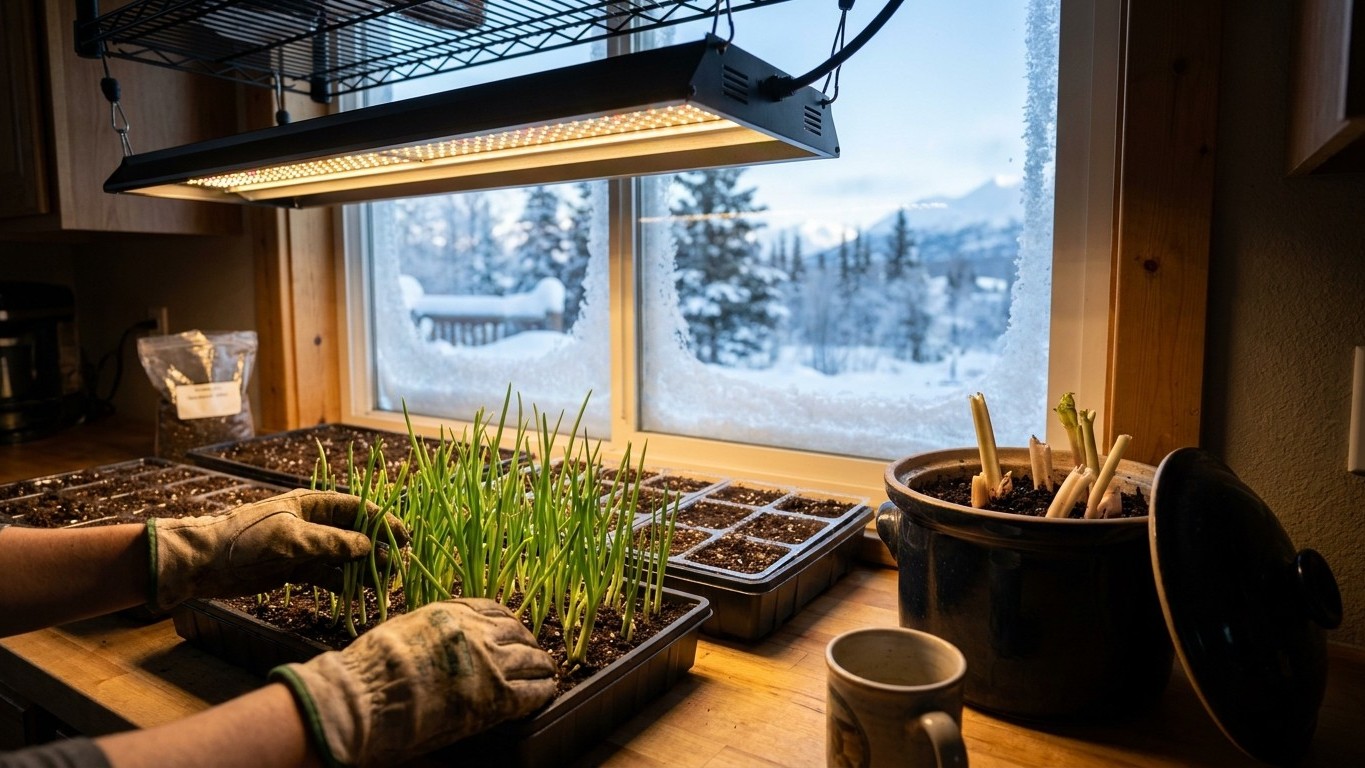

Nothing goes into open garden soil in Alaska in January, not even in Anchorage, the state’s mildest inhabited pocket. What actually happens this month is indoors and under lights: forcing rhubarb or chicory in the dark, starting onions and leeks under grow lights on a countback from spring frost, and working through the dormant-season jobs list that decides how the rest of the year goes.
What goes in the ground in January

No seed and no transplant goes into open ground anywhere in the state this month. The soil profile is frozen solid, and that holds even in Anchorage, where the last spring frost typically falls between May 3 and May 12, based on 1991-2020 NOAA data for freeze probabilities. That’s roughly four months out from January. Across the rest of Alaska, where growing seasons are shorter and colder than the Anchorage reference, the wait is longer still.
Cold frames don’t change the math much this month. The soil beneath the glass is just as frozen as the open ground around it, and daylight is too thin for germination even with the extra warmth a frame provides. This is one of the rare months where a cold frame is basically a storage box, not a growing space.
What’s real this month lives indoors. Forcing rhubarb crowns or chicory roots in a dark, cool space produces tender stalks or chicons on a three-to-five week cycle, and it’s one of the only ways to pull something fresh out of the garden system in the dead of winter. Dug rhubarb crowns and chicory roots that were lifted and stored in fall are the ones to use; nothing planted now will force in time. Seed potatoes and garlic bulbs meant for spring planting should be checked over for soft spots or premature sprouting while they sit in storage, since a bad bulb caught now is a bulb that doesn’t waste a planting slot later. Bare-root fruit trees and cane fruit can be ordered for spring delivery, but the actual planting waits until the ground opens, months from now.
What to start under cover
The right way to time indoor starts is to count backward from the frost window, not forward from the calendar. Using Anchorage’s May 3 to May 12 last-frost range as the reference point, long-season alliums like onions and leeks need roughly 10 to 12 weeks of indoor growth before they’re ready to go outside. Counting back from early May lands the start date squarely in mid-to-late January, which makes this the natural month to get onion and leek seed going under lights.
| Crop | Weeks before transplant | Indoor start window (counting back from May 3-12) |
|---|---|---|
| Onions | 10-12 weeks | Mid-to-late January |
| Leeks | 10-12 weeks | Mid-to-late January |
| Peppers | 8-10 weeks | Late February to early March |
Peppers and other short-window warm-season starts don’t belong on the seed tray yet. Starting them now runs into the first failure mode: weeks of extra growth indoors under imperfect light leaves plants leggy and rootbound long before the ground is warm enough to take them, and a stressed, overgrown transplant rarely outproduces one started on schedule. The opposite mistake, waiting too long on onions and leeks, is just as costly. Alaska’s frost-free window is short enough statewide that a late start on a long-season crop can mean the plant never reaches a useful size before fall frost closes things down again.
What is ready to pick
Outdoors, the honest answer is nothing. Snow cover and frozen ground rule out harvest in the open garden across the entire state this month. Anywhere overwintered kale or leeks were left standing under mulch and snow, they’re insulated but inaccessible, and digging through frozen ground to reach them usually isn’t worth the effort or the risk of damaging the crown.
Indoors is where the food is. Sprouts and microgreens started on a kitchen counter or under a small grow light are ready in one to two weeks and are the fastest fresh crop available this month by a wide margin. Forced rhubarb and chicory, started from stored roots, come in on their own three-to-five week cycle.
Storage checks matter just as much as anything growing. Squash, potatoes, and onions held in a root cellar, garage, or cool pantry should get a hands-on inspection: any squash going soft at the stem end, any potato that’s started to sprout or wrinkle, any onion gone soft in the neck. Pull those out and use them first, since one rotting piece left in a bin of stored produce speeds up spoilage in everything around it.
The jobs that matter this month
Dormant pruning is the biggest task on the list. Fruit trees and cane fruit like raspberries are fully dormant now, which makes it the cleanest window to prune structure and remove damaged wood without stressing the plant or inviting disease into fresh cuts. The one caveat: skip pruning during a hard cold snap, since wood cut in extreme cold is more prone to cracking and dieback around the cut.
Seed ordering has a real deadline attached to it. Alaska’s short season means gardeners lean on a narrower list of proven varieties bred for quick maturity, and the popular short-season cultivars sell out early. Ordering now, rather than waiting for a warmer month, is the difference between getting the variety that’s actually worked in past seasons and settling for whatever’s left.
The rest of the list is quieter but no less useful: planning next season’s crop rotation while last year’s results are still fresh, testing soil pH and nutrient levels so amendments have time to work before planting, turning an insulated compost pile if it’s still active, and cleaning and sharpening tools before the spring rush makes that thirty-minute job feel impossible to fit in. Beds, cold frames, and fencing damaged by snow load are also worth a walk-through and repair now, before frozen ground and deep snow make the fix harder than the original problem.
What not to do in January
The most common misstep this month is treating a mild stretch of weather as a sign the season has turned. Alaska gets occasional midwinter thaws, and a few days above freezing can tempt a gardener to pull back mulch from perennial beds or uncover a cold frame early. Don’t. The freeze-thaw cycle that follows a premature uncovering does more damage to roots and crowns than a steady, unbroken cold ever would.
Starting warm-season seed too early is the second trap. It feels productive to get peppers or tomatoes going the moment the seed catalog arrives, but on the Anchorage frost timeline those crops need to start in late February or March, not January. A seedling that spends two extra months indoors under artificial light usually ends up stretched, weak-stemmed, and slower to establish once it finally goes outside.
Fertilizing dormant plants is the third. Woody plants and anything overwintering outdoors are not actively growing, and nitrogen applied now has nowhere useful to go. At best it’s wasted; at worst it can push soft, untimely growth right when a cold snap is most likely to kill it back.
Checking this against your own county
A statewide month is a starting point, not an instruction, and nowhere is that more true than in Alaska. Elevation, coastal versus interior location, and simple distance north or south can shift these windows by weeks rather than days. The Anchorage frost dates used throughout this page describe one of the mildest parts of the state; interior and northern communities work with a shorter, colder season on a different clock entirely.
The University of Alaska Fairbanks Cooperative Extension Service publishes region-specific guidance for local growing conditions. Its Cooperative Extension Service is the place to confirm local frost timing and hardiness expectations before locking in a planting plan built around a single statewide date.
Common questions
Can anything be planted outdoors in Alaska in January?
No. Frozen soil rules out direct seeding and transplanting statewide this month, including in Anchorage, the state’s mildest inhabited area. The only real garden activity is indoors: forcing stored rhubarb or chicory, starting onions and leeks under lights, and checking stored crops for spoilage.
What USDA hardiness zone is Alaska?
Alaska spans USDA Plant Hardiness Zones 1a to 8a, based on the 2023 USDA Plant Hardiness Zone Map built on 1991-2020 climate normals. That’s an extreme range for one state, driven by the difference between coastal and interior climates, so a zone number alone doesn’t tell you what will survive in a specific location without checking a reference city close to home.
When should onion and leek seed be started for an Anchorage-timed garden?
Counting back 10 to 12 weeks from the Anchorage last-frost window of May 3 to May 12 places the ideal indoor start in mid-to-late January. Starting earlier risks leggy, rootbound seedlings; starting later can leave the plants undersized when transplant time arrives.
Is it worth uncovering perennial beds during a January thaw?
No. A brief warm spell doesn’t mean the cold season is over, and Alaska’s freeze-thaw pattern can return hard within days. Pulling back mulch or row cover early exposes roots and crowns to a freeze cycle that causes more damage than leaving the insulation in place through the full winter.