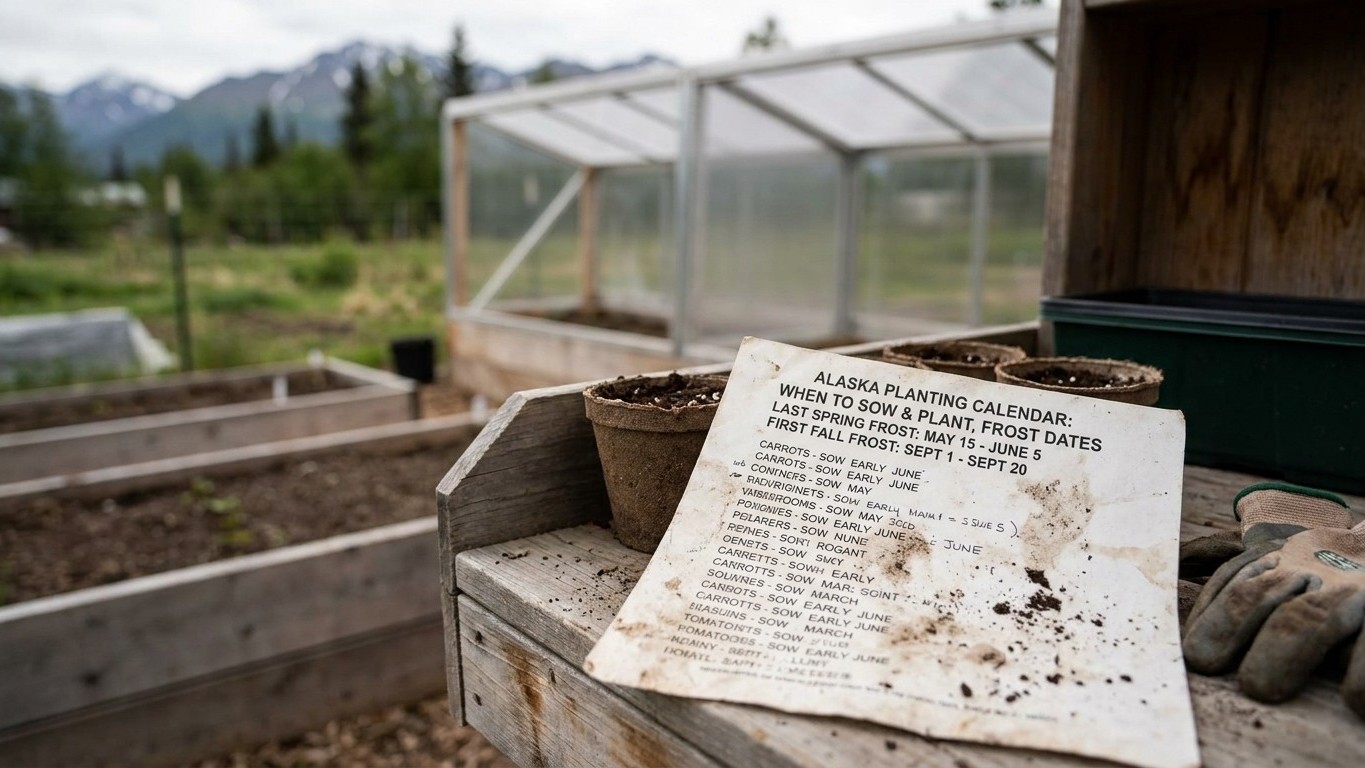

Alaska’s growing season is short, and the question every gardener here asks first is the same: when is it actually safe to plant? Near Anchorage, that window runs from roughly early May to late September, but the real answer isn’t a date on the wall — it’s what your own soil is doing right now. Grab a soil thermometer, push it a few inches into the bed you’re about to plant, and let that number, not the calendar, decide whether today is a sowing day or a waiting day.
The frost window in Alaska

Two dates decide the whole growing season: the last hard freeze in spring and the first hard freeze in fall. At Anchorage, NOAA’s NCEI 1991-2020 Climate Normals put the last spring frost (32°F) at May 3 to May 12, and the first fall frost at September 22 to October 1. Between those two ranges sits a frost-free season of roughly 143 days, measured at the same Anchorage station.
What the range actually means
These are not single dates picked out of the air. NOAA calculates them from three decades of daily temperature records, then reports the window where a 32°F freeze has a 30 to 70 percent chance of occurring. That is why the last frost is written as a nine-day span rather than one date: in some years the freeze risk clears in the first days of May, in others it lingers past the middle of the month. Treat the early end of the range as the point to start hardening off transplants, and the late end as the point to trust the soil has warmed for good.
Anchorage sits among the mildest inhabited parts of the state. The Interior around Fairbanks and the areas farther north run considerably colder and shorter, with frost risk persisting later into spring and returning earlier in fall. If you garden outside the Anchorage bowl, use these dates as a reference point rather than a match, and lean on the long summer daylight, often eighteen hours or more at this latitude in June, which pushes plant growth along faster than the day count alone would suggest. That daylight is part of why a season this short still produces a full tomato harvest for some gardeners, even though a Lower 48 gardener might assume the days simply run out too soon. For a sense of how different that math looks farther south, the California Planting Calendar works from a frost-free season measured in months rather than weeks; before that window even opens, What to Plant in Alaska in January covers the earliest planning steps, What to Plant in Alaska in February covers the earliest indoor starts, and once the last frost dates above actually arrive, What to Plant in Alaska in May covers the first outdoor sowings, and at the other end of the season, What to Plant in Alaska in December covers the final tasks once the frost-free window has long closed, and at the other end of the season, once frost has closed things back down, What to Plant in Alaska in November covers the final outdoor tasks before winter season, What to Plant in Alaska in September covers the final harvest push before that frost-free window opens fully, What to Plant in Alaska in June covers the peak of the outdoor planting season closes again in fall, What to Plant in Alaska in October covers the last harvests and season-ending tasks is fully open, What to Plant in Alaska in July covers the peak of the growing season, What to Plant in Alaska in March covers the indoor starts and early prep worth doing while the ground is still frozen, and once you’re past midsummer, see What to Plant in Alaska in August for what still has time to mature before that first fall frost.
Cool-season crops
Peas, spinach, lettuce, radishes, and the brassica family tolerate a light frost and actually prefer to germinate in cool soil, so they don’t wait for the last frost date the way a tomato does. In Anchorage, that means these crops can go into the ground well before the May 3 to May 12 last-frost window closes, as soon as the soil can be worked — for a full month-by-month breakdown, see What to Plant in Alaska in April, as soon as the soil can be worked and isn’t still frozen or waterlogged from snowmelt.
Direct-sown crops versus transplants
Peas and spinach germinate at soil temperatures too cold for most other vegetables, and a light frost after they emerge rarely sets them back. Radishes and many loose-leaf lettuces follow the same pattern: sow them directly once the ground is workable, without waiting for frost risk to pass completely. Root crops like carrots and beets need slightly warmer soil to germinate evenly, so most Alaska gardeners hold those a couple of weeks later than peas, though still well ahead of tomatoes.
- Peas: direct sow as soon as soil is workable, tolerates hard frost once established
- Spinach: direct sow early, bolts fast if planted too late into long daylight
- Lettuce (loose-leaf): direct sow early, or transplant for a faster start
- Radish: direct sow early, matures fast enough for a second spring crop
- Carrots and beets: direct sow slightly later, needs warmer soil to germinate evenly
- Brassicas (cabbage, broccoli, kale): start transplants indoors, set out while some frost risk remains
Cabbage, broccoli, and kale are usually started indoors as transplants and moved out while some frost risk is still on the table, since a young transplant handles a light freeze better than direct-sown seed handles cold, slow-germinating soil. Because the season is short even at Anchorage, many gardeners succession-sow radishes and lettuce every couple of weeks through late spring and into summer, since the long daylight keeps germination brisk and a first sowing can bolt before a second one is ready to pick.
Warm-season crops

Tomatoes, peppers, squash, beans, and corn all need warm soil, not just frost-free air, to grow well. Soil at 40°F barely wakes up a bean seed, and a tomato transplant set into cold ground will often just sit there, stalled, for weeks even if the air temperature is safely above freezing. That’s why the rule for warm-season crops in Alaska is wait for the soil to warm, not just for the calendar to clear the frost date.
Starting tomatoes indoors and counting back
Almost every tomato variety grown in Alaska is started indoors as a transplant, since direct-sown tomato seed has no realistic chance of reaching maturity inside a season this short. Seed packets typically call for starting six to eight weeks before the outdoor transplant date. Counting backward from a mid-May to late-May transplant window, most Alaska gardeners are sowing tomato seed indoors in late March to early April.
Days-to-maturity figures on a seed packet are counted from the transplant date, not the sowing date, and they shift by a week or two depending on how warm and sunny the season runs. The table below works from the Anchorage last-frost window of May 3 to May 12: setting transplants out in the second half of May, after that window closes, and adding each variety’s catalogue days to maturity gives an approximate first-harvest date, which can then be checked against the September 22 to October 1 first fall frost for margin.
| Variety | Days to maturity | Type | Set out | First ripe | Margin before frost |
|---|---|---|---|---|---|
| Sakura | 55 | Indeterminate | Mid to late May | Mid July | ~64 days |
| Edox | 55 | Indeterminate | Mid to late May | Mid July | ~64 days |
| Valentine | 55 | Indeterminate | Mid to late May | Mid July | ~64 days |
| Glacier | 55 | Determinate | Mid to late May | Mid July | ~64 days |
| Sun Gold | 57 | Indeterminate | Mid to late May | Late July | ~62 days |
| Juliet | 60 | Indeterminate | Mid to late May | Late July | ~59 days |
| Supersweet 100 | 60 | Indeterminate | Mid to late May | Late July | ~59 days |
| Amalfi | 68 | Determinate | Mid to late May | Early August | ~51 days |
| Cherokee Purple | 72 | Indeterminate | Mid to late May | Early August | ~47 days |
| Big Beef Plus | 72 | Indeterminate | Mid to late May | Early August | ~47 days |
| Tiren | 75 | Indeterminate | Mid to late May | Early August | ~44 days |
| Granadero | 75 | Indeterminate | Mid to late May | Early August | ~44 days |
| San Marzano II | 78 | Indeterminate | Mid to late May | Mid August | ~41 days |
| Celebrity Plus | 78 | Determinate | Mid to late May | Mid August | ~41 days |
Short-season varieties like Sakura, Edox, Valentine, and Glacier carry the widest cushion, over 60 days between first ripe fruit and the average first fall frost. Longer-season varieties such as San Marzano II and Celebrity Plus still ripen before the September 22 to October 1 window in an average year, but with roughly six weeks of margin instead of nine, which leaves far less room for a cool, cloudy summer to push the harvest later. Peppers, which need even warmer soil than tomatoes to set fruit, and squash and corn, which resent any check to their roots, generally do best in Alaska under some form of season extension such as a low tunnel or a small greenhouse, rather than fully in the open ground. Compare that to the Puget Sound climate covered in the Washington Planting Calendar, where summers run milder than Alaska’s but the frost-free season still stretches months longer.
The fall planting window
Working backward from the first fall frost is the other half of the calendar, and it matters as much as the spring end for anyone who wants a second round of quick crops or a longer harvest of what is already in the ground. At Anchorage, NOAA’s 1991-2020 normals put the first fall frost at September 22 to October 1. Subtract a crop’s days to maturity, plus extra time for the slower growth of shortening fall daylight, and that sets the last safe sowing date.
Counting backward for a fall crop
A radish that matures in a few weeks in June can take noticeably longer in late August and September, as daylight shortens and temperatures drop, so it’s worth padding the days-to-maturity figure by at least a week or two when sowing for fall rather than spring. Spinach and loose-leaf lettuce, both fast growers, are usually the safest bets for a late-summer sowing aimed at a fall harvest, since even a stunted crop is generally still worth eating at a smaller size.
Some crops actually improve after a light frost rather than being ruined by it. Kale, carrots, and brussels sprouts convert stored starches to sugars when nighttime temperatures drop toward freezing, which is why gardeners in cold climates often leave these in the ground deliberately past the first light frost rather than rushing to harvest before it. A hard, repeated freeze will eventually damage them, but the first frost or two is generally a benefit rather than a threat for this group.
Because the first fall frost at Anchorage can arrive as early as September 22 in some years, treat that early end of the range as the planning date for anything you want to harvest before frost risk becomes serious, and treat October 1 as the outer edge you can push a frost-tolerant crop toward if the weather is cooperating. Gardeners farther from Anchorage, especially at higher elevation or in the Interior, should expect that window to close earlier and should shorten their fall planting math accordingly.
Reading a planting calendar properly
A statewide planting calendar, including this one, is built from a single weather station and should be read as a starting point, not an instruction to follow to the day. The Anchorage figures come from one NOAA station, and Alaska’s geography produces enormous local variation that no single date range can capture.
What actually shifts the dates where you garden
Elevation is one of the biggest factors: a garden a few hundred feet higher than the valley floor can run a week or more behind on both ends of the season. Proximity to open water changes things too, since a lake or the coast moderates temperature swings in ways that can either protect a garden from an early frost or, in a low-lying frost pocket near still water, make it more vulnerable. Urban areas like downtown Anchorage hold a bit more heat overnight than the surrounding hills, which is part of why frost dates measured at the airport station don’t necessarily match a garden in a colder pocket a few miles away. Alaska’s more remote regions, including the Interior and the areas farther north, aren’t just colder on average. They also see harder late cold snaps that a statewide range can’t predict at all.
The better approach is to treat the published dates as the outer bounds and then watch your own garden for the signals that matter more locally: whether the soil has actually thawed and warmed at planting depth, whether a late cold snap is forecast even after the average last-frost date has passed, and how your own yard performed in past years. A logbook of your own frost dates, kept over a few seasons, ends up being more useful than any published range, including this one. For guidance specific to your own region of the state, our Alaska guides break down conditions beyond the Anchorage bowl.
Local help
For frost dates, soil testing, and planting advice specific to your borough, contact the University of Alaska Fairbanks Cooperative Extension Service. Local agents can confirm how far your own dates run from the Anchorage figures, and most offices offer soil testing that will tell you more about when your particular garden bed is actually ready to plant than any regional calendar can.
Common questions
Can I grow tomatoes outside in Alaska without a greenhouse?
Yes, especially with a short-season variety like Sakura, Edox, Valentine, or Glacier, all rated at 55 days from transplant, which leaves roughly nine weeks of margin before the average Anchorage first fall frost. A cool or cloudy summer can still eat into that margin, so many gardeners hedge with a wall of water or a low tunnel for the first few weeks after transplanting.
What’s the fastest tomato I can grow in Alaska?
Among the varieties covered here, Sakura, Edox, Valentine, and Glacier all reach maturity in 55 days from transplant, the shortest figure in this list. Set out in mid to late May at Anchorage, that puts first ripe fruit around mid July, well ahead of the September 22 to October 1 frost window.
Is Fairbanks colder than Anchorage for planting purposes?
Generally yes, the Interior around Fairbanks runs a shorter, colder season than the Anchorage figures, though the exact local dates aren’t covered by the NOAA station. Check with the University of Alaska Fairbanks Cooperative Extension Service for frost dates specific to your borough rather than assuming the Anchorage window applies.
When should I start my seeds indoors for an Alaska garden?
For tomatoes, count back six to eight weeks from your outdoor transplant date, which at Anchorage falls in mid to late May, putting most indoor sowing in late March to early April. Peppers and other slow starters are often sown even earlier, since they’re slower to size up than tomatoes at the same seedling age.
Do I need to cover my garden if frost is forecast after I’ve already planted?
Cover any warm-season transplants, tomatoes, peppers, squash, and beans, since even a light frost can kill them outright. Cool-season crops like peas, spinach, lettuce, and the brassicas generally don’t need protection from a light frost and often shrug it off without visible damage.
Some gardeners layer an older custom on top of frost dates: planting by the moon, which we explain as almanac tradition, not fact.
Related guides
- California Planting Calendar: When to Sow and Plant, Frost Dates Included
- When to Plant Summer Squash in Alaska
- Tomato Planting Dates in Alaska
- When to Plant Cucumbers in Alaska