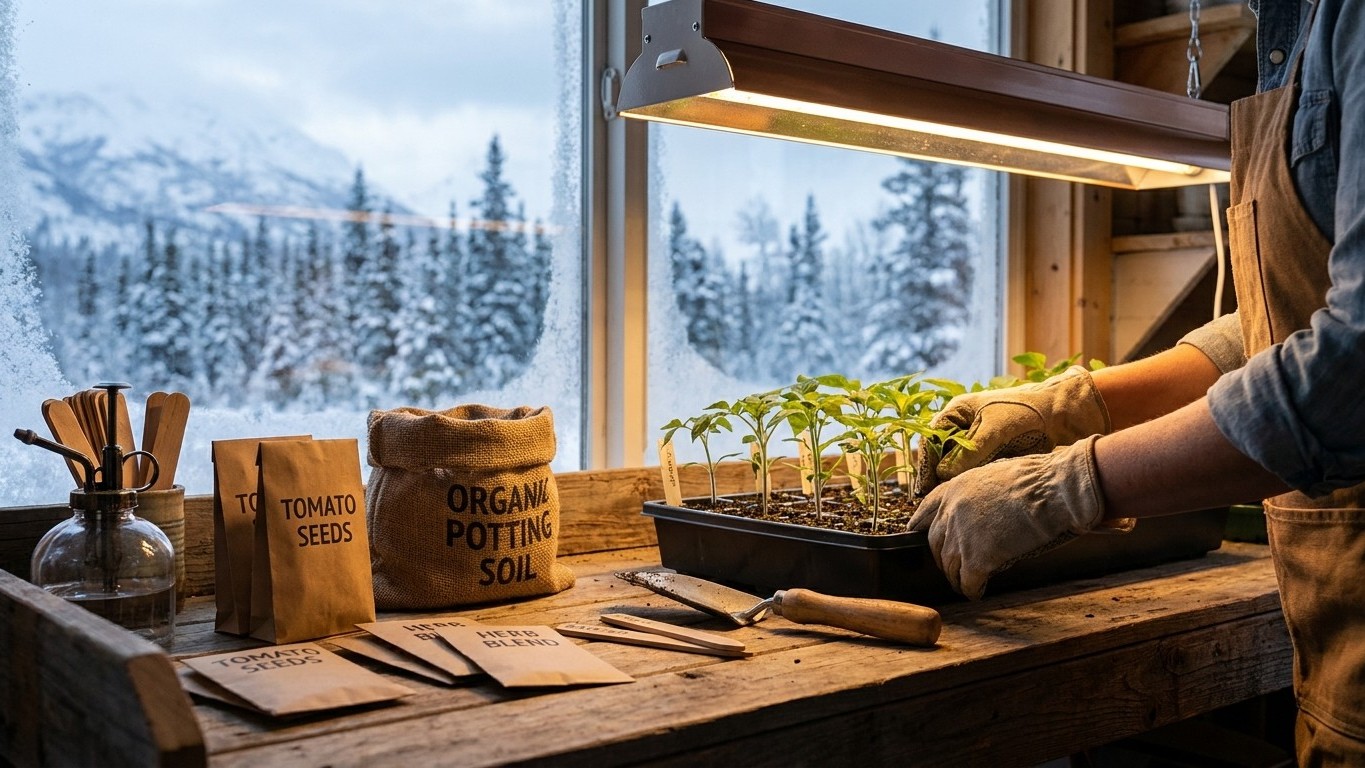

February in Alaska means one thing outdoors: frozen, snow-covered ground from Ketchikan to Fairbanks. Nothing gets direct-sown or transplanted into open soil anywhere in the state this month. The real gardening work happens indoors and under cover, starting slow-growing seedlings, forcing early greens, and getting tools, soil, and seed orders ready for a growing season that, in Anchorage, doesn’t reliably open until early May at best.
What goes in the ground in February

The short answer is nothing. Open ground across Alaska in February is frozen solid, often under a foot or more of snow, and it stays that way for weeks yet. Even in Anchorage, the mildest of Alaska’s inhabited areas, the last spring frost doesn’t clear until May 3 to May 12 based on 1991-2020 NOAA climate normals for that station. That’s a wide window on its own, and it doesn’t account for how much colder and later the thaw arrives in the Interior around Fairbanks or in the far north. Soil temperature, not the date on the wall calendar, decides when planting starts, and in February that soil temperature is nowhere close to workable anywhere in the state.
That doesn’t mean the garden sits untouched. Gardeners with a cold frame or unheated greenhouse built over a raised bed can sometimes work the top few inches once late-month sun starts warming the frame interior on clear days, though this is site-specific and depends entirely on how much passive heat that structure traps. It is not a general green light for the state.
A few narrow exceptions exist for anyone with truly protected, insulated beds: garlic and shallots planted the previous fall are dormant underground and need nothing done to them now beyond checking that mulch or snow cover hasn’t blown away. Bare-root fruit trees and canes, if they arrived from a nursery, should stay in cold, moist storage (a root cellar, unheated garage, or heeled into a snowbank) rather than going into frozen ground. And forcing rhubarb or chicory indoors, digging up dormant roots and bringing them into a dark, cool basement to push blanched growth, is one of the few living harvests February offers. Everything else waits for the ground to thaw and for daytime soil temperatures to climb well above freezing, which for most of Alaska is still months away.
What to start under cover
Seed starting in February works backward from the frost window, not forward from the calendar page. For a gardener near Anchorage, the last spring frost falls between May 3 and May 12. Count back roughly ten to twelve weeks for slow, cold-tolerant crops that need a long head start indoors before transplant, and February lands right in that window for onions, leeks, and celery started from seed, all notoriously slow to size up under lights.
Peppers also belong on the February tray for anyone gardening this far north, since they need eight to ten weeks of indoor growth before it’s safe to move them into a warmed bed or greenhouse well after the frost window closes. Alaska gardeners with grow lights often start peppers earlier than growers in milder states simply because the outdoor transplant date arrives so late and peppers are slow to fruit once they’re out.
The two failure modes are worth naming plainly. Starting too early means six or eight extra weeks under lights, and by transplant time the plants are rootbound, stretched, and stressed before they ever see real soil, a common problem when gardeners get restless in a dark February and start everything at once. Starting too late means running out of season entirely: with roughly 143 frost-free days in the mildest part of the state, and far fewer in the Interior, there’s little slack to make up lost weeks. A tomato or pepper seed sown in April instead of February may never ripen fruit before the September frost closes the season. Splitting the difference, sowing the slowest crops (onions, leeks, peppers) now and holding faster ones (most brassicas, lettuce) for March, keeps both risks in check.
What is ready to pick
Outdoors, the honest answer is nothing. Every Alaska garden bed is frozen and buried under snow in February, and nothing is being harvested from open ground anywhere in the state this month.
What still feeds a household comes from storage and from protected structures. Kale and other hardy greens planted the previous fall under heavy mulch or row cover can sometimes be dug out and checked on milder days, though in most of Alaska the ground is too frozen to access them until later in spring. A cold frame with a south-facing exposure can carry over hardy greens like spinach or mâche in areas where snow load doesn’t crush the structure, giving a small but real harvest on sunny days when the frame interior climbs above freezing.
Indoors, sprouts and microgreens are the most reliable February harvest: a tray of pea shoots, radish sprouts, or sunflower greens on a windowsill or under a shop light matures in one to two weeks regardless of what’s happening outside, and takes almost no space.
The other February job on the food side is inspection, not harvest. Stored squash should get a squeeze test at the stem end; any softening or a sweet fermented smell means it’s turning and needs to be used immediately. Potatoes stored in a cool, dark spot should be checked for sprouting eyes and for any soft, wet spots that signal rot spreading through the bin. Onions kept in mesh bags should be checked for ones going soft at the neck. Pulling the failing ones now protects everything stored around them.
The jobs that matter this month
February carries real deadlines even though nothing is being planted outdoors, and skipping them costs the coming season rather than this one.
Pruning and tool care
Dormant pruning of fruit trees, currants, and raspberry canes is best done in late winter while the plant is fully dormant and the branch structure is easy to see without leaves in the way. Cuts made now heal cleanly before spring sap flow begins, and removing dead or crossing wood now means the plant puts its energy into the branches worth keeping. This is also the slow window to clean and sharpen pruners, shovels, and hoes: a dull blade tears plant tissue and invites disease, and a rusted tool head is a spring problem avoided by an hour of work now.
Ordering and planning
Seed catalogs move fast in late winter, and the varieties bred for short, cool Alaska seasons, fast-maturing tomatoes, early brassicas, cold-hardy greens, are exactly the ones that sell out first. Ordering in February beats competing for the last packets in April. This is also the natural point to sketch next season’s bed rotation on paper: deciding where nightshades, brassicas, and legumes will go before the ground thaws avoids the scramble of deciding on the spot in May.
Soil and structures
Where beds are accessible, a soil test taken now gives time to order and apply amendments before planting begins. Turning an outdoor compost pile, even a frozen one, keeps material breaking down once temperatures allow and prevents it from compacting into a solid block. February is also the month to repair raised bed frames, tighten fencing, and patch cold frame glazing before the rush of spring planting leaves no time for maintenance.
What not to do in February
The most common February mistake in Alaska is treating a stretch of clear, cold-but-sunny days as a sign that planting season has arrived. Air temperature climbing into the 30s or 40s on a bright afternoon says nothing about soil temperature several inches down, which stays near freezing for weeks after the air warms. Direct-sowing anything into that soil, or transplanting tender starts outdoors, simply kills them.
A related error is uncovering cold frames, mulched beds, or overwintered crops too early after a mild spell, exposing roots and crowns to the next hard freeze that follows almost every warm snap this time of year in Alaska. Mulch and row cover exist precisely to buffer that swing; pulling them back on the first nice day removes the protection right before it’s needed again.
Feeding nitrogen to anything overwintering outdoors, fruit trees, canes, or dormant perennials, is also a February mistake. Nitrogen pushes soft new growth, and soft growth has no defense against the hard freezes still weeks or months away across the state. Fertilizing dormant plants now trades winter hardiness for growth the plant can’t safely use yet. The fix for all three mistakes is the same: let soil temperature and the calendar’s frost data, not a warm afternoon, decide when protection comes off and when nitrogen goes on.
Checking this against your own county
A statewide February guide is a starting point, not an instruction for a specific yard. Alaska’s hardiness zones span USDA 1a to 8a, an enormous range built on average annual extreme minimum temperature alone, and elevation, coastal exposure, and simple distance between the Interior and the milder Southcentral and Southeast regions shift real planting windows by weeks or more. A frost date built around Anchorage says little about Fairbanks, Juneau, or a homestead at higher elevation nearby.
For dates and guidance tuned to a specific area, the University of Alaska Fairbanks Cooperative Extension Service publishes region-specific planting information worth checking against anything general written here.
Common questions
Can anything be planted outdoors in Alaska in February?
No. Ground across the state is frozen and typically snow-covered this month. The only outdoor activity is checking that fall-planted garlic, shallots, or mulched perennials still have adequate snow or mulch cover.
When does the growing season actually start in Alaska?
It depends heavily on location. Near Anchorage, the last spring frost falls between May 3 and May 12 based on 1991-2020 NOAA climate normals, giving roughly 143 frost-free days before the first fall frost arrives between September 22 and October 1. Interior and northern areas run shorter and later.
What should be started indoors in February for an Alaska garden?
Slow-growing crops that need eight to twelve weeks of indoor growth before transplant: onions, leeks, celery, and peppers are the standard February starts for gardeners counting back from a May transplant window.
Is it too early to prune fruit trees in February?
No, this is close to ideal timing. Trees are fully dormant, branch structure is easy to see, and cuts have time to heal before spring sap flow begins.