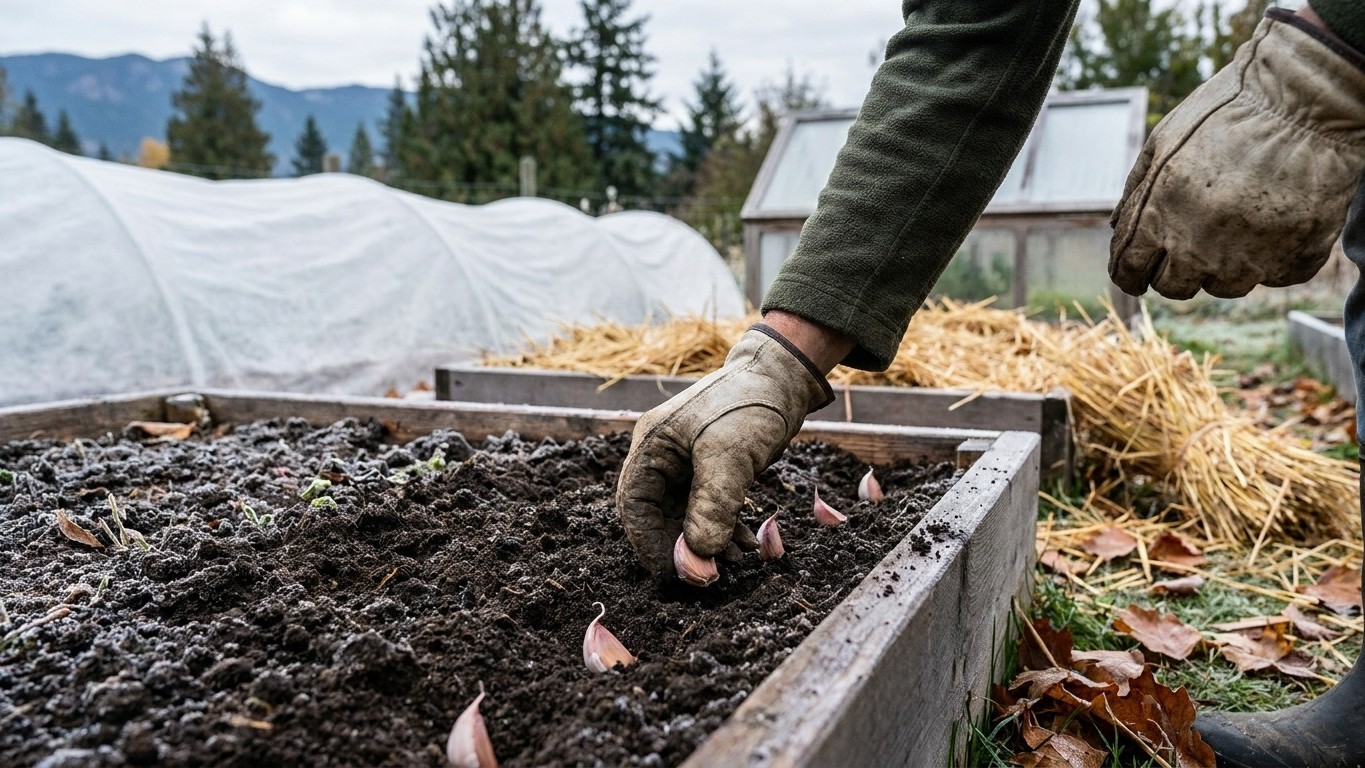

By October, Alaska has already crossed its first fall frost window (September 22 to October 1 in the Anchorage area, per NOAA). The direct answer for most of the state: garlic and shallots still go into workable ground, cold frames get sealed up or planted with hardy greens, and everything else outdoors is finished for the season. What matters now is dormant planting, storage checks, and the planning work that sets up next spring.
What goes in the ground in October

The calendar says October, but the soil has already made its decision. Once ground temperature drops toward freezing and daylight shrinks toward single-digit hours in parts of the Interior, almost nothing you’d call a growing season is left. The frost window (September 22 to October 1 for the Anchorage reference station) has typically already passed by the time this month starts, which means the question isn’t “what will grow” but “what tolerates dormancy in cold soil.”
Garlic and shallots answer that question well. Both go in as cloves or sets, pushed a few inches into loosened, well-drained soil, then buried under a thick mulch of straw or leaves before the ground locks up hard. They don’t grow much before winter, but they root, and that root system is what lets them push up fast once the soil warms in spring. This is the one true “planting” job left for open ground in most of the state.
Beyond garlic, the honest list is short. Bare-root fruit trees, shrubs, and dormant perennials can sometimes still be heeled in if the ground remains workable, though in much of the Interior and the north that window has already closed by early October. Cold frames and low tunnels extend the option for a few more weeks: hardy greens like spinach, mâche, and some kale varieties can be direct-sown under cover where soil is still diggable, gaining a head start for next spring rather than a harvest this fall. Indoors, forcing rhubarb crowns or chicory roots in a dark, cool space gives a small fresh crop through winter without touching frozen ground at all.
What doesn’t belong on this list: lettuce, peas, brassica transplants, or anything expecting weeks of open growing time. If the soil in your area is still soft and workable this late, treat that as a bonus window for garlic and bare-root stock, not an invitation to sow tender crops that have no season left to finish in.
What to start under cover
Backward planning is the only planning that makes sense this month, and the arithmetic runs the wrong direction from what gardeners expect in spring. Alaska’s last spring frost falls between May 3 and May 12 at the Anchorage reference station, roughly seven months out from an October start. Seedlings started that early, sitting under lights through a Alaska winter, run headlong into the first failure mode: rootbound, leggy, stretched plants that never really recover once they finally go outside. There is no crop worth starting from seed this month with next spring’s transplant date in mind.
What does belong under cover in October is anything you can eat within weeks, not months. Microgreens and sprouts are the standout choice: sunflower, pea shoot, radish, and broccoli microgreens finish in one to three weeks under a simple grow light or a bright south-facing window, giving fresh, crunchy greens through the darkest stretch of the year without any dependence on outdoor soil temperature at all. Sprouted mung beans or lentils in a jar finish even faster, in three to five days.
Forcing bulbs is the second worthwhile project. Paperwhites need no chilling and bloom in three to five weeks from potting. Amaryllis bulbs follow a similar timeline. Both give a payoff that matches the season: color and growth indoors while the ground outside is done for the year.
The second failure mode worth naming is starting too late for the crops that do have a real winter use, like forcing rhubarb or chicory: those roots need a period of cold dormancy first, so digging and potting them up needs to happen before the ground freezes solid, not after.
What is ready to pick
Open-ground harvest is mostly finished by October across the state, and pretending otherwise sets a gardener up for disappointment. Anything left in an unprotected bed after the first fall frost window (September 22 to October 1) has likely already taken damage, so the realistic harvest list has shifted indoors and under cover.
Kale and leeks are the exception worth watching. Both crops tolerate freezing far better than most garden vegetables, and where snow cover arrives before the hardest cold, they can sit in the ground and stay harvestable in pockets, particularly in the milder south-central areas near the Anchorage reference zone. Check them after a cold snap: leeks that still feel firm when squeezed are fine to pull; kale leaves that go from crisp to mushy once thawed have passed their point.
Cold frames carrying spinach or mâche from an earlier planting may still offer small pickings, a few leaves at a time rather than a full harvest. Indoors, microgreens and sprouts started this same month are usually the most reliable fresh food coming out of any home growing space right now.
Storage crops need their own kind of harvest check. Squash should feel hard-skinned with no soft spots; anything with a bruise or a soft patch should be used first, since it won’t keep. Potatoes and onions stored in a cool, dark space need a hands-on check every few weeks: pull and use any that have started sprouting, gone soft, or developed a sour smell before it spreads to the rest of the bin.
The jobs that matter this month
The garden work that pays off in October isn’t in the ground, it’s in the toolshed, the compost pile, and the seed catalog. This is the month where planning and maintenance carry the page, and none of it is filler.
Pruning, ordering, and planning
Dormant pruning of fruit trees and cane berries can begin once leaves have dropped and the plant has gone fully dormant, cutting out dead, crossing, or diseased wood while the branch structure is easy to see without foliage in the way. This is also the window to order seed for next season: the varieties bred for Alaska’s short, bright summers (fast-maturing tomatoes, short-day onions, cold-hardy brassicas) tend to sell out of stock well before spring, and ordering now avoids settling for a second-choice variety later. Sketching next year’s rotation plan, even roughly, while this year’s layout is still fresh in memory, saves real guesswork in April.
Soil, compost, and storage
Testing soil now, rather than waiting for spring rush, gives time to amend based on results before planting season returns. Turning the compost pile one more time before hard freeze locks it in place keeps decomposition moving through the cold months instead of stalling entirely. Tools deserve attention too: cleaning soil off blades, oiling hinges, and sharpening pruners and hoes now means they’re ready to grab in spring instead of needing an hour of maintenance before the first use.
Raised beds, fencing, and cold frame frames often reveal their weak points after a full growing season of use, wood rot, a sagging wire panel, a cracked cold frame lid. Repairing these now, while the ground is still workable enough to reset a post or patch a frame, beats discovering the failure in the middle of next spring’s planting rush. Finally, stored crops need that same recurring check described above: rot spreads fast in a dark bin, and one soft potato left too long can take out its neighbors.
What not to do in October
The classic October mistake in Alaska is trusting a mild afternoon over the calendar and the soil thermometer. A stretch of unusually warm, sunny days can feel like an invitation to direct-sow something tender, but air temperature and soil temperature are not the same measurement, and ground that takes weeks to warm in spring takes just as long to hold onto residual warmth in fall. Anything warm-season planted into cooling October soil is planting into a dead end.
A related error: uncovering cold frames or pulling back mulch after a mild spell, assuming the cold has passed. It hasn’t. A single hard freeze following that mild stretch can undo weeks of protective work in one night, killing greens that would have survived comfortably under their cover. Once mulch or a cold frame lid goes on for the season, the safer habit is leaving it in place and checking moisture and ventilation rather than removing protection at the first sign of sun.
Fertilizing, especially with nitrogen, is another timing trap. Feeding nitrogen this late pushes soft, tender new growth right when a plant should be hardening off and shutting down for dormancy, and that new growth is exactly what frost damages first. If soil testing this month shows a need for amendment, the better move is applying slow-release amendments like compost or rock minerals now, saving any nitrogen feeding for active spring growth instead.
Garlic left unmulched is the last common misstep: cloves planted but not buried under a thick enough layer of straw or leaves can heave out of the ground during freeze-thaw cycles over winter, losing the whole planting before spring ever arrives.
Checking this against your own county
A state-wide October guide is a starting point, not an instruction, and nowhere is that truer than in Alaska. The frost windows and hardiness figures cited here reference conditions typical of the Anchorage area; the USDA Plant Hardiness Zone Map puts the state’s range at zone 1a to 8a, a spread wide enough to cover both the mildest coastal pockets and the harshest Interior valleys. Elevation, distance from the coast, and simple latitude can shift these windows by weeks in either direction, and a garden in the Interior or the north operates on a fundamentally shorter season than one near Anchorage.
For a planting calendar built around your specific region, the University of Alaska Fairbanks Cooperative Extension Service maintains localized guidance worth checking before committing seed or garlic cloves to the ground.
Common questions
Can you still plant garlic in October in Alaska?
Yes, in most areas garlic and shallots are the main crop still going into open ground this month, as long as soil remains workable and the planting gets buried under a heavy mulch layer before hard freeze sets in.
Is it too late to start seeds indoors in October?
For anything meant to transplant outside next spring, yes. Alaska’s last spring frost falls between May 3 and May 12 at the Anchorage reference station, and starting seed this early leads to leggy, rootbound plants long before that date arrives. Microgreens, sprouts, and forced bulbs are better fits for an October indoor start.
What vegetables can survive frost in the garden this month?
Kale and leeks tolerate freezing better than most crops and can remain harvestable in pockets, especially where snow cover arrives before the deepest cold. Cold-frame spinach and mâche can also hang on for limited picking.
Does Alaska’s hardiness zone matter for October planting decisions?
It matters for choosing which perennials and fruiting plants can survive winter in your specific spot. The USDA map places Alaska across zones 1a to 8a, a wide range built on average extreme minimum temperature alone, so a plant rated hardy in one part of the state may not survive in another.