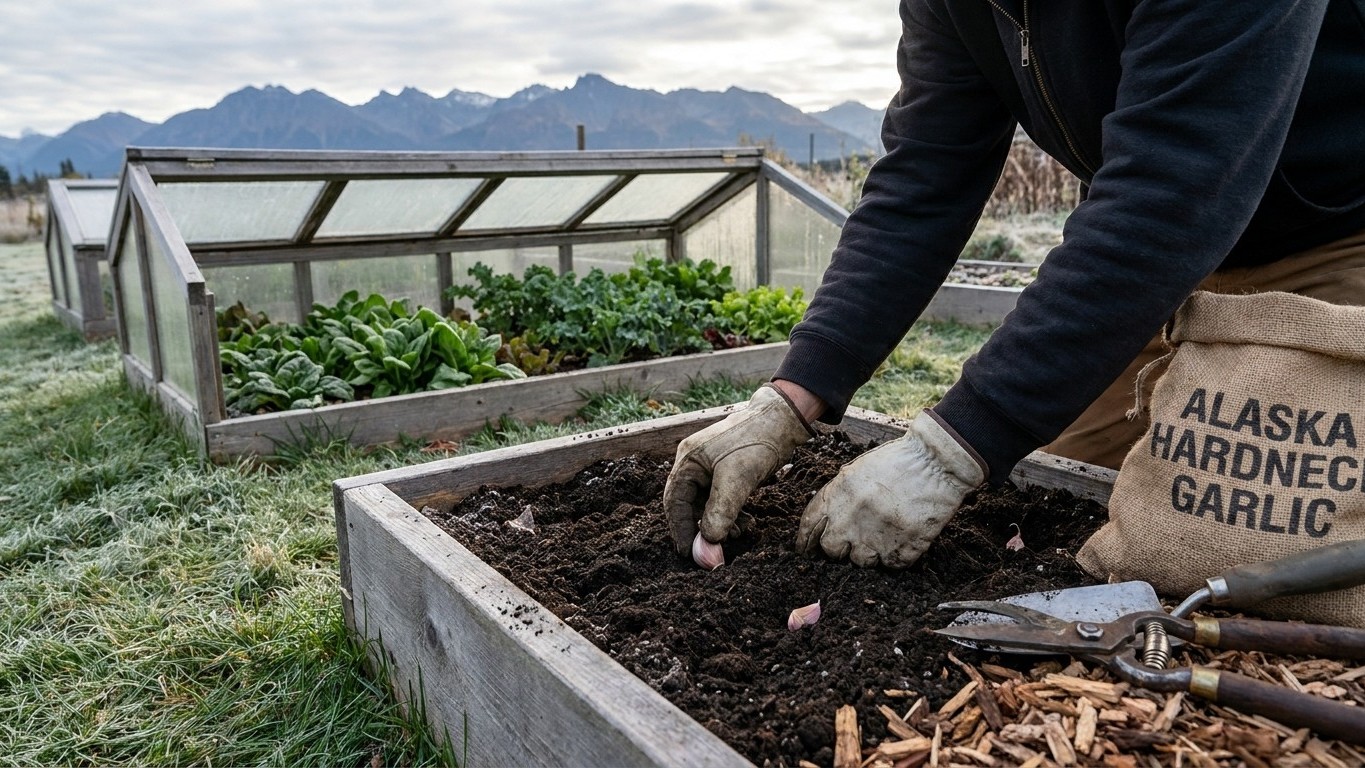

By September, most of Alaska is racing the calendar rather than planting into it. Around Anchorage, the first fall frost typically lands between September 22 and October 1, so the safe bets this month are garlic and shallots going into the ground for next year, hardy greens tucked under cover, and a full-court harvest push before that freeze arrives.
What goes in the ground in September

The decision this month is not the date on the wall, it is soil temperature and how many frost-free days remain before that September 22 to October 1 window closes. Anything you sow now needs to either mature in the next two to three weeks or be built to survive a hard freeze once it hits. That rules out almost every warm-season crop and narrows the outdoor list down to a handful of genuinely reliable choices.
Garlic and shallots are the headline planting of the month. Both go into the ground in fall, root before the soil freezes solid, and resume growth the following spring, which suits a state where 143 frost-free days is already tight for anything started fresh in spring. Plant cloves in well-drained, amended beds and mulch heavily once the ground starts to cool, since Alaska’s winter mulch layer is doing real insulating work, not just tidying the bed.
Beyond alliums, this is a month for hardy greens under protection rather than in open soil. Spinach, mache, and claytonia can go into a cold frame or low tunnel where the extra few degrees of buffer might let them limp toward a light harvest before real cold sets in. Direct-sowing the same greens in open ground is a gamble almost everywhere in the state once the calendar hits mid-month.
| Category | Examples | Outcome this month |
|---|---|---|
| Safe, direct into soil | Garlic, shallots | Overwinters, harvested next summer |
| Safe, under cover only | Spinach, mache, claytonia | Possible light fall harvest |
| Gamble in open ground | Lettuce, radish, peas | Likely lost to frost before maturity |
Anything not on that garlic-and-cold-frame short list is better saved for spring, when the region’s long daylight hours can make up for lost calendar time far more efficiently than a September sowing ever will.
What to start under cover
Counting forward from a first frost that could arrive as early as September 22 leaves very little runway for new sowings, so the arithmetic here runs the opposite direction from a spring planting guide. If a quick green needs 25 to 30 days to reach a pickable size, sowing it under cover in the first week of the month is defensible; sowing it in the third week is not, because the light is fading as fast as the temperature.
Radishes and baby lettuce mixes are the two crops with enough speed to fit that shrinking window, and both do better in a cold frame or an unheated hoop house than in open beds, since the extra protection buys a few degrees on the coldest nights right when the frost probability curve is climbing. Microgreens indoors sidestep the frost question entirely and are a reasonable way to keep fresh greens coming once outdoor sowing stops making sense.
The two ways this goes wrong are familiar to any Alaska gardener who has pushed the season too far in either direction. Sow too early relative to what’s left of warm daylight and the plants stall in cooling soil, sulking rather than growing. Sow too late, past roughly the second week of the month in most of the state, and there simply isn’t enough light or heat left to bring anything from seed to harvest before the frost window closes the door. The safer play under cover this late in the season is transplanting or overwintering already-established plants rather than starting from scratch.
What is ready to pick
September is one of the heaviest harvest months of the Alaska garden year, the payoff for a growing season that only runs about 143 frost-free days but stretches those days with nearly around-the-clock summer light. Potatoes are ready once the foliage yellows and dies back, and they should come out of the ground before a hard freeze can damage the tubers sitting just under the surface. Carrots and beets can stay in the soil a little longer since cold sweetens them, but they still need to be pulled before the ground itself starts to freeze.
Cabbage, broccoli, and other brassicas that were started early in the short spring window typically size up through August and finish in September, and a firm, tight head is the simplest sign a cabbage is done. Rhubarb is winding down for the year, and any stalks still standing are worth cutting now rather than leaving them to be knocked flat by the first freeze.
Wherever the local frost has already arrived before harvest is finished, check tender crops daily rather than weekly. A single cold night can turn an otherwise fine squash or tomato patch into a loss overnight, so this is the month to harvest slightly ahead of “perfectly ripe” rather than risk losing the crop to a freeze that lands earlier than the average window suggests.
The jobs that matter this month
Harvest and storage prep carry this month more than any new planting does, and skipping them costs real food, not just tidiness. Curing onions and winter squash in a warm, dry spot for a week or two before storage prevents rot that would otherwise show up midwinter, once it’s too late to do anything but toss the loss. Digging potatoes ahead of the first hard freeze protects the tubers from cold damage that turns them soft and unstorable.
Garlic beds planted this month need a heavy mulch layer once the soil starts to cool, both to insulate the cloves and to even out the freeze-thaw cycles that can otherwise heave them out of the ground over winter. Any bed finishing its last crop should get cleaned of plant debris rather than left standing, since diseased leaves and stems left in place over winter are exactly what carries fungal and pest problems into next year’s plants.
This is also the month to drain and store hoses and irrigation lines before a freeze splits them, and to get a soil test done on beds that underperformed, since fall results give enough lead time to order and apply amendments before the ground locks up. Cover cropping any bed that’s finished for the season, even a simple planting of winter rye, protects soil structure through the winter far better than bare dirt does. Tool cleaning and sharpening, and getting ahead on garlic and seed orders for next spring before popular varieties sell out, round out a list that has more urgency to it than the quiet look of a September garden might suggest.
What not to do in September
The classic mistake this month is treating a warm, sunny afternoon as proof the season has more room left in it than the calendar says. Air temperature is a poor guide to what’s coming after dark, and a mild September day can be followed by a freeze that catches tender crops still standing in the open. Row cover or a cold frame lid left off overnight because the day felt warm is one of the most common ways gardeners lose a late harvest they were one night away from saving.
Heavy nitrogen fertilizing is another timing error that shows up this month. Nitrogen pushes soft new growth, and soft new growth is exactly what a freeze damages first. Beds going into fall are better served by potassium and phosphorus, which support root development and hardiness, than by anything that encourages fresh leafy growth this late in the year.
Pruning fruit trees and shrubs now, rather than waiting for true dormancy later in winter, can trigger new growth at the cut sites that then gets killed by the first hard freeze, weakening the plant going into the cold months instead of helping it. And uncovering a cold frame or hoop house too early after a mild stretch, on the assumption the worst of the cold is past, ignores how quickly the frost probability climbs through the back half of the month across most of the state.
Checking this against your own county
A statewide answer for September is a starting point, not an instruction, and nowhere is that truer than in Alaska. The territory spans USDA Hardiness Zones 1a through 8a, and elevation, coastal influence, and the sheer distance between the southern coast and the Interior or the North Slope can shift a frost window by weeks in either direction from the Anchorage-area dates used here. A garden in a low-lying interior valley may already be past its first frost by early September, while a sheltered coastal spot could still have real growing days left.
For local frost data and a planting calendar built around your specific region, the University of Alaska Fairbanks Cooperative Extension Service is the right next stop.
Common questions
Can I still plant vegetables outdoors in Alaska in September?
Only a narrow list makes sense. Garlic and shallots go into open soil for next year’s crop, and fast-growing greens like spinach or radishes can work under a cold frame in the first week or two of the month, but open-ground sowing of most vegetables is too late once the frost window is approaching.
When does the first frost usually hit Alaska?
Around Anchorage, NOAA’s 1991-2020 climate normals put the first fall freeze between September 22 and October 1. Other parts of the state, particularly the Interior and the north, typically see frost arrive earlier, so treat this date as a reference rather than a guarantee for your specific location.
Is it too late to start a fall cold frame in September?
Early in the month, yes, it’s still workable for quick crops like radishes or baby greens that mature in around three to four weeks. By the back half of the month, shrinking daylight and the approaching frost window make new sowings under cover a poor bet.
Should I prune my fruit trees in September?
Hold off. Pruning before true dormancy can push new growth at the cut, and that new growth is exactly what an early freeze damages. Save major pruning for later in winter once the tree is fully dormant.