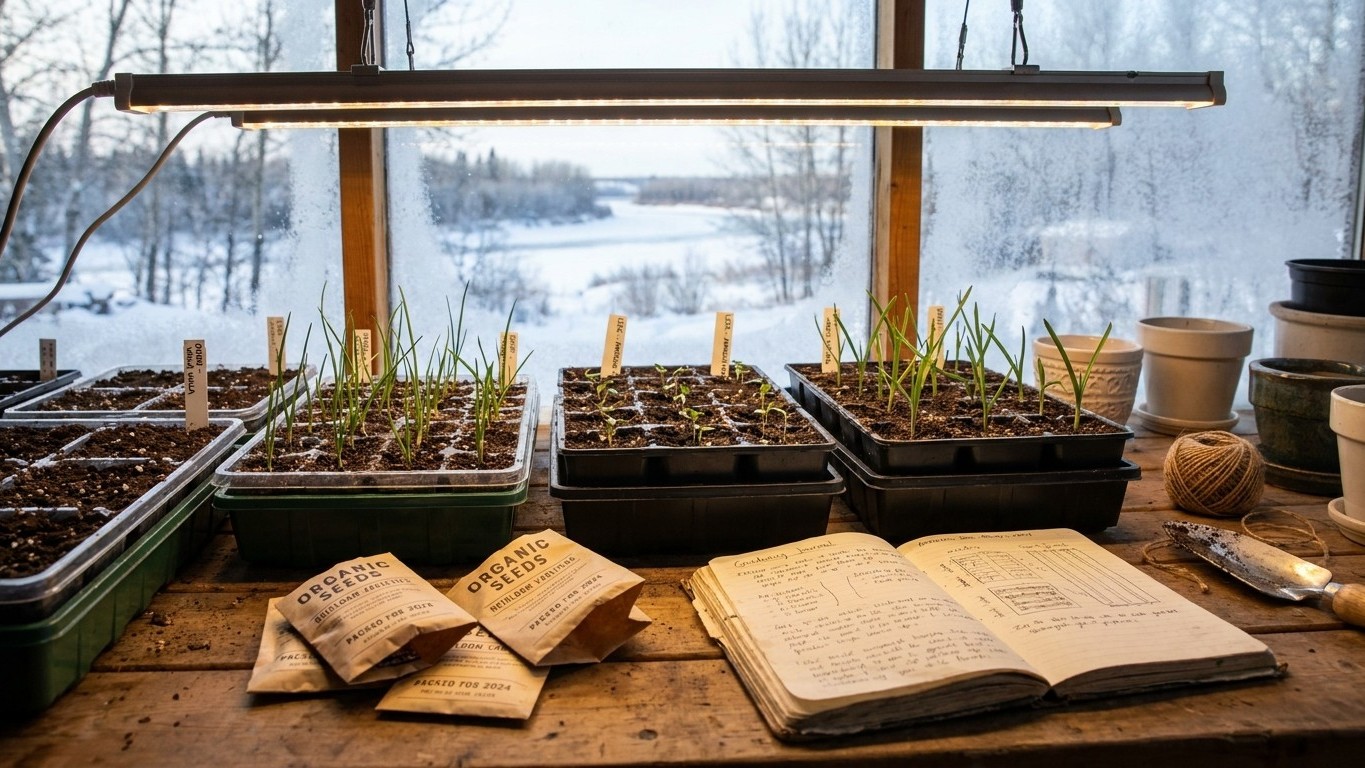

February in Alberta means frozen ground from Medicine Hat to Peace River, so nothing goes into open soil this month. What actually happens now is indoors: starting onions and leeks from seed, forcing rhubarb in a dark basement corner, pruning dormant fruit trees, and getting seed orders in before the popular varieties sell out.
What goes in the ground in February

The honest answer is nothing, and the mechanism is straightforward. Alberta’s average last spring frost sits around May 21, based on Environment and Climate Change Canada’s 1981-2010 normals for the Calgary Int’l A station, which puts the province in Canadian hardiness zone 4a at that reference point. That’s a mean date, not a safe date, and in half the years frost lingers even later. February sits roughly twelve weeks before that midpoint, with soil still frozen solid a foot or more down across most of the province. Direct-sown seed or transplants placed in that ground simply sit there, rot, or freeze outright. Calendar dates don’t decide this; soil temperature does, and in February that temperature is nowhere near what any vegetable seed needs to germinate.
Garlic and shallots, the crops most gardeners associate with cold-weather planting, already went into the ground back in fall, timed to root before freeze-up and sprout the following spring. There is no February equivalent for them here. Cold frames offer a head start in many climates, but in most of Alberta the frame itself is buried or frozen shut through February, so treat it as a March tool, not a February one, unless a chinook has genuinely thawed the surface for several consecutive days.
What does work this month is entirely indoor or semi-indoor. Bare-root fruit trees, canes, and roses can be held in cold, frost-free storage such as an unheated garage or root cellar, keeping the roots slightly damp and the wood dormant until planting becomes possible after the frost window closes. Forcing crowns of rhubarb or roots of chicory in a dark, cool spot in the house gives a genuine harvest of tender stalks or blanched leaves within a few weeks, without touching the frozen garden at all. That’s the real February planting story in this province: not seeds in soil outdoors, but dormant stock kept alive indoors until the ground is ready to receive it.
What to start under cover
Counting backward from the average May 21 frost gives February its real purpose. Onions and leeks grown from seed need roughly ten to twelve weeks of indoor growth before they’re ready to harden off and move outside, which lands the sowing window squarely in late February through early March. Start them now under grow lights or on a bright south-facing sill, and by the time the frost risk has genuinely passed, the seedlings will have the pencil-thick stems and developed roots that transplant well. Start them too early and the reader ends up fighting leggy, rootbound plants stretching for light long before outdoor conditions are safe; the stems weaken and the plants never fully recover once transplanted.
The opposite failure shows up with anything started too late for this climate. Peppers and other long-season crops that eventually need eight to ten weeks indoors before transplant can technically wait until March, but pushing them past that risks running out of season entirely, since the frost-free stretch here averages only about four months between the May 21 mean and the first fall frost around September 16. That’s a tight window for anything slow to mature, and every week lost at the start compounds by harvest.
February, then, is the month for the slowest starters: onions, leeks, and any perennial herb seed that’s notoriously slow to germinate, like parsley or thyme. Faster crops such as tomatoes can wait a few more weeks without penalty, and starting them now, this far from the frost window, almost guarantees the leggy, stressed seedlings that struggle once finally planted out.
What is ready to pick
Outdoors, there is little to nothing coming out of an Alberta garden in February, and no amount of season-extension gear changes that in most winters. Snow cover several inches deep sits over any overwintered kale or leeks, and while both can survive under that insulation in a mild pocket of the province, digging through frozen crust to reach them usually isn’t worth the effort or the risk of damaging the crown. If a chinook has cleared snow and softened the top inch of soil for a few days, overwintered kale leaves can sometimes be harvested, but this is opportunistic, not reliable.
Indoors is where February actually feeds the table. Sprouts and microgreens grown on a countertop take only days to a couple of weeks and need no soil at all, just seed, water, and light, making them the most dependable fresh green this month. Cold-frame greens are possible only where the frame has genuinely thawed; check before assuming anything survived underneath.
The other job this month is going through the root cellar or cold storage room. Squash softens at the stem end and develops sunken, water-soaked spots before it fully rots, so any squash showing those signs should be used first, not last. Potatoes that have started sprouting or gone soft and wrinkled are past their best but often still usable once the sprouts are removed. Onions that have gone soft at the neck or started to smell should be pulled from storage before they spread rot to the rest of the batch. Checking weekly, rather than waiting for a bad smell to announce the problem, saves far more of the harvest.
The jobs that matter this month
Pruning, ordering, and planning
Dormant pruning is the single biggest job that has a real deadline attached to it. Fruit trees and cane fruits like raspberries should be pruned while fully dormant and before sap starts moving, which in most of Alberta means February through early March, before buds swell. Pruning cuts made now heal cleanly and don’t stress the plant the way a cut made once growth has resumed does. This is also the window to order seed, particularly for the slower-germinating crops covered above, since the more sought-after onion and leek varieties tend to sell out by the time most gardeners start thinking about spring.
Planning next season’s bed rotation costs nothing but time, and doing it now, while there’s nothing urgent competing for attention outdoors, means fewer mistakes once planting season actually arrives. The same goes for testing soil: samples can be sent to a lab or tested with a home kit regardless of the season, and knowing what amendments a bed needs well before planting gives lime or compost time to work into the soil profile.
Maintenance that pays off later
Compost piles in Alberta largely freeze solid through February, so turning them is less about active decomposition and more about breaking up ice layers so the pile doesn’t compact into a solid block that takes weeks to thaw come spring. Cleaning and sharpening tools now, rather than reaching for a rusted, dull hoe in April, saves time later when every week of the short growing season matters. The same logic applies to repairing raised beds, trellises, and fencing while there’s no growth to work around; a cracked bed frame or sagging fence post is far easier to fix in February than once seedlings are already in the ground beside it.
What not to do in February
The most common mistake this month is treating a chinook, the warm westerly wind that can push temperatures up sharply for a few days even in the depths of winter here, as a sign that spring has arrived. Gardeners uncover perennial beds, pull back mulch, or even attempt early direct sowing during one of these thaws, only to have hard cold return within days and expose newly bare soil and crowns to damage they would have otherwise been insulated against. Mulch and winter covers exist specifically to buffer against that swing; removing them early defeats the purpose.
Starting warm-season transplants indoors too soon is the second classic error. Tomatoes, peppers, and squash started in February, three months or more before the average frost clears in late May, end up rootbound and leggy long before it’s safe to plant them out, and a stressed, overgrown seedling rarely outperforms one started on time. Fertilizing dormant plants is the third trap: nitrogen applied to bare, dormant trees or canes in February does nothing for a plant that isn’t actively growing, and can leach away entirely before the roots are able to use it once growth resumes. Save the feeding for when active growth actually starts.
Checking this against your own county
A province-wide month is a starting point, not an instruction. Alberta stretches from prairie grassland in the south to boreal forest in the north, and elevation in the foothills alone can shift frost timing by weeks compared to Calgary, the reference point behind the zone 4a and frost-date figures used here. A garden near Lethbridge, in chinook country, thaws and refreezes very differently than one near Grande Prairie. For local planting calendars and soil guidance specific to a district, the Alberta Agriculture and Irrigation site is the place to check before treating any provincial average as a personal deadline.
Common questions
Can anything be direct-sown outdoors in Alberta in February?
No. Ground across the province is frozen through February in nearly all winters, and even a mild chinook thaw rarely penetrates deep enough or lasts long enough to make direct sowing viable.
Is February too early to start tomato seeds indoors?
Generally yes. With the average last frost around May 21, starting tomatoes in February gives them far more indoor time than the roughly six to eight weeks they typically need, leading to leggy, stressed plants before transplant.
What is Alberta’s hardiness zone, and does it match USDA zones?
The reference city used for Alberta’s normals sits in Canadian zone 4a, based on Natural Resources Canada’s system, which measures seven climate variables rather than the single winter-minimum figure USDA zones use. The two systems don’t convert directly, and Canadian zone 4a overlaps nine different USDA zones, so it shouldn’t be read on the same scale as USDA figures.
Should mulch be removed during a warm spell in February?
No. Chinook winds can raise temperatures sharply for a few days even in deep winter, but cold typically returns quickly, and mulch removed early leaves crowns and roots exposed to that swing without the insulation they need.