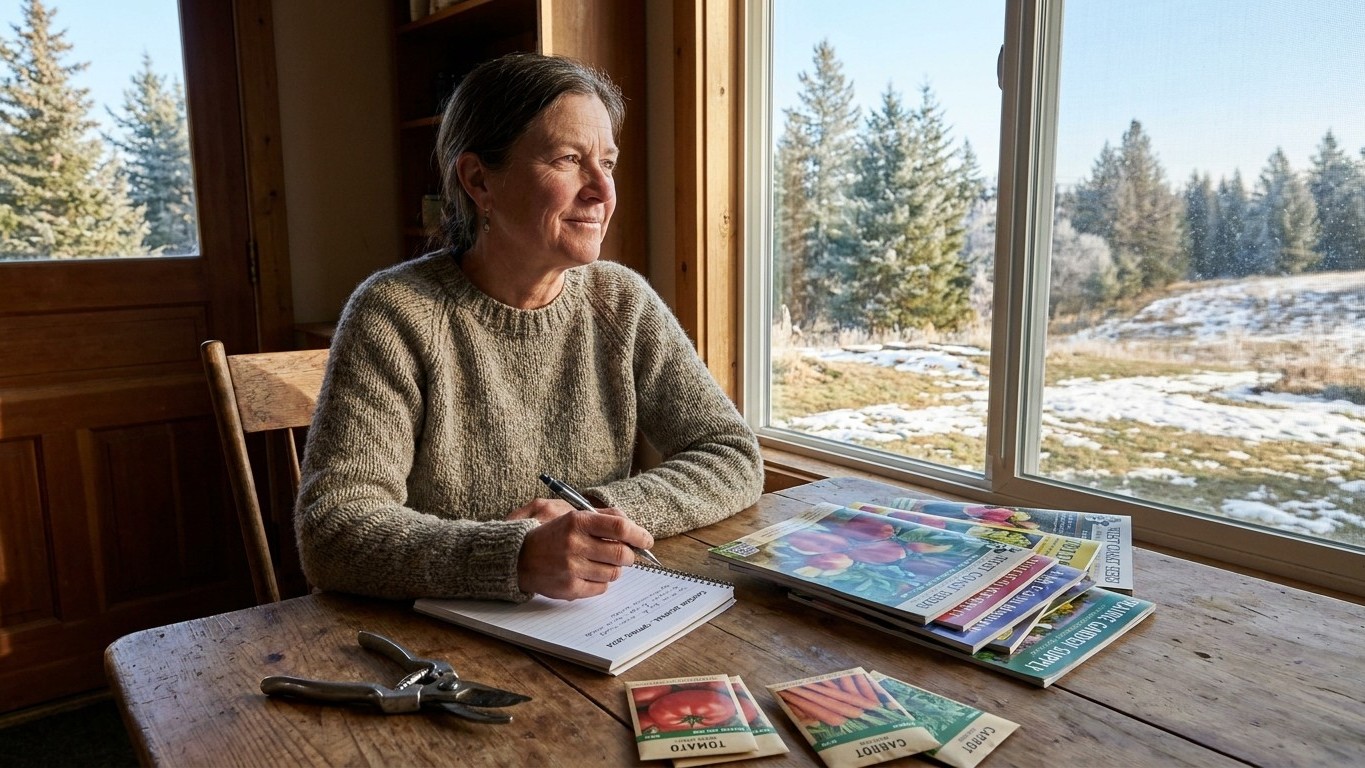

March in Alberta means seed catalogs and pruning shears, not seed packets going into open ground. With an average last spring frost around May 21, the soil is still frozen or waterlogged across most of the province, and the real work this month happens indoors, under cover, or with a pair of loppers in a dormant orchard.
What goes in the ground in March

For most of Alberta, March is not a planting month for open ground. The average last spring frost lands around May 21, and that’s a mean date from Environment and Climate Change Canada, not a safe cutoff. In roughly half of all years, frost arrives even later than that. Two months out from that average, garden soil across the province is typically still frozen at depth, snow-covered, or too saturated to work without compacting it. Trying to dig into that ground does more harm than good.
Southern Alberta is the exception worth naming. In the Chinook zone around Lethbridge and Medicine Hat, warm winds can strip snow cover and thaw the top few inches of soil for days at a time, even in late winter. If that happens and the ground is genuinely workable (not just surface-thawed over frozen subsoil), it’s reasonable to plant garlic cloves that were missed in fall, or to tuck in bare-root fruit trees, canes, and shrubs while they’re still dormant. These are cold-hardy enough to sit through a return freeze once planted correctly and mulched.
Cold frames and low tunnels change the math. Under a cold frame, soil warms faster than open ground, and a gardener in the Calgary area (Canadian hardiness zone 4a) can get hardy greens like spinach, arugula, and mâche germinating weeks before bare soil would allow it outside. Forcing is another option worth using this month: rhubarb crowns and chicory roots can be brought into a dark, cool space indoors to produce tender early stalks and shoots long before anything shows outside.
What doesn’t belong in the ground yet, anywhere in the province, is anything from the warm-season list. Peas are the closest thing to an exception since they tolerate light frost and cool soil, but even peas need soil that has actually thawed and drained, not just a mild afternoon. Patience here costs nothing; planting into frozen or waterlogged ground costs the whole crop.
What to start under cover
Indoor seed starting in March is counted backward from that average May 21 frost date, not forward from a calendar page. The arithmetic is simple once you have the frost window: count the weeks a crop needs before it’s ready to transplant, then subtract that from the frost date to find the sowing window.
Onions and leeks need the longest lead time, often 10 to 12 weeks before they go outside, which puts their indoor sowing squarely in early March for an Alberta garden. Celery and celeriac run a similar timeline. Peppers need roughly 8 to 10 weeks and fit comfortably into mid to late March. Tomatoes are shorter, usually 6 to 8 weeks, which means late March is early enough for most Alberta gardeners; sowing them in early March often backfires.
| Crop | Weeks needed before transplant | Approximate indoor sowing window |
|---|---|---|
| Onions, leeks | 10-12 weeks | Early March |
| Celery, celeriac | 10-12 weeks | Early to mid March |
| Peppers | 8-10 weeks | Mid to late March |
| Tomatoes | 6-8 weeks | Late March |
The two failure modes to watch for run in opposite directions. Start too early, especially with tomatoes, and by transplant time in late May or early June the plants are leggy, rootbound, and stressed before they ever hit the garden. Start too late, particularly with onions and celery, and the plants never build enough size to perform once the short Alberta growing season kicks in. Both mistakes are common, and both are avoidable with a calendar and the frost date in hand rather than a guess.
What is ready to pick
Little to nothing comes out of an Alberta garden bed in March, and there’s no point pretending otherwise. The ground is still locked up or half-thawed at best, and anything that was in the soil going into winter has either been harvested already or isn’t worth digging for yet.
That doesn’t mean the kitchen runs empty. Kale and other hardy overwintered greens, if they were left standing under snow cover in a sheltered bed, can sometimes be picked as the snow retreats, though quality varies a lot depending on how hard the winter ran. Leeks that were mulched heavily in fall sometimes survive under a thick blanket of snow and can be dug once the ground softens enough to get a fork in.
Cold frames are the more reliable source this month. Greens sown under cover in late winter, along with anything overwintered there, are usually ready to cut well before open-ground crops are even in the ground. Sprouts and microgreens grown indoors on a windowsill or under lights fill the gap with almost no lag time between sowing and harvest, which makes March a good month to lean on them.
Storage crops need a check-in now too. Squash, potatoes, and onions that have been sitting in a root cellar or cold room since fall should be gone through by hand: soft spots, sprouting eyes on potatoes, and a give in the neck of an onion all signal it’s time to use that one first, before it takes the crops around it down with it.
The jobs that matter this month
March in Alberta is a working month even without anything going into the ground, and skipping these jobs costs real time later in the season.
Dormant pruning of fruit trees, currants, and raspberry canes belongs here. Cuts made while the plant is still fully dormant heal faster and don’t push the tree into stress the way a mid-summer cut can. Wait too long, once buds start swelling, and every cut becomes a bigger setback to the plant’s energy reserves.
Seed ordering has a real deadline too, even though it feels informal. Popular varieties, especially anything bred for short-season prairie growing, sell out from Canadian seed suppliers well before spring, and a gardener who waits until April is often choosing from what’s left rather than what they actually wanted.
Soil work pays off disproportionately this month. Testing pH and nutrient levels now leaves time to amend before planting, rather than trying to fix a deficiency mid-season when it’s already showing up in stunted plants. Turning a compost pile that’s been sitting since fall gets air back into it and speeds up the breakdown that will feed spring beds.
A short list of other jobs earns its place on the March calendar:
- Cleaning and sharpening pruners, loppers, and shovels before the season’s first real use
- Repairing raised bed frames, trellises, and fencing while beds are still empty
- Sketching out crop rotation for the coming season, especially for anything in the nightshade or brassica families
- Rechecking stored crops for rot on a weekly basis, not just once
None of this is filler work. Every item on that list has a window that closes once the ground thaws and the season’s real pace picks up.
What not to do in March
The most common mistake in an Alberta March is trusting the air temperature over the soil temperature. A string of warm, sunny days can push the thermometer well above freezing while the ground six inches down is still frozen solid or turned to cold mud. Direct-sowing anything into that soil, even a supposedly hardy crop, usually ends in rot or a seed that simply sits without germinating.
Chinook winds cause a second, related mistake. A week of warm weather in the south of the province can feel like spring has arrived, and it’s tempting to pull mulch off perennial beds or uncover cold frames fully to “let them breathe.” But Alberta’s frost window runs deep into spring, and a hard freeze after that mulch comes off can kill back growth that had just started waking up. Leave winter protection in place until the pattern holds, not just for one warm stretch.
Nitrogen timing trips up a lot of gardeners too. Feeding a high-nitrogen fertilizer to fruit trees or perennials too early in the dormant season pushes soft new growth right before the plant is likely to face another freeze, and that new growth is exactly what cold damage hits hardest. Save nitrogen feeding for closer to active leaf-out, once the frost risk has genuinely started to drop.
Starting tomatoes and peppers too early belongs on this list as well. It feels productive to get a jump on the season in early March, but a tomato seedling started that early is often rootbound and leggy by the time late-May transplant weather actually arrives, and a stressed transplant frequently underperforms a later-started, healthier one.
Checking this against your own county
A province-wide date is a starting point, not an instruction. The average frost dates cited here come from the Calgary International Airport station, and Alberta is not one climate zone. Elevation, the Chinook belt in the south, and the longer, colder winters of the Peace River region in the north can shift these windows by several weeks in either direction.
For a planting window tuned to a specific county, the Alberta agriculture and irrigation service is the place to check local frost data and provincial planting guidance before committing seed or transplants to the ground.
Common questions
Can anything be direct-sown outdoors in Alberta in March?
In most of the province, no. Soil is typically still frozen or too wet to work. Only in favorable Chinook-zone conditions in the south, when soil has genuinely thawed and drained, might peas or garlic go in early.
Is it too early to start tomato seeds indoors in March?
Early March is too early for most Alberta gardens. Tomatoes need only 6 to 8 weeks before transplant, and with an average last frost around May 21, late March is a better sowing window to avoid leggy, rootbound seedlings.
What Canadian hardiness zone does most of Alberta fall into?
The Calgary area sits in Canadian hardiness zone 4a, based on Natural Resources Canada’s 1991-2020 data. This is the Canadian seven-variable system, not a USDA zone, and the two scales don’t convert directly.
When is it safe to remove winter mulch from perennial beds?
Not based on a single warm spell. Chinook winds can create a false spring in southern Alberta, and pulling mulch too early exposes new growth to a hard freeze before the frost window has actually closed in mid to late May.