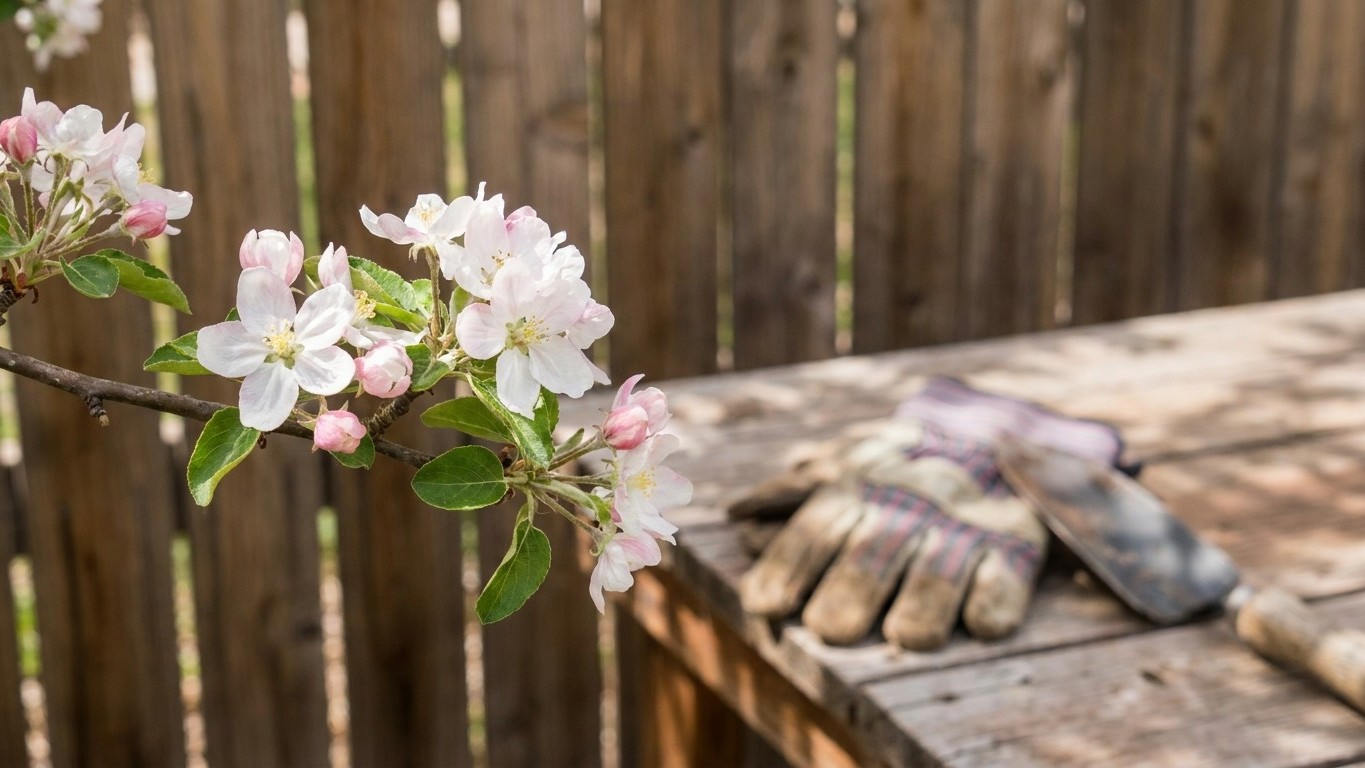

Colorado’s apple calendar runs on frost, not the calendar itself. Near Denver, NOAA’s 1991-2020 climate normals put the last spring freeze between May 1 and May 11, and the first fall freeze between September 30 and October 12, at station USW00003017. That window sets every stage from green tip to harvest. Check where your tree’s buds actually sit against that frost window before you spray, thin, or panic over a forecast cold night.
The short answer for Colorado
The apple year on the Front Range doesn’t run by the month on a nursery tag, it runs by frost. Near Denver, that last hard freeze usually lands between May 1 and May 11, and the first fall freeze shows up between September 30 and October 12. Everything a tree does, leaf out, flower, hold fruit, happens inside that window. Before you spray a bud, thin a branch, or lose sleep over a cold forecast, walk out and check what stage the buds on your own tree are actually at right now.
What that calendar actually depends on is not the month printed on a nursery tag but three things: the bud stage the tree has genuinely reached this year, how well a variety’s own bloom timing lines up with the Denver frost window, and how much colder that tree’s own site runs than the reference station. The same 1991-2020 normals put the mean minimum temperature of Denver’s coldest month at 17.1F, cold enough that any apple variety without solid winter hardiness has no business going in the ground on the Front Range. That figure is an average of the coldest month, not the record low, so treat it as a floor a hard winter can still drop well below.
Pick a variety whose bloom lands comfortably after the tail of that spring frost window, and whose fruit finishes ripening before the fall freeze window opens, and the rest of the calendar mostly takes care of itself. The Best Apple Varieties for Colorado page has the specific cultivar list with bloom timing and chill figures; this page is about reading the stages in between once a tree is already growing.
Working through it

This assumes a tree already in the ground, following the steps in Growing Apples in Colorado. From here, the calendar is about stages, not planting dates, and each stage is what decides the timing of the next job, not the number on a calendar page.
Dormancy

The tree stands leafless from the fall freeze through winter, its buds sealed under tight scales that keep a warm January afternoon from tricking them into growth. This is the pruning window, because cutting while the wood is fully dormant avoids pushing new growth into weeks of hard cold. Near Denver that stretch runs roughly from NOAA’s fall freeze window in early October through winter, up to the point buds start to swell again.
Green tip

Buds swell and a narrow sliver of green leaf tissue shows through the brown scales. This is the last safe point for a dormant oil spray against overwintering mites and scale, since oil applied once green tissue is exposed can burn it. Green tip on the Front Range typically arrives well before the May 1 to May 11 spring frost window has closed, which is exactly the risk: the tree wakes up before the last freeze date has actually passed.
Pink

Flower buds cluster tightly and show pink before they crack open. This is the last point to get a fungicide on against apple scab before petals open and pollinators start working the tree, since spraying an open bloom risks the bees along with the fungus. A cold snap at pink still damages the flower cluster, though a closed pink bud tolerates more cold than the same flower will once it’s fully open.
Bloom

This is the stage where the Denver frost window matters most. An open apple blossom is killed by temperatures several degrees warmer than the same bud would tolerate closed, so a variety that blooms inside NOAA’s May 1 to May 11 last-frost window, rather than safely after it, is gambling the year’s crop on which side of that ten-day spread an actual spring frost lands.
Petal fall

Petals drop, exposing a small green ovary at the base of each spent flower. Thinning decisions and the first cover sprays against codling moth start here, once bloom is finished and the pollinators have moved on.
Fruit set

Pea-sized green fruitlets show which flowers actually took. A grower thins by hand now, down to one or two fruit per cluster spaced along the branch, because a tree left to carry every fruitlet through to harvest produces small, poorly colored apples and stresses the following year’s bloom.
Harvest
Fruit ripens on its own schedule by variety, and the practical deadline is the fall freeze window, September 30 to October 12 by NOAA’s Denver normals. A grower with a late-ripening variety close to that window checks the fruit daily rather than trusting a tag date, since a hard freeze on unpicked apples costs the crop a week’s earlier picking would have saved.
What changes across Colorado
Every figure above is measured at or near Denver, on the plains at 5,280 feet, and NOAA’s own caution on that station data is blunt: the western slope differs, and mountain towns run a shorter season that can still see a frost in July. That’s the range a state this size covers, and it makes the calendar above a starting point, not a statewide figure.
Elevation and terrain
The western slope, the country around Grand Junction and the orchard belt near Palisade, sits at a lower elevation than Denver and has long been Colorado’s commercial fruit ground for that reason, with a longer, milder season than the Front Range gets. Mountain valleys run the opposite way: a higher elevation shortens the frost-free stretch, and a valley floor that pools cold air overnight can post a summer freeze even while the slopes just above it stay clear. A tree on the valley bottom carries more bloom-frost risk than an identical tree fifty feet up the same hillside.
The foothills west of Denver run cooler than the city itself on elevation alone, which pushes green tip and bloom a little later in spring and can buy a marginal variety a few extra days of frost safety it wouldn’t get on the plains. None of this is quantified in NOAA’s Denver-station normals, so a grower outside the metro area is working from the shape of the pattern here, not an exact date, until a station closer to their own site is checked.
The mistakes this climate punishes
Each of these shows up as a missing crop rather than a slow decline, because Colorado’s problem stages are sharp events, not a gradually bad season.
The first is choosing an early-blooming variety for a Front Range site. NOAA’s 1991-2020 normals put Denver’s last spring freeze in the May 1 to May 11 window, and a variety that opens its flowers ahead of that window is betting the year’s fruit on the early side of a ten-day spread. Some years the frost lands inside that window anyway, and an open blossom has far less frost tolerance than the same bud would have had a week earlier at pink.
The second is feeding nitrogen too late in the season. A tree pushed into soft new growth in late summer has no time to harden that wood off before NOAA’s fall freeze window opens on the Denver normals, and soft green tissue is exactly what an early fall freeze kills first, sometimes taking next year’s fruiting wood with it.
The third is underestimating winter itself. Denver’s coldest month runs to a mean daily minimum of 17.1F by NOAA’s normals, and that number is the average cold of that month, not the worst single night of a hard winter. A variety chosen for flavor or color without checking its published hardiness rating can coast through several mild winters and then die back to the trunk in one genuinely cold one, a loss measured in years of regrowth rather than one season’s fruit.
Chill, by contrast, is rarely what fails on the Front Range. Colorado’s winters run cold enough for long enough that even a high-chill cultivar generally gets what it needs. The risk this climate actually punishes is a tree that survives the cold fine but blooms too early for the frost calendar above, or one that never had the hardiness to make it through the cold at all.
| Filter | What it tests | Where the number comes from |
|---|---|---|
| Winter hardiness | Whether the tree survives the coldest night | Published cultivar hardiness rating, plus NOAA’s Denver coldest-month minimum of 17.1F as a floor |
| Winter chill | Whether the tree flowers properly in spring | Published chill requirement per cultivar, rarely limiting on the Front Range |
| Bloom timing | Whether the flower opens before or after the last frost | Cultivar bloom date crossed against NOAA’s May 1-11 last-frost window |
Checking this against your county
Every date and temperature figure above comes from a single reference station near Denver, and Colorado’s terrain means a county one valley over, or two thousand feet higher, can run measurably different. Colorado State University Extension keeps county-level contacts and local trial data that a statewide page like this one can’t replace. Check the extension office before setting a spray date, a pruning date, or a harvest deadline off the Denver numbers alone, especially west of the Divide or above 7,000 feet. Find your local office through Colorado State University Extension.
Common questions
Is it too late to plant if the buds have already broken?
No, but plant as soon as you can and water it in well. A bare-root or container tree planted after green tip needs closer attention to watering that first season since it’s already trying to leaf out while its roots are getting established.
My tree bloomed and then we got a hard freeze, is the tree dead?
Almost certainly not. A bloom-killing freeze usually takes the flowers and that year’s fruit, not the tree itself, since the wood and buds for next year are far hardier than an open blossom. Check for a crop loss that season and watch for return bloom the following spring before writing the tree off.
Can I get apples with just one tree?
Most apple varieties need a second, different variety blooming at the same time nearby for pollination, either your own second tree or a neighbor’s within bee range. A few varieties are marketed as self-fertile, but even those set a heavier crop with a pollinator partner.
Why did my tree bloom so early this year compared to last?
A warm stretch in late winter or early spring pulls bloom forward regardless of what the variety usually does, because bud development responds to accumulated warmth, not the date on a calendar. That’s the reason to check the actual bud stage in a given year rather than relying on last year’s timing.