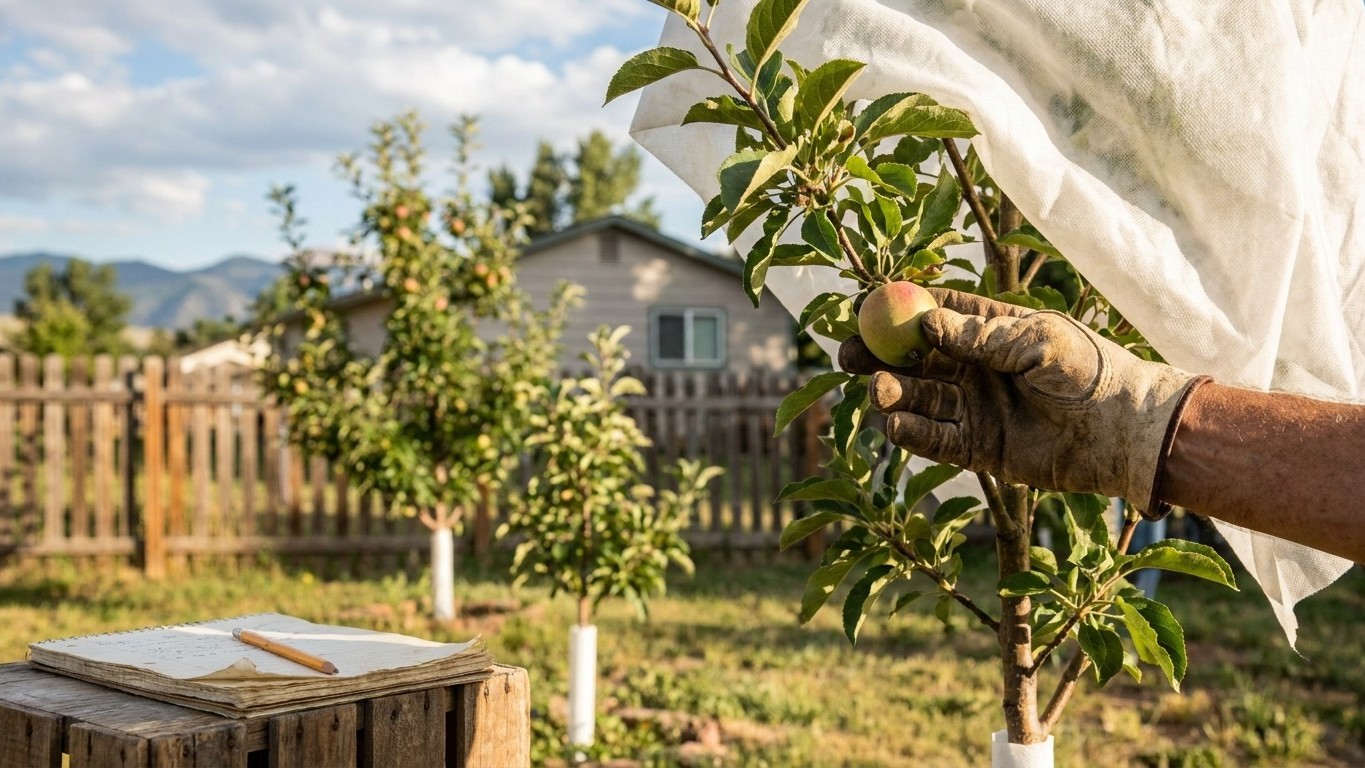

Yes, apples grow successfully across much of Colorado, though the growing conditions vary enormously by elevation. The USDA Plant Hardiness Zone Map’s 2023 update spans zone 3b to zone 7b across the state, and at the Denver reference station, NOAA’s 1991-2020 climate normals put the coldest month’s mean minimum temperature at 17.1°F. That gap between the coldest mountain valleys and the warmer front range means variety choice matters more here than in most states. Check your own zone first, then pick a cold-hardy, high-chill cultivar such as Honeycrisp or Haralson before you order a tree.
Can you grow apples in Colorado
Colorado apple trees live or die on one line of a nursery tag: the hardiness zone. Your yard’s actual zone, not the state’s average, decides whether Honeycrisp or Haralson makes it through a January cold snap without splitting bark or losing every flower bud. Skip that check and even a well-reviewed cultivar can fail in a low spot where cold air settles overnight. Before you order a single tree, find your zone, then match it against a published cold-hardy, high-chill variety bred for a real northern winter, not a mild one.
Elevation shapes a Colorado orchard more than latitude does. A yard in Denver sits around 5,280 feet and behaves nothing like a mountain valley a thousand feet higher, or the Western Slope on the far side of the Continental Divide, where orchards have grown tree fruit for generations. Treat your own elevation and zone as the starting filter, not the statewide range printed on a map. A tree rated for zone 5 can sail through a front-range winter and still struggle in a colder mountain pocket a short drive up the canyon.
Reading your own zone before you buy
If your address falls somewhere in roughly zone 4 to zone 6, the cold-hardy apple varieties bred in the northern United States generally survive Colorado winters without extra protection. Toward the coldest mountain zones near 3b, the workable variety list narrows to the toughest cultivars, and even those do better on a sheltered site out of the prevailing wind. Toward the warmer end of the front range and the lower valleys, near zone 7, a grower has more room to choose but should still check winter chill requirement before ordering a tree bred for a milder state, since hardiness and chill answer two different questions. For a closer look at which cultivars actually perform well here, see this guide to Colorado apple Best varieties.
Site selection matters almost as much as variety at altitude. Cold air pools in low spots on a property, so a gentle slope spares young flower buds from the coldest pocket of frost that a low corner collects overnight. A wind-sheltered spot cuts the winter desiccation that dry Colorado air causes on exposed bark, and orienting the trunk away from direct winter sun avoids the bark-splitting inju, a risk that shifts throughout the year as detailed in The Colorado Apple Calendar, Stage by Stagery called sunscald, a common problem on young apple trees at altitude.
Which varieties suit this climate

Two filters decide whether an apple tree belongs in a Colorado yard. The first is hardiness, whether the wood survives the winter minimum at all. The second, separate question is winter chill, the number of cold hours a tree needs before it can flower normally. Get the first wrong and the tree dies. Get the second wrong and the tree lives but blooms thin, ragged and out of sequence, which is exactly what happens when a low-chill variety bred for a warm, short winter is planted somewhere with a long, cold one, or the reverse.
Colorado’s long, cold winters put most of the state at the high-chill end of the scale, not the low end. A low-chill cultivar bred for a mild-winter climate like Hawaii’s apple-growing conditions would satisfy its chill requirement during any brief warm spell in a Colorado January, then break dormancy and bloom weeks before the last frost has any business leaving. The safer direction is a long-chill, cold-hardy cultivar bred for northern winters, which holds dormancy until the season genuinely turns.
Varieties bred for this kind of winter
Several cultivars developed for northern-tier states and Canada carry a published hardiness range that covers most of Colorado’s zones. None of these figures come from a Colorado-specific source, they are the catalog ratings printed by the nurseries that breed and sell the trees.
| Variety | Published hardiness zone | Bloom timing | Note |
|---|---|---|---|
| Honeycrisp | Zone 3 to 7 | Mid-season | Widely grown fresh-eating apple, needs a pollen partner |
| Haralson | Zone 3 to 7 | Mid-season | Tart, reliable pollenizer with fertile pollen |
| Zestar! | Zone 3 to 7 | Early | Ripens ahead of most, good early pair |
| State Fair | Zone 3 to 7 | Early | Bred in Minnesota for short seasons |
| Liberty | Zone 4 to 8 | Mid to late | Scab-resistant, later bloom than most on this list |
No single published list ties a named cultivar to every Colorado zone the way a state extension bulletin sometimes does for other crops. Where that gap matters for your specific address, Colorado State University Extension is the body to check before ordering, and its contact details are below.
Planting a pair that works here
An apple tree planted alone in most Colorado yards will flower and produce little or no fruit, because the great majority of apple varieties need pollen from a genuinely different variety blooming at the same time. Plant two trees that flower together, and make sure at least one of them carries fertile pollen, since a handful of popular apples are triploid and produce sterile pollen that cannot pollinate anything, even though their own flowers still need pollinating by someone else.
Among the cold-hardy varieties that suit Colorado’s zones, a few pairings are realistic without hunting through a catalog for compatibility charts. Honeycrisp and Haralson bloom in the same mid-season window and both carry fertile pollen, which makes them a workable pair for a front-range or lower-mountain yard. Zestar! and State Fair bloom earlier in the season together and suit a shorter growing window. Liberty blooms later than most of the others on this list, which matters more once you get to the frost discussion below, but it still needs a partner blooming in roughly the same stretch rather than weeks apart.
Before ordering, check whether either cultivar you are considering is one of the triploid varieties with sterile pollen. Planting two triploids together, or a triploid with nothing else nearby, is the single most common reason a mature apple tree flowers heavily every spring and fruits poorly every fall. A local nursery tag or catalog listing will usually flag this directly, and it is worth reading before the tree goes in the ground rather than after three barren summers.
The frost that costs a crop here

At the Denver reference station, NOAA’s 1991-2020 climate normals put the last spring freeze in the window of May 1 to May 11, based on the 30 to 70 percent probability band for a 32°F freeze. Other parts of the state run on a different schedule entirely: mountain towns can see frost into July in a hard year, and the Western Slope follows its own pattern again. Whatever your local window turns out to be, the mechanism that costs a Colorado grower a crop is the same everywhere.
Why a late frost is worse than it looks
Once flower buds have opened to the pink stage and moved into bloom, a freeze at or below 32°F kills the open flowers and the tender pistils inside them, not the tree itself. The wood, the leaves that follow and next year’s growth are almost always fine. What is gone is this year’s crop, because a flower that has been frosted cannot set fruit even if the tree looks completely healthy two weeks later. That gap between a tree that looks fine and a harvest that never comes is the part beginners misread most often.
There is not much a home grower can do to warm an entire orchard, but a few things narrow the risk on the nights that matter. Covering small trees with frost cloth or an old sheet before a clear, cold night traps ground heat and can hold the canopy a few degrees above the open air. Stringing incandescent Christmas lights under the cover adds a small amount of real heat on the coldest nights. Commercial orchards run overhead sprinklers through a freeze because the latent heat released as water freezes on the bud keeps the tissue itself right at 32°F rather than below it, though that trick needs a reliable water supply and careful timing most backyard setups do not have.
The more durable fix is choosing a variety that blooms later in the season, since a cultivar like Liberty, which flowers later than Honeycrisp or Zestar! in the same yard, is simply less likely to be in flower during the tail end of the frost window. A grower comparing timing strategies against another short, cool-season region, such as the interior valleys covered in British Columbia’s apple-growing guide, will see the same principle applied under a different set of dates.
The apple year in Colorado
Timing an apple tree by the calendar alone is a mistake at altitude, because the tree does not know what the calendar says. It responds to accumulated warmth, so the safest way to track a season is by the tree’s own stage, anchored loosely against the Denver-area frost dates from NOAA’s 1991-2020 normals and adjusted for your own elevation.
Stage by stage
- Dormancy (winter through early spring): buds are closed and hard. This is the window for pruning, while you can see the branch structure without leaves in the way.
- Green tip (as days lengthen toward the last-frost window, roughly the weeks before May 1 to May 11 at Denver): the first green shows at the bud tip. Watch the forecast now rather than later, since the tree is starting to lose its cold tolerance.
- Pink (days to a couple of weeks before bloom): buds show pink but haven’t opened. This is the most frost-vulnerable stage discussed above, and it often falls right inside or just before the Denver frost window.
- Bloom: flowers are fully open. Bees and other pollinators need to be active and moving between your two varieties for fruit set to happen at all.
- Petal fall: petals drop and tiny fruitlets begin to swell. A late frost here can still thin or ruin a crop that survived bloom.
- Fruit set (weeks after petal fall): the tree naturally drops some fruitlets on its own. Thinning the rest by hand to one fruit per cluster improves size and reduces limb breakage later.
- Harvest: timing depends on the variety, but the season closes out as the first fall frost approaches. At Denver, NOAA’s 1991-2020 normals put that first freeze between September 30 and October 12, which gives most early and mid-season Colorado apples plenty of room, though a late-ripening cultivar in a shorter mountain season should be picked with that earlier local date in mind.
Local help
For a variety list matched to your specific county, current spray timing and disease pressure that changes year to year, Colorado State University Extension is the body to check before you plant or spray. Extension offices differ by county in what they stock and recommend, so call or check the county office nearest your orchard rather than relying on general statewide advice.
Common questions
Can I grow apple trees above 8,000 feet in Colorado?
It gets harder but is not automatically ruled out. That elevation typically sits at the coldest end of Colorado’s zone 3b to 7b range from the USDA hardiness map, so the workable variety list narrows to the toughest cold-hardy cultivars, planted on a sheltered, wind-protected site with good cold-air drainage.
Will one apple tree by itself ever produce fruit?
A few self-fertile varieties exist, but most of the cold-hardy cultivars suited to Colorado still set far more and larger fruit with a second, compatible variety nearby. If space only allows one tree, check the specific cultivar’s self-fertility rating before assuming it will crop alone.
Does hail damage apple trees in Colorado?
Hail can bruise or scar developing fruit and shred leaves, and Colorado’s front range sees hailstorms regularly through the growing season. The tree itself usually survives and leafs out fine the following year, but a hail event during fruit development can mark or split the crop that year.
What rootstock should I use for Colorado’s alkaline soil?
Rootstock choice affects mature tree size, disease tolerance and soil adaptability, and Colorado’s often alkaline, clay-heavy soils make this worth getting right at planting rather than fixing later. A local nursery or Colorado State University Extension can point to rootstocks proven in your county’s soil type, since this varies enough by region that a single statewide answer would be misleading.
How many years before a new apple tree produces fruit?
Most apple trees on standard nursery rootstock take three to five years to bear a meaningful crop, with the exact timeline depending on rootstock size, variety and how hard the tree was pruned in its early years. A tree that blooms in its first or second year usually benefits from having those early flowers removed so it puts energy into root and branch growth instead.