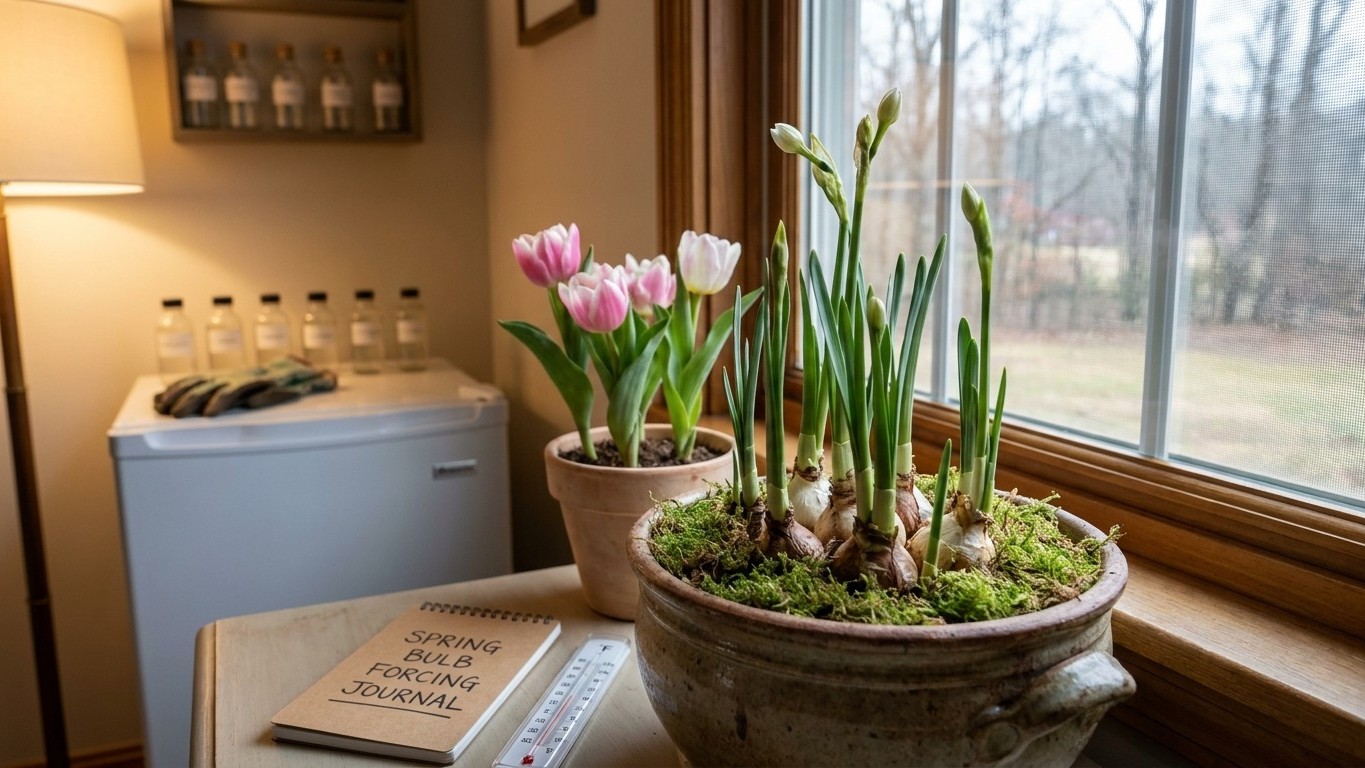

Forcing spring bulbs indoors works in Georgia because the state’s winter is either too short, too warm, or too unpredictable to hand a bulb the sustained chill it needs on its own. You supply that cold artificially, in a refrigerator or an unheated space, then bring the pot into warmth and light on your own schedule.
Why this matters in Georgia

Start with the number that actually decides this: at the Atlanta reference station, the coldest month’s mean daily minimum runs 35.6°F, per NOAA NCEI’s 1991-2020 Climate Normals. That’s a single month’s average, not a measure of how long the cold season lasts. A spring bulb doesn’t care about one cold month. It needs 12 to 14 weeks of nights holding consistently below 45°F to finish its chilling requirement and set a flower bud inside the bulb. Georgia’s problem isn’t that it never gets cold enough. It’s that the cold season is often too short, too mixed with warm spells, or too localized to guarantee that full stretch.
The USDA Plant Hardiness Zone Map (2023 edition, built on 1991-2020 normals) puts Georgia across a 6a-9b range, which is really several different climates wearing one state name. In the warmer bands, roughly 8a through 9b in the southern and coastal counties, the ground rarely holds below 45°F long enough for the full window a tulip or hyacinth wants. That’s the classic case for forcing: you’re not fighting killing cold, you’re making up for cold that never shows up in sufficient dose. Forcing indoors lets you guarantee the chill regardless of what a mild December decides to do.
North Georgia, up in the 6a-7a mountain counties, runs the opposite risk, and it’s a container-specific one. Soil in the ground holds heat and buffers temperature swings; a pot sitting on a deck or a porch has no such mass around it. The same bulb that would survive fine bedded in that county’s garden soil can freeze solid, roots included, if left in a container outdoors through a hard cold snap. A pot needs to be treated as roughly two zones colder than the ground it’s sitting on. So the state carries both problems at once: warmer counties short on natural chill, cooler counties where an unprotected pot turns a survivable zone into a lethal one.
How to do it here
The process is straightforward, but each step needs to be something you can verify yourself, not a guess about what’s happening inside the bulb.
- Choose bulbs suited to forcing. Paperwhite narcissus, hyacinth, crocus, and muscari handle the process reliably (more on why in the next section).
- Pot them in fall, using a well-draining mix, bulb tips just at or above the soil surface, and water lightly right after planting.
- Move the pot to a steady cold spot below 45°F but above freezing. An unheated garage works if it genuinely never sees frost against the wall where the pot sits; check that with a simple min-max thermometer rather than assuming.
- If using a refrigerator drawer instead, keep it well away from apples, pears, or any ripening fruit. Fruit gives off ethylene gas, and ethylene can abort the flower bud forming inside the bulb before you ever see a stem.
- Check weekly and keep the soil barely moist, never soggy. Write down the date you started chilling, since the 12 to 14 week window is what you’re tracking toward, not a guess.
- Once that window has passed and you can see shoots an inch or two tall, the chilling requirement has been met and the bulb is ready to move.
- Bring the pot into a bright but cool room first, giving it several days before moving it to full warmth and direct light, so the stem doesn’t stretch and flop under sudden heat.
For containers you’d rather chill outdoors than in a garage or fridge, the pot itself needs to be rated at least two hardiness zones tougher than the bulb requires, or it needs to be sunk into the ground and mulched heavily so the surrounding soil does the buffering a garden bed would normally provide.
Which bulbs are worth it
Not every bulb pays back the counter space and the weeks of waiting. Some finish their chill requirement fast and stay compact enough to stand up in a pot without support. Others carry a chilling requirement long enough to test anyone’s patience, or grow a stem too tall and top-heavy for indoor conditions to hold upright.
- Paperwhite narcissus, which needs no chilling at all and blooms in three to six weeks from potting
- Hyacinth, sturdy and compact, holding its stem well indoors after a roughly 12 to 13 week chill
- Crocus, short enough that it never has a toppling problem
- Muscari (grape hyacinth), low-growing and reliable under the same treatment
- Tulips, which force well and cost you nothing extra in the long run, since Georgia’s ground rarely gives them the sustained deep chill they’d need to come back a second year anyway. Here, they’re already a one-season purchase, forced or not.
- Tall trumpet daffodils, whose long stems tend to flop without the wind resistance and root anchoring a garden bed provides
- Fritillaria, top-heavy and prone to tipping the whole pot over once the flower opens
A reader chilling a pot of grape hyacinths and a pot of trumpet daffodils side by side will get very different results for the same effort, which is really the whole case for picking short, compact bulbs first.
What goes wrong, and when you can still fix it
Leaves but no flower
This means the chilling period ran short. The bulb had enough stored energy to push leaves but never finished forming the flower bud inside itself before you moved it into warmth. There’s no fixing this season’s pot. The bulb needs a full, uninterrupted chill next fall before it will flower.
A flower on a stem too short to see over the pot’s rim
The bulb finished its chill correctly, but it was warmed too fast, too soon, without the gradual step into brighter, warmer conditions. The stem never had time to elongate before the flower opened. This bloom won’t stretch out after the fact. Next time, give it several days in a cool bright spot before full warmth.
Rot inside the pot
Usually a drainage failure. If the soil stayed wet during the long chilling weeks, especially in a pot without real drainage holes, the roots sat in water and the bulb rotted from the base up. That bulb is lost for this season. Repotting in a container with functioning drainage, and erring toward drier rather than wetter during chilling, is the only real fix for next time.
Related guides
- Growing Spring Bulbs in Containers in Georgia
- Forcing Spring Bulbs Indoors in Hawaii