
Some spring bulbs return every year in Georgia. Others bloom once, thin out, and vanish by the third spring. The difference almost never comes down to hardiness zone maps, it comes down to whether a bulb got enough sustained cold underground last winter. That’s the question this page answers, bulb by bulb, using Georgia’s own winter numbers rather than a national planting chart that assumes a Minnesota freeze.
When to plant bulbs in Georgia

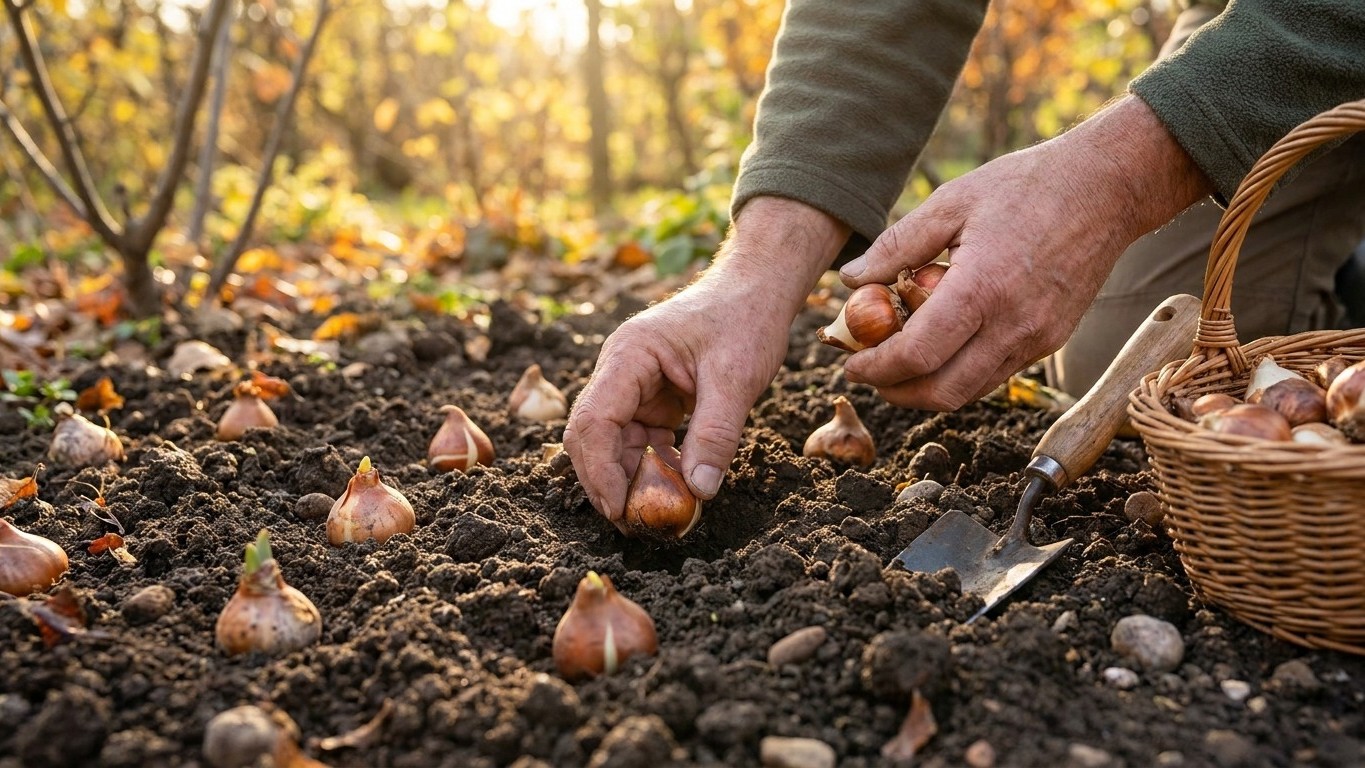
Spring bulbs go into the ground once the soil has cooled from summer heat but before it locks up hard for winter. In Georgia, that window runs from mid-October through late November for most of the state, timed against the average first fall frost, which lands between November 13 and December 1 at the Atlanta reference station. The rule of thumb gardeners use nationally is to plant roughly six weeks before the ground freezes solid, and in Georgia the ground rarely freezes solid at all in the southern two-thirds of the state, which gives more flexibility than colder climates enjoy.
Plant too early and the problem isn’t cold, it’s warmth. Bulbs set into soil that’s still holding summer heat will push top growth before winter arrives, and that tender green growth gets cut down by the first hard freeze. The bulb survives, usually, but it’s wasted a season’s worth of stored energy on leaves that never got to feed it through photosynthesis. Plant too late and the opposite failure shows up: the bulb goes into cold, hard ground without enough time to grow the root system it needs before dormancy sets in. Come spring, it emerges weak, undersized, or not at all. Gardeners working with limited yard space or unpredictable timing can sidestep much of this guesswork by Growing Spring Bulbs in Containers in Georgia, where soil temperature and drainage are easier to control.
Worth saying plainly: that November frost date is an average, built from thirty years of NOAA climate records. Half of all years fall on the early side of it, half on the late side. A gardener in the north Georgia mountains should lean toward the earlier end of the planting window, since higher elevations freeze several weeks ahead of Atlanta. Someone gardening on the coastal plain near Savannah can push planting later, since that region runs consistently milder than the reference station this guide uses.
Whether your winter is cold enough
This is the question that decides everything else on this page, and it has nothing to do with whether a bulb survives the winter. It’s about whether the bulb flowers at all. A spring bulb needs a sustained cold period, typically twelve to fourteen weeks with soil temperatures below about 45°F, to trigger the internal chemistry that turns a bud into a flower. Skip that chilling period and the bulb doesn’t die. It just puts up leaves, sometimes a stunted, flowerless stalk, and nothing worth planting it for in the first place. Gardeners who want blooms without waiting on the ground to cool can replicate this chilling artificially by Forcing Spring Bulbs Indoors in Georgia.
Atlanta’s coldest month, January, runs a mean daily minimum of 35.6°F, comfortably under the 45°F threshold. That’s a real margin, not a marginal pass. The stretch of consistently cool soil across a typical Georgia winter, roughly late November through February, gives most of the classic spring bulbs enough chilling to bloom without help. But the margin isn’t unlimited, and it isn’t identical across every bulb species. Tulips and hyacinths sit at the demanding end, needing the longest, most consistent chill. In much of Georgia, especially the warmer central and southern counties, they often flower beautifully the first spring, on energy stored in the bulb from the grower, and then fail to rebuild that chill-triggered flower bud in subsequent winters. Daffodils, crocus, and grape hyacinth ask for less and get it reliably.
Where the chill falls short, pre-chilling is the fix, and it has to be done right. That means twelve weeks in a refrigerator before planting, kept away from apples, pears, or any ripening fruit, because those fruits release ethylene gas, and ethylene kills the flower bud forming inside the bulb. A refrigerator full of pre-chilled tulip bulbs sitting next to a bowl of ripening peaches is a refrigerator full of bulbs that will grow leaves and nothing else. Skip pre-chilling on a demanding bulb in a marginal Georgia winter, and the money spent on it is largely wasted after year one.
Cold required versus cold delivered
| Bulb | Weeks of cold needed (below 45°F) | What Atlanta’s winter delivers | Verdict |
|---|---|---|---|
| Tulips | 14-16 weeks | ~10-12 weeks reliably cold | Marginal, pre-chill 12 weeks, or treat as one-season color |
| Hyacinths | 12-14 weeks | ~10-12 weeks reliably cold | Marginal, same pre-chilling applies |
| Daffodils (Narcissus) | 12-14 weeks | Met in most years | Reliable, no pre-chilling needed |
| Crocus | 8-15 weeks, species-dependent | Met for most species | Reliable |
| Grape hyacinth (Muscari) | 8-10 weeks | Met comfortably | Reliable, naturalizes well |
| Allium | 10-14 weeks, species-dependent | Met for most species | Generally reliable, check species before buying |
North Georgia’s mountain counties clear every one of these thresholds with room to spare. The coastal plain, running milder than Atlanta, is where the marginal calls above tip toward failure for tulips and hyacinths without pre-chilling.
Which bulbs suit Georgia
The bulbs that come back reliably here are the ones whose USDA hardiness range comfortably covers the state’s 6a-9b span and whose cold requirement Georgia’s winter meets without intervention. That’s a shorter list than a big-box store bulb display suggests, but it’s a list that actually rewards the digging.
- Daffodils / Narcissus — hardy zones 3-9, naturalizes for years without replanting
- Grape hyacinth (Muscari) — hardy zones 4-9, spreads readily
- Crocus — hardy zones 3-8, reliable in most of the state
- Allium (ornamental onion) — hardy zones 4-9 depending on species
- Snowdrops (Galanthus) — hardy zones 3-9, an early, low-key bloomer
- Spanish bluebell (Hyacinthoides hispanica) — hardy zones 4-9, tolerates Southern humidity better than English bluebell
The bulbs that disappoint here do it in one of three predictable ways, and a gardener who has already lost a bed of tulips will recognize the pattern. Tulips, hardy zones 3-7, put on a strong first-year show grown from the energy the grower packed into the bulb, then fade: fewer flowers, shorter stems, and within two or three years, leaves with no bloom at all in the warmer half of the state. Hyacinths, hardy zones 4-8, follow the same decline in Georgia’s hotter counties. Fritillaria and crown imperial, workable further north, tend to rot outright in a wet Georgia winter, since heavy clay soil holds moisture around the bulb longer than the cold-climate soils these species evolved in.
None of these ranges are a hard line. A tulip bed tucked against a south-facing wall in the Georgia mountains, with excellent drainage, will often outperform the same bulbs planted in a low, wet spot in metro Atlanta. Microclimate moves the outcome as much as the map does.
What digs them up here
Squirrels and voles are selective, and the selection isn’t random. It’s chemistry. Bulbs in the onion family, daffodils included, contain compounds that make them bitter or mildly toxic to rodents, so squirrels dig around them and voles tunnel past without touching them. Tulips, crocus, and hyacinths have no such defense. They’re essentially starchy, and a squirrel that finds a freshly planted bed of tulip bulbs will often clear the whole row in a single night.
- Bulbs squirrels and voles take: tulips, crocus, hyacinths
- Bulbs squirrels and voles leave alone: daffodils, allium, snowdrops, grape hyacinth
The one measure that consistently works is physical: lay galvanized wire mesh flat over the planting bed, pinned down at the edges, and leave it in place until the ground freezes and rodent digging activity drops off for the season. The bulbs grow up through the mesh openings in spring without trouble. Repellent sprays and granules get marketed heavily every fall, but they wash off with the first rain and need reapplying constantly to do anything at all, which makes them a weak match for a Georgia winter that includes plenty of rain between plantings and bloom.
Where to check for your own county
Every figure on this page, the frost date, the coldest-month minimum, comes from a single reference station in Atlanta. Georgia stretches across USDA hardiness zones 6a through 9b, from the Blue Ridge foothills down to the coastal plain near the Florida line, which means a planting calendar built around Atlanta can run three weeks or more off the mark at either edge of the state.
The University of Georgia Extension, the state’s land-grant extension service, publishes county-level guidance that accounts for that spread, and every Georgia county has a local extension office that can confirm frost dates and soil conditions specific to that address. For a gardener in Rabun County near the North Carolina line or in Camden County on the coast, that local number matters more than any statewide average, since both places will plant bulbs on a real calendar the Atlanta figures only approximate.